Ford Raptor FAQ: Straight Answers to What Owners Ask
Get straight answers to common Ford Raptor questions about engine, mpg, towing, 0-60 times, reliability, best year, 35 vs 37 tires, and cost.
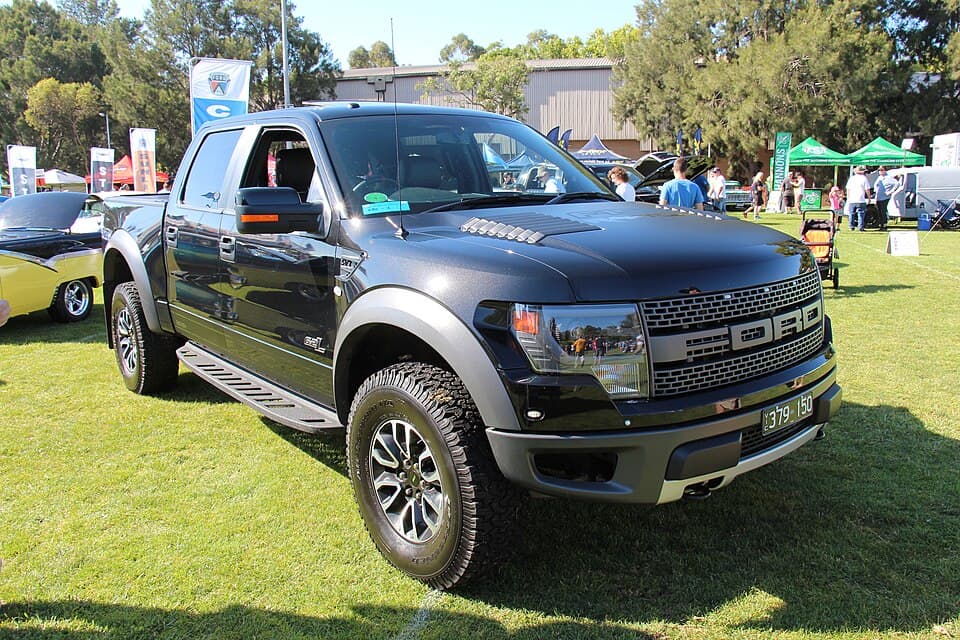
Short on time answers first, detail after. Here is what owners actually ask about the Ford Raptor, by the numbers, with the hedges that keep you from getting burned.
What engine is in the Ford Raptor?
It depends on the generation, and for the original truck, the model year. The Gen 1 (2010-2014) launched in 2010 with a 5.4L Triton V8, then switched to the 6.2L Boss V8 for 2011-2014. The Gen 2 (2017-2020) and Gen 3 (2021-present) both run a 3.5L High-Output EcoBoost V6, and the Raptor R (2023-present) runs a supercharged 5.2L V8. The Gen 2 3.5L HO makes 450 hp at 5,000 rpm and 510 lb-ft at 3,500 rpm. The Gen 3 3.5L HO makes the same peak numbers, 450 hp and 510 lb-ft, but the power peak moves to 5,850 rpm and torque peaks lower at 3,000 rpm, a result of recalibration rather than a different engine block. Full breakdown by generation is on the Ford Raptor engines explained page.
How much horsepower does the Raptor R have?
The 2024 Raptor R makes 720 hp at 6,650 rpm and 640 lb-ft of torque from the supercharged 5.2L V8. The 2023 model year made slightly less, commonly cited around 700 hp, before a running change. We will not give you a torque peak rpm for the Raptor R because Ford's own materials are inconsistent on that number across model years, so treat anything you read with a specific torque-peak rpm as an estimate. The full spec rundown is on the Raptor R engine page.
What gas mileage does a Raptor get?
EPA combined is roughly 15-16 mpg for a Gen 2 or Gen 3 3.5L EcoBoost, and real-world owners typically land a bit under that once you factor in 35s or 37s and a heavy right foot. The Raptor R is thirstier, with EPA combined around 12 mpg and owners commonly reporting 10-13 mpg in mixed driving, an estimate based on owner logs rather than a published test figure. None of these trucks are efficient, and lifted or re-tired trucks lose another mpg or two off the EPA sticker. The full generation-by-generation numbers, including what owners actually log, are on Ford Raptor MPG: what owners actually get.
How much can a Raptor tow?
Max towing climbs with each generation: Gen 1 tops out around 6,000 lbs, Gen 2 around 8,000 lbs, Gen 3 around 8,200 lbs, and the Raptor R is rated highest at roughly 8,700 lbs. Those are max-package numbers with the right hitch and configuration, not what every build will hit, and the Raptor's tall stance and soft-for-towing suspension tune make it a worse tow rig than a stripped F-150 with the max tow package even when the number on paper is higher. We go deep on what the Raptor does badly when loaded down in towing with a Raptor: what it does well and what it does badly, and generation-by-generation figures are on Raptor towing capacity, every generation.
What is the Raptor's 0-60 time?
Gen 2 and Gen 3 run roughly 5.1 seconds to 60 in independent testing, the Raptor R drops to around 3.8 seconds, and the Gen 1 with the 6.2L V8 is back around 6.4 seconds. These are test numbers from controlled runs, not what you will see on pump gas with 37s and 50 extra pounds of bumper hardware on the front, so treat them as a ceiling, not a promise. Full test conditions and source notes are on Ford Raptor 0-60: every generation, real numbers.
Are Ford Raptors reliable?
Mostly, with specific, well-documented weak points by generation rather than one blanket problem. The Gen 2 3.5L EcoBoost (2017-2020) is known for cam phaser rattle at cold start, a timing-chain-related knock that Ford addressed with an updated phaser design on later production, covered in full in Gen 2 cam phaser rattle: every fix, ranked by cost. Owners and independent shops also report harsh 1-2 shift behavior and torque converter shudder on the 10R80 10-speed automatic used across Gen 2 and Gen 3, though nobody has published a fleet-wide failure rate worth quoting; the diagnosis and fix paths are in 10R80 harsh 1-2 shift and torque converter shudder. Gen 1 trucks (2010-2014) are old enough now that normal wear items, ball joints and the IWE (integrated wheel end, the vacuum actuator that locks the front hubs), show up most often in owner complaints, rather than anything design-specific to that truck. None of this means avoid the truck. It means budget for known items and read the year-specific pages before you buy.
Which Raptor model year is the best to buy?
For Gen 1, most buyers land on 2011 or later, once the SuperCrew four-door body was available and the 6.2L V8 had replaced the underpowered 5.4L from the 2010 launch year. For Gen 2, 2018 is a common pick as a carryover year with the phaser issue largely understood and strong used values relative to a 2017. For Gen 3, 2021 is the first model year with the new five-link coil-spring rear suspension (replacing the old leaf-spring rear) and the factory 37-inch tire option, and it is the cheapest way into that platform. We rank every year with real tradeoffs in the best Ford Raptor year to buy in 2026, and generation-level buying guides live at Gen 1, Gen 2, and Gen 3.
35s or 37s, which should you run?
35-inch tires keep more of the factory ride quality and do not usually require a re-gear, while 37-inch tires (the factory option on later Gen 3 trucks, or a common aftermarket upgrade on Gen 2) buy real clearance and approach angle at the cost of acceleration, braking distance, and often a transmission tune. On a Gen 3 with the factory 37 package, Ford lists roughly 13.1 in of ground clearance and a 33.1-degree approach angle versus roughly 12.0 in and 31.0 degrees on 35s. The difference matters most on rock, not sand. We measured every real tradeoff, not just the spec sheet numbers, in 35s vs 37s on a Raptor: every tradeoff, measured, what it actually costs to make the swap is in how much does it cost to put 37s on a Gen 2 Raptor, and whether you need a tune afterward is answered plainly in do you need a tune after 37s.
How much does a Ford Raptor cost?
New MSRP for a current F-150 Raptor runs roughly the high $70,000s to low $80,000s before options depending on model year, and the Raptor R starts around $110,000-115,000, though dealer markup varies hard by region and demand and neither figure should be treated as a quote. Used values track the live market: a 2023 F-150 Raptor averages roughly $67,100 and a 2024 averages roughly $74,100 across current listings, while a 2023 Raptor R averages roughly $98,500 and a 2024 Raptor R averages roughly $111,600. Every generation's pricing, new and used, is broken out in how much is a Ford Raptor, 2026 prices for every model.
What does a used Gen 1 or Gen 2 Raptor cost?
Gen 1 trucks (2010-2014) are generally the cheapest way into a Raptor, though this site's live pricing data only tracks 2017 and later, so we will not put a number on Gen 1 here rather than guess. Later Gen 2 model years track with the site's live used-market data: a 2017 averages roughly $34,700, an 2018 roughly $38,000, a 2019 roughly $42,100, and a 2020 roughly $45,300 across current listings, with condition, mileage and mods swinging any individual truck well outside those averages in either direction.
What does a Raptor R cost used?
Used Raptor R pricing has moved up every year it has been on the road: 2023 models average roughly $98,500, 2024 roughly $111,600, 2025 roughly $125,300, and 2026 roughly $139,800 across live listings as of this writing. That is an unusual depreciation curve for a truck, and it says more about demand outstripping supply than it does about the truck holding value the way a collector car does. The full pricing breakdown, including what drives a given listing up or down, is in what a used Raptor R actually costs right now.
What's the difference between the Raptor and the Raptor R?
The Raptor R swaps the 3.5L EcoBoost V6 for a supercharged 5.2L V8, adds roughly 270 hp and 130 lb-ft over a Gen 3 Raptor, and carries a price premium of roughly $30,000-35,000 over a comparable non-R Raptor at MSRP. Whether that gap is worth it depends entirely on what you do with the truck, and we lay out the real-world case in Raptor vs Raptor R: what the extra money actually buys.
What terrain modes does the Raptor have?
Every Gen 2 and Gen 3 Raptor has selectable drive modes through the terrain management system: Normal, Sport, Slippery, Tow/Haul, Off-Road, Baja, and on trucks with the locking rear differential, Rock Crawl. Baja is the one unique to this truck among half-ton pickups, tuned for sustained high-speed desert running rather than a one-time launch setting, and it is the mode most owners actually use once they have run a wash or a dry lake bed like those at Glamis or Johnson Valley.
Is the Ranger Raptor or Bronco Raptor comparable?
They are built on different platforms and serve different jobs. The Ranger Raptor runs a 3.0L EcoBoost V6 in a smaller, lighter body with real rock and trail capability, while the Bronco Raptor is a short-wheelbase SUV built around technical terrain rather than desert speed. Neither is a smaller F-150 Raptor with the badge swapped. Full specs and the honest fit question for each are on Ranger Raptor specs, engine, 0-60 and the Bronco Raptor generation page.
What does the Raptor cost to own beyond the purchase price?
Insurance, fuel, tires, and the 10R80 transmission service interval are the recurring costs that surprise first-time owners most, and they differ meaningfully by generation and by how the truck is built. We track real annual numbers, not estimates pulled from a brochure, in what a Ford Raptor actually costs to own per year.
The short version
The Raptor lineup spans a 5.4L V8 for the 2010 launch year and a 6.2L V8 for 2011-2014 (Gen 1), a 450 hp 3.5L EcoBoost V6 (Gen 2 and Gen 3), and a 720 hp supercharged 5.2L V8 (Raptor R), with mpg, towing, and 0-60 numbers that scale accordingly. The Gen 3's 2021 model year is the value pick for the current coil-spring rear and factory 37 option, while Gen 1 and Gen 2 trucks have well-documented, budgetable weak points rather than one dealbreaker flaw. Check model-year specific pages and the Gen 2 vs Gen 3 buying comparison before you commit, and treat every price in this article as a range tied to live market data, not a quote.
Deal alert
Shopping for one? Get new listings first
We sweep US dealer inventory and send you new Raptors matching your search — real listings, real asking prices, no spam.