Ford Raptor 0-60: Every Generation, Real Numbers
The Raptor R runs 3.6 to 3.9 seconds to 60 while a base Gen 3 needs 5.2 to 5.6, and the gap between them matters less off-road than the spec sheet suggests. Here is every generation's tested number, why the published figures never agree, and what 37s and a tune actually do to them.
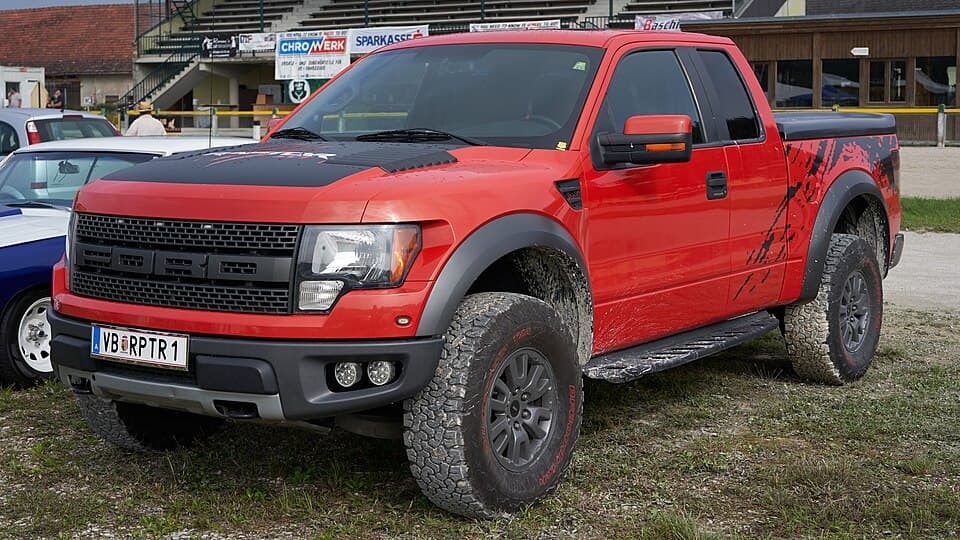
The quickest Raptor built is the Raptor R, which instrumented tests put in the 3.6 to 3.9 second range to 60 mph. The standard Gen 3 F-150 Raptor runs 5.2 to 5.6 seconds, the Bronco Raptor 5.6 to 6.3 seconds, and the Ranger Raptor 5.9 to 6.5 seconds. Every one of those is a tested range, not the number off the press release, and here is why that distinction matters before you buy one to race a stoplight.
| Model | Engine | Horsepower / torque | 0-60 (tested) | Quarter mile |
|---|---|---|---|---|
| F-150 Raptor Gen 1 (2010-2014) | 6.2L V8 | 411 hp / 434 lb-ft | approx. 7.0-7.9s | approx. 15.3-15.7s |
| F-150 Raptor Gen 2 (2017-2020) | 3.5L twin-turbo EcoBoost V6 | 450 hp / 510 lb-ft | approx. 5.1-5.8s | approx. 13.7-14.1s |
| F-150 Raptor Gen 3 (2021-2024) | 3.5L twin-turbo EcoBoost V6 | 450 hp / 510 lb-ft | approx. 5.2-5.6s | approx. 13.7-14.0s |
| F-150 Raptor R (2023-2025) | 5.2L supercharged V8 | 700-720 hp / 640 lb-ft | approx. 3.6-3.9s | approx. 11.9-12.3s |
| Bronco Raptor (2022-present) | 3.0L twin-turbo EcoBoost V6 | 418 hp / 440 lb-ft | approx. 5.6-6.3s | approx. 14.0-14.4s |
| Ranger Raptor (2024-present) | 3.0L twin-turbo EcoBoost V6 | 405 hp / 430 lb-ft | approx. 5.9-6.5s | approx. 14.3-14.7s |
These are compiled ranges from instrumented tests run by major buff books, not a single outlet's best run and not Ford's own claim. Treat the low end of each range as what a well-driven, warmed-up truck on a good surface can hit, and the high end as normal variation, not a sign your truck is broken.
Gen 1: the 6.2L V8 that started it
The 2010-2014 F-150 SVT Raptor created this category, and it is also the slowest truck in this comparison by a wide margin. The 6.2-liter V8 made 411 hp and 434 lb-ft, backed by a 6-speed automatic, in a truck that weighed close to 6,000 lbs with the long-travel Fox suspension and wide fender flares. Instrumented tests of the era landed in the 7.0 to 7.9 second range to 60, quarter mile in the mid-15s. Nobody bought a Gen 1 Raptor for stoplight numbers. They bought it because nothing else on a Ford lot could run 100 mph across the desert and land 3 feet of whoops without breaking.
Gen 2 and Gen 3: the EcoBoost years
Ford dropped the 6.2L V8 for the 2017 model year and put in a 3.5-liter twin-turbo EcoBoost V6 making 450 hp and 510 lb-ft, paired with a 10-speed automatic, in the same "turbo V6 versus V8" swap that still gets argued on every forum. That is a real jump in torque delivered lower in the rev range, and it shows: instrumented 0-60 runs on a Gen 2 Raptor landed in the 5.1 to 5.8 second window, roughly two full seconds quicker than Gen 1, quarter mile dropping into the high 13s. The 2021-2024 Gen 3 F-150 Raptor carries the same engine, same 450 hp and 510 lb-ft, and lands in a nearly identical 5.2 to 5.6 second band. Gen 3's real gains over Gen 2 are the electronically controlled Fox Live Valve dampers and a wider track that carries speed into the whoops better, not a quicker 0-60. If you are cross-shopping a clean Gen 2 against a base Gen 3 on acceleration alone, you are looking at the wrong spec; the best Ford Raptor year to buy in 2026 covers what actually separates them.
Raptor R: the supercharged V8 that actually delivers
The Raptor R puts the 5.2-liter supercharged Predator V8 back under the hood, the same architecture out of the old Shelby GT500, fed by a 2.65-liter Eaton TVS supercharger. Early 2023 trucks were rated at 700 hp; 2024-and-later trucks got a bump to 720 hp, and 640 lb-ft carries across both. On the 37x12.50R17 tires it ships on standard, instrumented tests put the Raptor R in the 3.6 to 3.9 second range to 60, quarter mile in the high 11s to low 12s. That is quicker than a stock Mustang GT, in a 6,500-lb truck riding on all-terrain tires. It is also the only Raptor where the horsepower figure everyone quotes online is the least interesting part of the story; the chassis underneath it is what makes that power usable.
Bronco Raptor and Ranger Raptor: smaller trucks, shared engine family
The Bronco Raptor runs a 3.0-liter twin-turbo EcoBoost V6 making 418 hp and 440 lb-ft, a step down from the F-150's 3.5L but bolted to a lighter, shorter platform. Instrumented 0-60 runs land in the 5.6 to 6.3 second range, quarter mile around 14.0 to 14.4 seconds. It is not as quick as a Gen 3 F-150 Raptor in a straight line, and it was never built to be; the Bronco Raptor's reason for existing is technical trail capability the full-size truck cannot touch, not a lower 0-60 number.
The Ranger Raptor arrived in US showrooms for the 2024 model year with the same basic 3.0L twin-turbo V6 architecture, tuned to 405 hp and 430 lb-ft in US spec. Because it is the newest variant sold here, fewer outlets have run a full instrumented test on it compared to the other five trucks in this table, so treat the 5.9 to 6.5 second range as a thinner sample than the rest, one that should tighten as more magazines get seat time.
Why the published numbers never match each other
Every outlet is measuring the same event under different conditions, and small differences compound fast. Launch surface matters most: a prepped drag strip grips a 37-inch all-terrain tire far better than the cold public road most instrumented tests actually happen on. Ambient temperature changes how hard a turbocharged or supercharged engine can pull before the computer protects itself. And the published number usually includes a one-foot rollout, the same convention used at the drag strip, where the clock starts after the truck moves the first foot instead of from a dead stop; that shaves a few tenths off compared to a true 0-60 with no rollout. A driver who knows how to load the torque converter and manage wheelspin will beat a driver who just floors it, on the identical truck, by several tenths. None of that means one outlet is wrong. It means a single number never tells the whole story, which is why this page gives you a range instead of fake precision.
What actually matters off-road versus at a stoplight
A 0-60 time measures a dead-stop straight-line launch on pavement, close to the least representative thing a Raptor ever does. Off-road, what matters is how quickly the truck recovers speed after a compression, how the suspension keeps the tires loaded through a whoop section at 50-plus mph, and how much torque is available at 3,000 rpm rolling out of a wash, not how it launches from idle. A Gen 3 Raptor and a Raptor R feel much closer to each other in the desert than their 0-60 numbers suggest, because in the dirt the R's extra power spends more time being managed by the driver than being used flat out. If straight-line speed against a TRX or an RHO is the actual question, the honest head-to-head is Raptor R vs TRX vs RHO, and it covers a lot more than who wins a stoplight.
How mods change your 0-60
The single biggest killer of a Raptor's 0-60 time is bigger tires. Stepping up to 37s on a truck that came with 33s or 35s adds rotating mass, changes the effective gearing, and asks the engine to spin up more unsprung weight before the truck moves at all; expect to give back several tenths, sometimes more, depending on how much heavier the new tire and wheel combo is. A properly calibrated tune commonly nets a real improvement in throttle response and part-throttle torque on the EcoBoost trucks, but it does not fully cancel out what a 37-inch tire costs in acceleration. Bigger turbos, intercoolers, and exhaust work move the needle further on the EcoBoost generations, while the Raptor R's supercharged V8 already runs close to what the factory cooling and fueling can support, so gains there are smaller and the risk of heat soak on repeated runs goes up. None of these mods are wrong to do. Just do not expect a magazine's stock number once you have changed the tire size, because you have changed the test.
The short version
- Raptor R is the quickest by a real margin: 3.6-3.9 seconds tested, and nothing else in the Raptor lineup is close.
- Gen 2 and Gen 3 F-150 Raptors run nearly identical numbers, 5.1-5.8 seconds, because they share the same EcoBoost powertrain; the real differences between them are suspension and reliability, not speed.
- Gen 1's 6.2L V8 is the slowest Raptor built, 7.0-7.9 seconds, and that was never the point of that truck.
- Bronco Raptor and Ranger Raptor trade some straight-line speed for a smaller, more trail-focused platform, landing in the 5.6-6.5 second range.
- 37s slow every one of these trucks down, and a tune helps but does not erase that cost.
- 0-60 is a pavement number. What a Raptor does at speed in the whoops is a different measurement entirely, and it is the one that actually matters for what these trucks are built to do.
Owner questions
- What is the fastest Ford Raptor 0-60?
- The F-150 Raptor R, at roughly 3.6-3.9 seconds in instrumented tests, from a 5.2L supercharged V8 making 700 hp (2023) or 720 hp (2024 and later) and 640 lb-ft.
- How fast is a Gen 2 Raptor 0-60?
- Roughly 5.1-5.8 seconds for the 2017-2020 trucks, with the 450 hp / 510 lb-ft 3.5L EcoBoost, about two seconds quicker than Gen 1.
- How fast is a Gen 1 Raptor 0-60?
- Roughly 7.0-7.9 seconds. The 2010-2014 SVT Raptor's 6.2L V8 made 411 hp and 434 lb-ft through a six-speed automatic in a truck near 6,000 lb.
- What is the Ford Raptor quarter mile time?
- Approximately 15.3-15.7s for Gen 1, 13.7-14.1s for Gen 2 and Gen 3, 11.9-12.3s for the Raptor R, 14.0-14.4s for the Bronco Raptor, and 14.3-14.7s for the Ranger Raptor.
- Why do published Raptor 0-60 times differ?
- Launch surface, temperature, driver technique, and whether the outlet uses a one-foot rollout all move the number by tenths. That is why this page gives tested ranges instead of a single figure.
Deal alert
Shopping for one? Get new listings first
We sweep US dealer inventory and send you new Raptors matching your search — real listings, real asking prices, no spam.