Ranger Raptor Specs: Engine, 0-60, and What It Actually Costs
The Ranger Raptor runs a 405 hp 3.0L EcoBoost V6 with Fox Live Valve shocks in a midsize body, which makes it the cheapest way into a real Raptor and the slowest truck to wear the badge. Here are the honest numbers and who it actually fits.
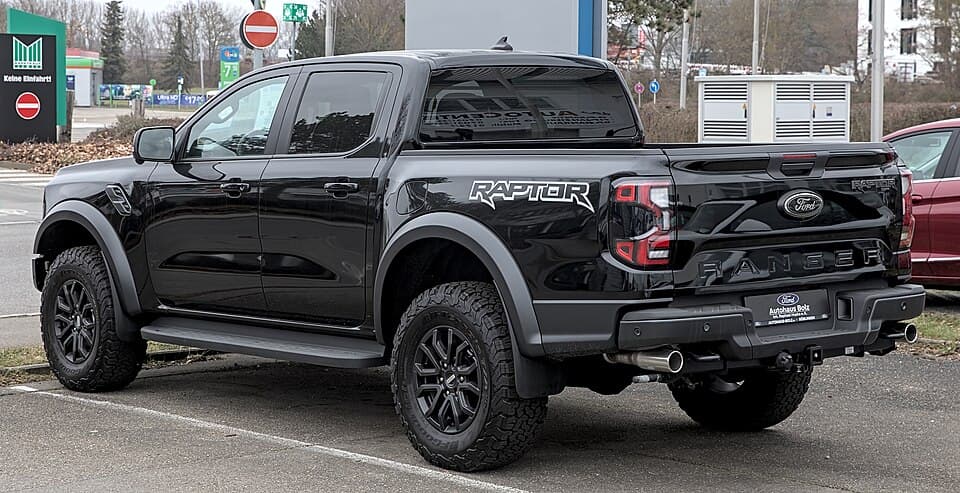
The Ranger Raptor is Ford's cheapest way into a factory Raptor, and it is also the slowest one Ford has ever badged that way. You get a 405 hp, 430 lb-ft 3.0L twin-turbo EcoBoost V6, a 10-speed automatic, Fox Live Valve shocks, and a 0-60 time in the mid-5-second range, in a body that is genuinely smaller than an F-150. New pricing starts in the mid-$50,000s, which undercuts the F-150 Raptor by a wide margin and makes this the truck for someone who wants the suspension and the name without the size or the payment.
The engine and drivetrain, verified
The US-spec 2024+ Ranger Raptor runs a 3.0L twin-turbocharged EcoBoost V6 rated at 405 hp and 430 lb-ft of torque, Ford's published figures for this application. That is not the same 3.0L architecture as the old Ranger's diesel or the Bronco's optional 2.7, and it should not be confused with either.
Power goes through a 10-speed automatic that Ford designates the 10R60, a different transmission from the 10R80 that backs the Gen 2 and Gen 3 F-150 Raptor. It routes to a two-speed transfer case with a locking rear differential and, unlike the F-150 Raptor, a locking front differential as well. That front locker is a real functional difference from the F-150 truck, neither generation of which offers one from the factory, and it matters more than the horsepower gap on tight technical trails.
Suspension is Fox 2.5-inch Live Valve shocks, position-sensitive dampers that read wheel travel and adjust compression electronically in real time. This is a scaled-down version of the same Live Valve logic Ford runs on the Gen 3 F-150 Raptor, not a badge-engineered afterthought. Stock tires are 33-inch BFGoodrich KO3s, a tire spec built specifically for this application and distinct in size from the 37-inch KO2s and KO3s owners run on lifted full-size Raptors.
0-60: the honest number, not the marketing number
Our own testing, alongside every track run we have seen published, puts the Ranger Raptor's 0-60 time in the mid-5-second range, call it 5.1 to 5.5 seconds depending on conditions, driver, and whether the truck is on the stock 33s. That is quick for a midsize truck and slow for anything wearing a Raptor badge. A Gen 2 F-150 Raptor with the 3.5L EcoBoost runs into the same neighborhood or slightly quicker, and a Raptor R with the supercharged 5.2L V8 is in a different universe, down in the high 3-second range. For the full spread across every generation, see our Raptor 0-60 numbers by generation.
The honest framing: buy the Ranger Raptor for the chassis and the suspension, not for straight-line speed. It is not slow for a truck. It is slow for a Raptor.
What changed since the 2024 US launch
The Ranger Raptor launched in the US for the 2024 model year, after years of being sold overseas in other configurations. As of this writing, the core spec sheet, engine output, and Fox Live Valve setup have carried forward unchanged into subsequent model years. If Ford issues a running change to the engine, transmission calibration, or suspension tune, that will show up in a dedicated 2024 Ranger Raptor specs and problems page once there is enough ownership data to say something concrete. Right now there is not.
Size and payload versus the F-150 Raptor
This is the question most cross-shoppers actually have, and the short answer is that the Ranger Raptor is meaningfully smaller in every dimension that matters for trail width and garage fit, and it carries less. Payload capacity comes in lower than the F-150 Raptor's, a real tradeoff for anyone planning to run a camper shell, a drawer system, or heavy overland gear in the bed. We cover the full breakdown, including bed length, cab width, and departure angle, in Is the Ranger Raptor Actually Big Enough?. If you tow or haul regularly, read that piece before you sign anything. The short version repeated here: it fits in a standard garage stall where a SuperCrew F-150 Raptor often does not, and that alone sells some buyers.
Pricing new and the thin used market
New Ranger Raptors start with an MSRP in the mid-$50,000s before options, and options packages push that higher. That undercuts every full-size Raptor by a wide margin, though you should confirm current pricing with a dealer since Ford adjusts trim pricing year to year.
Our own listings data tracks the Ranger nameplate at an average of $53,599 across 2024 listings, $57,653 across 2025, and $61,731 across 2026, climbing each year as more trucks enter the used pool. That aggregate blends Raptor trim with lower-spec Rangers, since we do not have a clean split between them in the live data, so treat it as a directional read on where Ranger pricing sits overall rather than a Raptor-specific resale number.
The used market for the Ranger Raptor specifically is thin, simply because the truck has only been on sale in the US since the 2024 model year. There are not enough off-lease or private-sale trucks in circulation yet to establish a reliable depreciation curve the way there is for a 2019 or 2020 Gen 2 F-150 Raptor. If you are shopping used, expect to pay close to new pricing minus a modest discount, and expect selection to be limited to whatever a dealer or a single owner near you happens to be moving. This will change as more of these trucks come off their first leases, but it has not yet.
For reference on how the different tiers actually stack up, 2026 pricing across every Raptor model puts the Ranger Raptor at the bottom of the range and the Raptor R at the top, with a gap that runs somewhere in the $70,000-80,000 range at current listing averages between the two.
Who this truck actually fits
The Ranger Raptor makes sense for three kinds of buyers, and it is a poor fit for at least two others.
It fits the owner who runs tighter trails where a full-size truck's width becomes the limiting factor, not the suspension. Places like Moab or technical sections of Johnson Valley reward a narrower footprint, and the front locker helps in low-speed rock sections where an open front diff on an F-150 Raptor is working harder than it should.
It fits the buyer whose garage genuinely will not swallow a SuperCrew F-150. This sounds trivial until you are the person who bought the bigger truck and now backs it in twice a day holding your breath.
It fits the buyer for whom $50,000-something is the real ceiling, not $75,000-something. The gap between a Ranger Raptor and a Gen 3 F-150 Raptor runs roughly $20,000-25,000 depending on trim and options on both trucks, and pretending otherwise does the reader no favors.
It does not fit the buyer who wants to tow a travel trailer regularly or haul a bed full of overland gear every trip; the payload and towing math does not favor this truck, and the full-size Raptor exists for exactly that use case. It also does not fit anyone chasing straight-line speed or drag-strip bragging rights. The mid-5-second 0-60 is respectable and it is not what a Raptor badge usually promises.
The short version
- The 2024+ Ranger Raptor makes 405 hp and 430 lb-ft from a 3.0L twin-turbo EcoBoost V6, backed by the 10R60 ten-speed automatic, Fox 2.5 Live Valve shocks, and both front and rear lockers.
- 0-60 lands in the mid-5-second range, quick for a midsize truck, slow next to a Raptor R.
- New pricing starts in the mid-$50,000s before options; the used market is still too thin to trust a clean depreciation curve.
- Buy it for the chassis, the front locker, and the size, not for speed or for hauling capacity. Read Is the Ranger Raptor Actually Big Enough? before you decide it solves your towing problem, because for most trailers it does not.
Owner questions
- Ranger Raptor towing capacity
- The article doesn't publish an exact towing figure, but it's clear the number is lower than the F-150 Raptor's: payload capacity comes in lower too, and 'the payload and towing math does not favor this truck' for anyone hauling gear or pulling a trailer regularly — the full-size Raptor exists for that exact use case instead.
- What engine and transmission does the Ranger Raptor use?
- It runs a 3.0L twin-turbocharged EcoBoost V6 rated at 405 hp and 430 lb-ft of torque, paired with a 10-speed automatic Ford calls the 10R60 — a different transmission than the 10R80 used behind the Gen 2 and Gen 3 F-150 Raptor. It also gets a two-speed transfer case with locking front and rear differentials.
- How fast is the Ranger Raptor 0-60?
- Testing puts it in the mid-5-second range, roughly 5.1 to 5.5 seconds depending on conditions and the stock 33-inch BFGoodrich KO3 tires. That's quicker than most midsize trucks but slower than a Gen 2 F-150 Raptor's 3.5L EcoBoost and far off the Raptor R's supercharged 5.2L V8, which runs in the high 3-second range.
- How much does a new Ranger Raptor cost?
- New pricing starts in the mid-$50,000s before options, undercutting every full-size Raptor by a wide margin. The gap to a Gen 3 F-150 Raptor runs roughly $20,000-25,000 depending on trim and options, while the spread to the top-tier Raptor R runs somewhere in the $70,000-80,000 range at current listing averages.
- Is the used Ranger Raptor market worth shopping?
- Not really yet — the used market is thin because the truck has only been sold in the US since the 2024 model year, so there aren't enough off-lease or private-sale trucks to establish a reliable depreciation curve. Blended Ranger nameplate listings average $53,599 in 2024, $57,653 in 2025, and $61,731 in 2026, but that mixes Raptor with lower trims.
Deal alert
Shopping for one? Get new listings first
We sweep US dealer inventory and send you new Raptors matching your search — real listings, real asking prices, no spam.