Towing With a Raptor: What It Does Well and What It Does Badly
The Raptor will tow, and the number on the spec sheet is real. It is also the wrong truck for some of the loads people try to put behind it, and the suspension is exactly why.
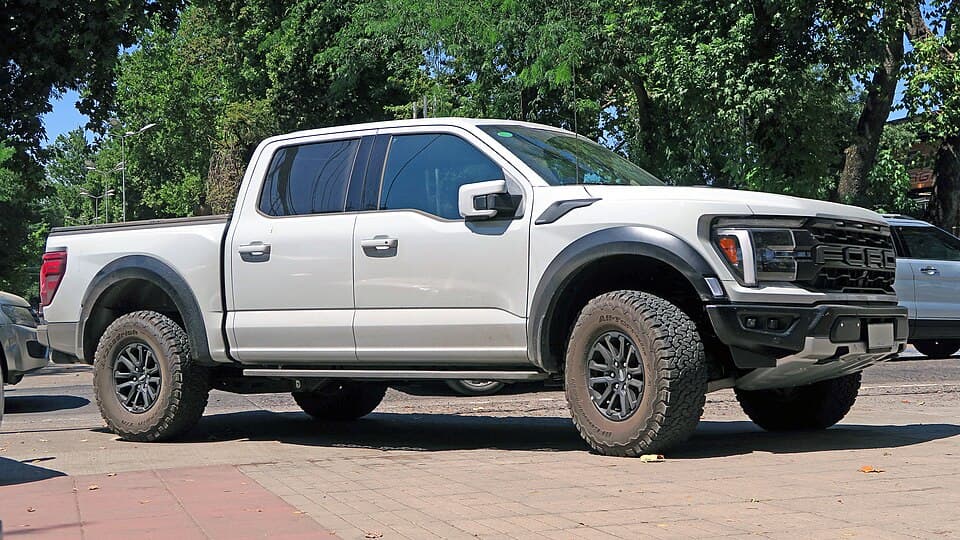
The Raptor will pull the number on its door sticker, but the suspension that makes it good off-road is the same suspension that makes it a mediocre tow vehicle. The real ceiling on what you should put behind a Raptor is payload, not the tow rating, and the long-travel, soft-sprung setup means the truck squats and moves more under tongue weight than a regular F-150 wearing the same badge.
Why the suspension changes towing behavior
A standard F-150 with the Max Tow package runs firmer rear leaf springs and shock valving tuned to carry and pull loads with minimal squat. The Raptor does not use that setup. Every generation, from the Gen 1 SVT Raptor through the Gen 3 and the Raptor R, runs long-travel front and rear suspension with softer spring rates and shocks (Fox internally, Fox Live Valve on Gen 3) tuned to soak up whoops and jumps, not to resist load transfer at a hitch.
That matters the moment you hook up a trailer. Tongue weight (the downward force the trailer puts on the hitch, usually 10-15 percent of trailer weight) pushes down on the rear axle. On a Max Tow F-150, the rear leaf pack barely moves. On a Raptor, the rear end squats noticeably more for the same tongue weight, because the springs are valved soft on purpose. That squat does three things: it changes headlight aim and cargo visibility, it unloads the front axle slightly and makes steering feel light at speed, and it makes the truck more sensitive to trailer sway because the rear is riding lower and softer than it was designed to at that ride height.
None of this means the Raptor cannot tow. It means it tows like a truck that was never the priority use case for the engineers who tuned it, and it rewards a driver who respects that instead of assuming Raptor equals capable at everything.
The Gen 3's Live Valve suspension helps some of this by adjusting damping in real time, but it cannot change spring rate, and spring rate is what determines how much the rear end sags under a fixed tongue weight. Live Valve makes the ride better while towing. It does not turn the Raptor into a Max Tow truck.
Payload is the number that actually limits you
Every Raptor's payload rating is lower than a comparable Max Tow F-150's, and it is lower by more than most buyers expect, because the truck itself is heavy before you put anything in it. Between the driver, passengers, fuel, any bed accessories, and tongue weight sitting on the hitch, you can run out of payload capacity well before you run out of tow rating on paper.
This is the number that gets people in trouble. A trailer rated to tow easily within the Raptor's tow capacity can still put more tongue weight on the truck than its payload allows once you account for occupants and cargo. Ford's tow rating tells you what the truck can pull. It says nothing about whether the truck can legally and safely carry the tongue weight that trailer puts on it. For the exact payload figures by generation and cab configuration, and how little room that actually leaves once people and gear are in the truck, see our breakdown of what a Raptor can actually carry. For the tow ratings themselves, generation by generation, use our towing capacity numbers rather than a number you saw quoted secondhand on a forum, since trim, cab, and model year all move it.
What tows comfortably behind a Raptor
A single-axle utility trailer, a small enclosed cargo trailer, a jet ski or two on a light trailer, a modest travel trailer in the 4,000-5,000 lb range with low tongue weight (the practical range varies by generation and trim, so confirm against the towing capacity numbers above before you commit) - these are the loads where the Raptor's power and low-end torque actually show up as an advantage. The 3.5 EcoBoost twin-turbo in the Gen 2 and Gen 3, and the supercharged 5.2 V8 in the Raptor R, both make enough torque low in the rev range that pulling a light trailer up a grade is not the issue. The truck accelerates fine, brakes fine within reason, and the squat under a light tongue weight is minor enough that most owners never notice it.
Short, low-profile trailers with tongue weight in the low hundreds of pounds are the sweet spot. They do not load the rear suspension hard enough to expose the soft spring rate, and they do not present enough side area to make the long-travel suspension's extra body roll a factor in crosswinds.
What exposes the suspension
Tall enclosed trailers, car haulers, and anything with high tongue weight are where the Raptor's compromises show up. A tall box trailer catches crosswind and semi-truck wake harder than a low trailer of the same weight, and the Raptor's taller ride height and softer suspension tuning mean more body roll transmitted into that sway than you would feel in a Max Tow F-150 at the same speed.
High tongue weight is the other trap. Anything pushing several hundred pounds down on the hitch, the kind of number you get from a mid-size travel trailer or a loaded car hauler, will squat the rear of a Raptor visibly. Owners who have towed both describe the difference bluntly: a Max Tow F-150 shrugs it off, the Raptor sits down and lets you know about it. That squat is also eating into payload fast, since tongue weight counts against the payload rating just like anything else sitting on the truck.
Does a weight distribution hitch actually help
A weight distribution hitch (a hitch with spring bars that transfer some of the trailer's tongue weight forward onto the truck's front axle and back onto the trailer's own axles) helps the squat and the light steering feel, and most experienced owners towing anything with meaningful tongue weight behind a Raptor run one. It will not raise your payload rating and it will not raise your tow rating. It also is not a universal fix: Ford's own guidance on weight distribution hitches varies by generation and by whether the truck has the factory tow package, so check your owner's manual before assuming one is approved for your specific truck, and budget for a shop to set it up correctly rather than eyeballing the spring bar tension yourself. A poorly adjusted weight distribution hitch can do more harm than none at all.
Sway control, whether integrated into the weight distribution hitch or as a standalone friction or electronic unit, is worth adding on anything with real side area, especially if you are running the taller factory ride height with 35s or 37s and the extra unsprung weight and altered geometry that come with it. If you have already gone down that road, our cost breakdown for putting 37s on a Gen 2 is worth reading before you also start planning a tow setup, since bigger tires change ride height and can change how the truck behaves loaded.
Who should buy a different truck
If towing is a regular part of your life, not an occasional trip, and the loads involve tall trailers, high tongue weight, or anything near the top of what the tow rating allows, a Max Tow F-150 or a heavier-duty truck will do the job with less drama and more payload margin. You are also paying a real premium for the Raptor's off-road hardware, and none of that hardware helps you tow; it works against you slightly. Compare what a Raptor R actually costs to own against a Max Tow F-150 if towing capability is genuinely the deciding factor, because the Raptor's price premium buys desert capability, not trailer capability.
If your towing is occasional and light, a single-axle trailer, a couple of dirt bikes, a small travel trailer within the payload math, the Raptor handles it fine and you get the rest of the truck's capability the other 350 days a year. That is the honest tradeoff, and it is the same one whether you are looking at a Gen 2, a Gen 3, or the Bronco Raptor, which has an even more limited tow rating and payload ceiling given its size.
The short version
- The Raptor's tow rating is real, but payload runs out before tow rating does on most real-world trailer setups.
- Long-travel, soft-sprung suspension means more squat and more sway sensitivity than a Max Tow F-150 under the same tongue weight.
- Light, low trailers with modest tongue weight are the sweet spot. Tall trailers and high tongue weight expose the compromises.
- A properly set up weight distribution hitch helps ride behavior. It does not raise your payload or tow numbers.
- If towing is a regular, heavy-duty job, buy the truck built for it. The Raptor is not that truck, and it was never trying to be.
Owner questions
- Ford Raptor towing a camper, is it enough?
- It depends on the camper. A modest travel trailer in the 4,000-5,000 lb range with low tongue weight is the sweet spot where the Raptor's torque works fine. A tall, high-tongue-weight camper will visibly squat the rear suspension and eat into payload fast, unlike a Max Tow F-150 which shrugs it off.
- What actually limits towing with a Raptor, the tow rating or payload?
- Payload is the real ceiling, not the tow rating on the door sticker. A trailer well within the Raptor's tow capacity can still exceed available payload once tongue weight (10-15 percent of trailer weight) plus driver, passengers, fuel, and cargo are counted, since every Raptor's payload rating is lower than a comparable Max Tow F-150's.
- Does the Gen 3 Raptor's Live Valve suspension fix the squat problem when towing?
- No. The Fox Live Valve system on the Gen 3 adjusts damping in real time and makes the ride better while towing, but it cannot change spring rate, which is what actually determines how much the rear end sags under a fixed tongue weight. It does not turn the Raptor into a Max Tow truck.
- Should I add a weight distribution hitch when towing behind a Raptor?
- Most experienced owners towing anything with meaningful tongue weight run one, since it transfers tongue weight forward onto the front axle and helps the squat and light steering feel. It will not raise your payload or tow rating, Ford's guidance on approval varies by generation, and a poorly adjusted one can do more harm than none.
- What kind of trailer is too much for a Raptor to tow well?
- Tall enclosed trailers, car haulers, and anything with high tongue weight (several hundred pounds, like a mid-size travel trailer or loaded car hauler) expose the compromises. Tall trailers catch crosswind harder given the Raptor's taller ride height, and high tongue weight visibly squats the rear versus a Max Tow F-150 at the same weight.
Deal alert
Shopping for one? Get new listings first
We sweep US dealer inventory and send you new Raptors matching your search — real listings, real asking prices, no spam.