2024 Bronco Raptor: Specs, Problems, and Value
Detailed specs, known issues, and used value insights for the 2024 Bronco Raptor. Compare it to previous models and understand what to expect.
Gear in this article
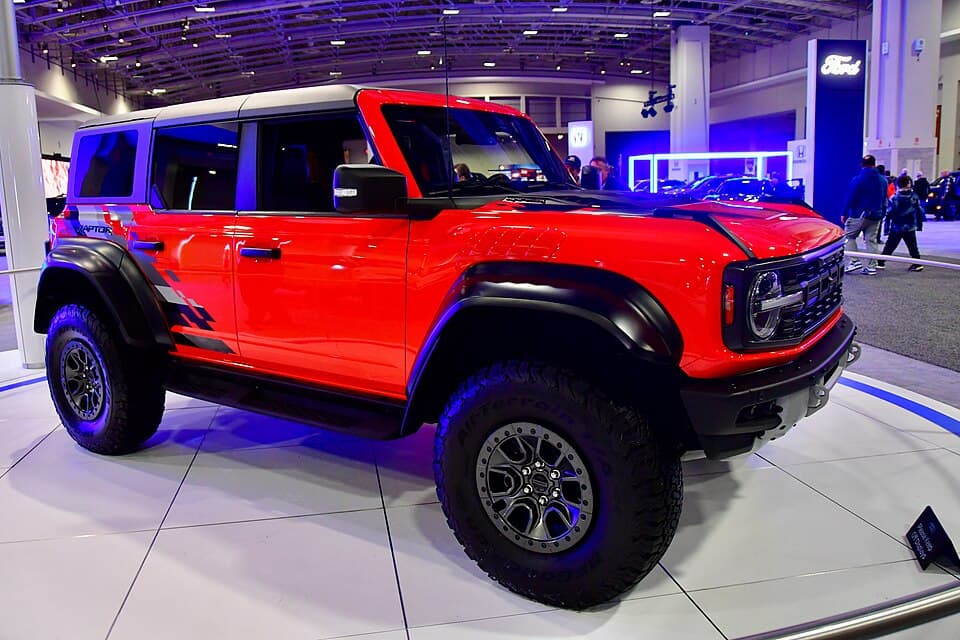
The 2024 Bronco Raptor is a carryover year. The powertrain, suspension, and axles are unchanged from the 2022 launch truck: same 3.0L EcoBoost V6, same HOSS 4.0 suspension, same Dana 44/50 AdvanTEK axles. If you're cross-shopping a 2022, 2023, or 2024, the mechanical truck underneath is identical and the decision comes down to options, mileage, and price. The known issues owners report (front-end clunk from ball joints and control arm bushings, carbon buildup on the intake valves, occasional locker actuator faults) affect the whole 2022-2024 run, not something unique to this model year.
What changed for 2024
Nothing mechanical. Ford did not touch the engine tune, the transmission calibration, the suspension geometry, or the axle hardware between 2022 and 2024. What moved was the color palette, some interior trim and seat material options, and the Ford Performance accessory catalog got deeper (more factory-backed bumpers, lighting, and rock rail options sold through dealers). If you're deciding between a 2022, 2023, or 2024 purely on capability or reliability, there is no mechanical reason to pay a premium for the newer model year. The premium you do pay is mostly about remaining factory warranty, not hardware.
For a side-by-side of what a 2022 or 2023 actually looks like against this one, the Bronco Raptor generation page has the full build history.
The specs that actually matter
The 3.0L EcoBoost V6 makes 418 hp at 5,750 rpm and 440 lb-ft of torque at 3,600 rpm, run through a 10R60 ten-speed automatic and a two-speed electromechanical transfer case. That's the same basic turbo V6 architecture used elsewhere in the Ford/Lincoln lineup, tuned specifically for this application. Both axles (Dana 44 AdvanTEK front, Dana 50 AdvanTEK rear) carry electronic locking differentials, and the front sway bar disconnects electronically for more front axle articulation off-road.
Suspension is HOSS 4.0, built around Fox 3.1 Live Valve shocks with remote reservoirs. Suspension travel runs roughly 13.0 inches up front and 14.0 inches in the rear, with front and rear track widened about 8.6 inches over a standard Bronco to make room for it. Stock tires are 37x12.50R17 BFGoodrich KO2s on beadlock-capable wheels, which is the detail that drives a lot of the ownership cost conversation below.
Curb weight lands around 5,730 lbs (an estimate, since it varies by options), towing capacity is rated at 4,500 lbs, and EPA fuel economy is 15 mpg city, 16 highway, 15 combined. Ford does not publish an official 0-60 figure for this truck; independent testing has clocked it in roughly 5.7 seconds, which is a reasonable representative number but not a factory spec, so treat it as an estimate rather than a published claim. For the full breakdown including angles and ground clearance, see the Bronco Raptor specs page.
Known problems on 2022-2024 Bronco Raptors
None of these are unique to the 2024 model year. They've shown up across the whole production run so far, and none of them have a published failure-rate number worth quoting, so the cost ranges below are working estimates based on typical shop labor rates, not figures from any manufacturer or survey.
Front-end clunk from ball joints and control arm wear. Owners describe a clunk over bumps and vague, loose-feeling steering, sometimes showing up well under 40,000 miles. The usual fix is replacing the upper control arms as an assembly rather than just the ball joint, since Ford doesn't sell the joint separately on most of these trucks. Budget roughly $700-1,800, with the swing depending on whether it's done under warranty, at a dealer, or at an independent shop, and whether one side or both need it. The full diagnostic walkthrough, including how to tell this apart from a sway bar link or tie rod issue, is in the Bronco Raptor front-end clunk writeup.
Intake valve carbon buildup. Direct-injected EcoBoost engines don't spray fuel across the back of the intake valve the way a port-injected engine does, so carbon accumulates there over time. On the Bronco Raptor's 3.0L, owners report a rough cold idle and occasional misfire codes, often starting somewhere past 30,000-50,000 miles depending on how the truck is driven. A walnut-blasting service (a process that physically blasts the carbon off the valves with crushed walnut shell media) runs roughly $500-900 at most independent shops, and that figure swings with regional labor rates. The mechanism, and why it happens on every direct-injected EcoBoost and not just this one, is covered in the carbon buildup explainer.
Locker actuator faults. A warning light or message on the cluster, or a rear locker that won't disengage cleanly, usually points to the actuator or its wiring at the axle housing rather than the differential itself. Nobody has published a reliable repair-cost figure for this specific failure, so treat this as our working estimate: roughly $400-1,100 depending on whether it's a wiring or connector repair versus a full actuator replacement. Get an actual shop quote before you budget around it.
Windshield damage. The Bronco Raptor's windshield rakes more than a standard Bronco's and the stock 37-inch KO2s throw rocks at highway speed. Chip repair is cheap, call it $120-200 as a rough estimate if you catch it fast; a full replacement with the camera recalibration these trucks need for their driver-assist systems runs closer to an estimated $800-1,500. Both numbers are ours, not a published source, and will move with glass availability and your local shop's ADAS calibration setup.
Width limits what trails it can actually run. At around 85.7 inches over the fenders, the Bronco Raptor is wider than a lot of the off-camber, tree-lined trails built for a standard Wrangler or Bronco. This isn't a mechanical defect, it's a design tradeoff for suspension travel, and it matters most on tighter rock trails rather than open desert. Rock sliders help with rocker panel damage but won't fix clearance on a trail that's simply too narrow.
What Ford's warranty actually covers
A 2024 Bronco Raptor carries Ford's standard new-vehicle coverage: 3 years/36,000 miles bumper-to-bumper and 5 years/60,000 miles on the powertrain. Exact in-force coverage can vary by build date and by whether any prior owner added an extended service plan, so confirm it against your specific VIN with a dealer rather than assuming the calendar math. The ball joint and control arm issue above is a warranty repair if the truck is still inside that window and a shop confirms play in the joint, not something you should be paying out of pocket for. Carbon buildup is generally treated as maintenance, not a warranty defect, so that walnut-blasting bill is usually on the owner even on a truck still under warranty. If a dealer cites a technical service bulletin (a documented repair procedure Ford publishes for a known issue, not free work by itself) for any of these, ask specifically whether the labor falls under your remaining powertrain coverage or whether you're paying out of pocket. Goodwill repairs outside the stated warranty window are entirely discretionary; Ford does not owe you anything once the mileage or year clock runs out, though a dealer may still extend it depending on service history. For the math on whether an extended service plan is worth adding on top of factory coverage, see the extended warranty breakdown.
Used values: what a 2024 is actually worth
Here's the catch with pricing this trim specifically: the site's own used-price tracker groups all Bronco trims together, from a base two-door Big Bend up through the Raptor, so the numbers below are not a Raptor-specific average and should not be read as what a 2024 Bronco Raptor actually trades for.
| Model year | Avg used price (all Bronco trims) | Live listings |
|---|---|---|
| 2022 | $63,606 | 86 |
| 2023 | $65,964 | 311 |
| 2024 | $71,395 | 500 |
| 2025 | $81,078 | 430 |
A 2024 Bronco Raptor stickered well above this blended average when new, so any real listing you find for the Raptor trim specifically should sit meaningfully higher than the $71,395 shown here for the full lineup. What this table is useful for is direction, not magnitude: used Bronco pricing across every trim has climbed each year since 2022, which tells you residual value on the platform is holding up, not what a specific Raptor-trim truck costs today. For an actual number, pull live Raptor-trim listings in your region before you set a budget. The generation-wide depreciation pattern, including how the Bronco Raptor compares to the F-150 Raptor's curve, is covered in Ford Raptor depreciation by generation.
Buying a used 2024: what to check before you sign
- Rock each front wheel at 12 and 6 o'clock with the truck jacked to feel for play in the upper ball joint.
- Run the removable roof and doors through a hose test if the seller allows it; water intrusion around the roof rails shows up here first.
- Cycle both electronic lockers with the truck in park and listen for a clean engage/disengage, not a grind or a warning chime.
- Check the inner shoulders of the front tires for feathering, a sign of worn control arm bushings even before you feel a clunk.
- Inspect the rocker panels and lower doors for scrapes consistent with the Bronco Raptor's wider stance catching on trail obstacles.
- Check the windshield edge to edge for chips, especially near the camera mount behind the mirror.
- Idle the engine cold and listen for roughness or a stumble that clears as it warms up, a sign of carbon buildup worth factoring into your offer.
A full line-by-line checklist, including VIN-specific questions to ask the seller, is in the used Bronco Raptor buying guide.
Worth doing if you keep it
Most owners who plan to actually use the truck off-road end up adding rock protection and nothing else for the first year. Full-length rock sliders and front/rear skid plates run an estimated $1,800-3,600 installed, depending on brand and whether you DIY the skid plates. After that, most of the useful spending goes toward lighting (the Baja Designs Squadron Sport pair is a common A-pillar pod choice) and recovery gear rather than anything that changes how the truck drives. A tune is not typical on this platform the way it is on the twin-turbo F-150 Raptor, since the 3.0L's calibration headroom and warranty implications are different; if you're weighing it anyway, what a tune actually changes covers the tradeoffs generally before you spend the money.
If you're cross-shopping this against an F-150 Raptor at similar money, the tradeoffs (size, ride, payload, and daily usability) are laid out in Gen 3 F-150 Raptor vs Bronco Raptor. If the Jeep Wrangler Rubicon 392 is also on your list, that comparison is covered separately in the Bronco Raptor vs Rubicon 392 writeup.
The short version
- The 2024 Bronco Raptor is mechanically identical to the 2022 and 2023 trucks; the only real changes are colors, interior options, and accessory availability.
- Known issues across all three model years are front-end clunk (ball joints/control arms), intake carbon buildup, and occasional locker actuator faults, none of which are unique to 2024, and none backed by a published failure-rate number.
- The site's used-price data for "Bronco" blends every trim together, so don't read $71,395 as a Raptor-trim number; expect real Raptor listings to run well above that blended average.
- Before buying used, check the ball joints, hose-test the roof, cycle the lockers, and cold-idle the engine. A failed check on any of these should move your offer, not kill the deal outright.
Deal alert
Shopping for one? Get new listings first
We sweep US dealer inventory and send you new Raptors matching your search — real listings, real asking prices, no spam.