Gen 3 F-150 Raptor vs Bronco Raptor: Same Money, Very Different Truck
They overlap almost exactly on price once you option a Bronco Raptor up, but they are not competing for the same buyer. This is the honest breakdown of who each one actually fits.
Gear in this article
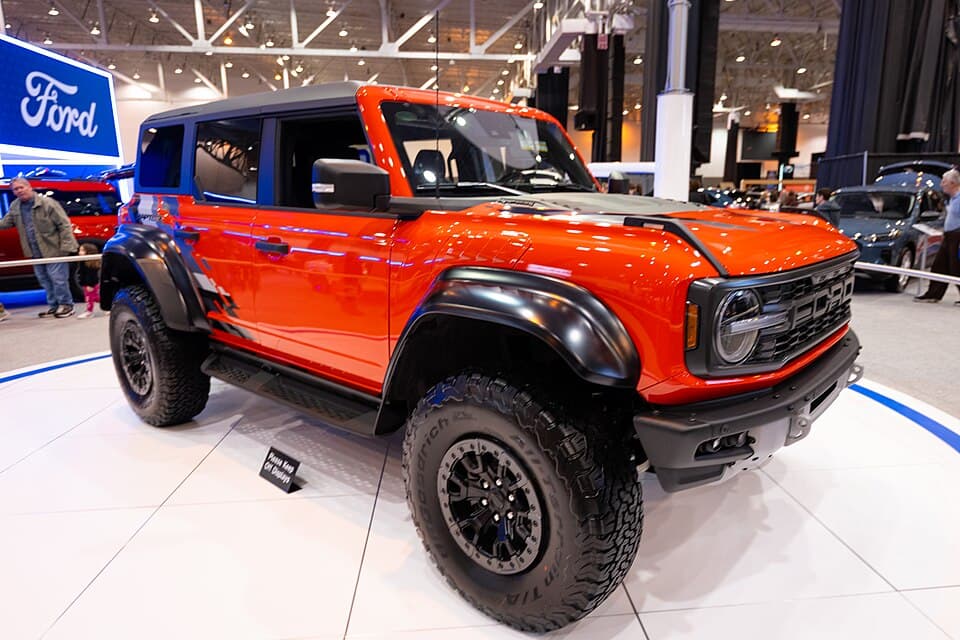
The plain answer: the Gen 3 F-150 Raptor is a truck first and a trail toy second, and the Bronco Raptor is the reverse. Optioned up, they land within a few thousand dollars of each other. But they are not cross-shopped by the same buyer with a straight face. One hauls your camper and your family and goes sideways in the dirt on weekends. The other crawls a rock ledge at 47 degrees of approach angle and treats towing as an afterthought.
If you need a bed, a back seat that fits three car seats without a fight, or you tow anything heavier than a light trailer, that alone should end the debate before you get to specs.
Where the prices actually land
The F-150 Raptor's 2026 base MSRP runs roughly $81,000 as an estimate. The truck most people actually want, on the 37 Performance Package with beadlock-capable wheels plus the equipment group it comes bundled with, typically lands in the $85,000-89,000 range, and it swings by region and by how badly a dealer wants to move a unit.
The Bronco Raptor starts around $92,000 for 2026 as an estimate, and it does not stay there. Add the leather-and-Code-Orange interior package, a couple of option groups, and destination, and you are commonly looking at $96,000-100,000-plus out the door, depending on your dealer's markup and what is actually in stock.
Budget $85,000-89,000 for a well-equipped F-150 Raptor and $92,000-100,000 for a well-equipped Bronco Raptor. They meet in the middle. Neither is the "value" pick, and if that phrase matters to you, you are shopping the wrong pair of trucks.
Powertrain, suspension, and tires: what each is actually good at
The F-150 Raptor runs the 3.5L High-Output EcoBoost twin-turbo V6, 450 hp and 510 lb-ft, through a 10R80 ten-speed automatic. Since the 2021 redesign it uses a five-link coil rear with a 24-inch Watt's link, replacing the leaf springs entirely. Fox 3.1 Live Valve shocks with remote reservoirs run all four corners, delivering 14.0 inches of front travel and 15.0 rear. Standard rubber is a 35-inch BFGoodrich KO2; the 37 Performance Package puts 37x12.50R17 KO2s on beadlock-capable forged wheels and does more for capability than anything you could bolt on afterward.
The Bronco Raptor runs a smaller 3.0L EcoBoost V6, 418 hp and 440 lb-ft, through a 10R60 and a real two-speed transfer case with low range, something the F-150 Raptor does not have. Its HOSS 4.0 suspension also uses Fox 3.1 Live Valve shocks, but travel is slightly less front and rear (13.0 in / 14.0 in). What it has instead is width: 8.6 inches more track than a base Bronco, Dana 44 and Dana 50 AdvanTEK axles, and electronic lockers front and rear as standard. Every Bronco Raptor rides on 37s from the factory. Nobody options into 35s here.
The practical difference: the F-150's coil rear rides better at speed over washboard and whoops because it was engineered around exactly that. The Bronco Raptor's low range and dual lockers mean it climbs and crawls terrain the F-150 has to find a way around. Neither suspension is better. They were tuned for different jobs.
Interior space, cargo, towing, and payload
This is where the decision usually makes itself. The F-150 Raptor has a real bed, a payload rating of roughly 1,400 lb, and can tow up to 8,200 lb. It also has back seats that fit adults and cargo that fits a family's gear without Tetris.
The Bronco Raptor tows 4,500 lb, has no bed, and its cargo area is SUV-sized, not truck-sized. Four doors are standard, and the removable roof and doors are a genuine lifestyle feature, but they come with wind noise and, on some trucks, water intrusion at the seals, worth checking on before you buy one used. Fuel range is also a real limitation: a 20.8-gallon tank against 15 mpg combined puts you around 280 miles between fill-ups, tighter in sand or at altitude.
If towing, hauling payload, or fitting three kids across a bench matters to your week, the F-150 Raptor wins outright. If you want the top off on a Saturday and do not care about a bed, the Bronco Raptor wins just as clearly.
Trail behavior: where each one runs out of talent
Width and geometry decide this, not horsepower.
The Bronco Raptor's approach, breakover, and departure angles (47.2 / 30.8 / 40.5 degrees) are in a different league than the F-150's (31.0 / 22.7 / 23.9 degrees on 35s). On a rock ledge or a tight technical climb, the Bronco Raptor clears obstacles the F-150 has to route around. Its low-range transfer case and dual lockers make it the more capable rock crawler by a wide margin.
But it pays for that geometry with width. At 85.7 inches, it does not fit through gates or rock gardens that a standard Bronco walks through, and it ships with no rock sliders standard, which is backwards for a truck this wide. If you are running anything technical, sliders are step one, not an accessory.
The F-150 Raptor is the better truck for open desert, whoops, and high-speed dirt. The five-link coil rear and Fox 3.1 Live Valve tune were built for exactly that, and the 37 Performance Package extends ground clearance to 13.1 inches without giving up the ride quality that makes 60 mph over rough ground feel controlled instead of violent. It is not a rock crawler, and asking it to be one exposes its longer wheelbase and shallower breakover angle fast.
Take the Bronco Raptor to Moab or a technical trail day at Johnson Valley OHV Area. Take the F-150 Raptor to Glamis / Imperial Sand Dunes or a fast desert run at Ocotillo Wells SVRA. Cross-shopping them on the same trail is where the "which one is better" argument falls apart, because they are not answering the same question.
Ownership: known problems, running costs, and resale
Both trucks share one specific failure point: turbo wastegate actuator rattle, a metallic chatter at idle that tracks with the turbo rather than a loose heat shield, running $500-1,100 per side on either truck.
Beyond that, the two engines diverge. The F-150 Raptor's 3.5L HO EcoBoost carries a lighter version of the cold-start cam phaser rattle Gen 2 owners know well, showing up mostly on 2021 and 2022 trucks, generally quieter and less frequent than on the earlier generation. Worth a cold start check on any used Gen 3. The Bronco Raptor's 3.0L is a different engine family, and owners have not reported the same cold-start rattle pattern, though nobody has published a teardown confirming a different phaser design, so treat that as owner-reported rather than settled. Its known engine complaint instead is intake valve carbon buildup past roughly 60,000 miles, the same story as the Ranger Raptor, corrected with a walnut blast running $500-900.
The F-150 Raptor's other weak points are Watt's link and trailing arm bushing clunk (retorque first, roughly $150, bushings after that run $500-900), Live Valve sensor faults, and SYNC 4 reboot issues mostly sorted by an over-the-air update. Long-term, budget for an internal water pump replacement past roughly 80,000 miles, a chain-driven design unchanged since Gen 2, running $2,000-3,400 when it fails. If you are chasing similar drivetrain gremlins on an older truck, the Gen 2 cam phaser rattle cost breakdown is useful background on how Ford's phaser fixes evolved, even though it does not apply to the Bronco Raptor's engine.
The Bronco Raptor's defining wear item is upper ball joint and control arm wear, showing up as early as 20,000 to 40,000 miles on hard-driven trucks and running $700-1,800 to correct with aftermarket serviceable-joint arms. It is common enough to have its own writeup: see Bronco Raptor front-end clunk diagnosis before you assume it is something worse.
Resale on both has generally tracked well relative to the rest of each nameplate's lineup, partly because production numbers are limited, but nobody has published a real resale-percentage figure worth quoting. Neither is a truck you buy expecting to lose money fast, but budget for real turbo and suspension wear-item costs on both somewhere in the 60,000-80,000 mile range regardless of which one you pick.
The short version
- Need a bed, real payload, or 8,200 lb of towing: the F-150 Raptor wins, no real debate.
- Want the best factory rock-crawling geometry Ford has ever sold with a Raptor badge: the Bronco Raptor wins, on the strength of its low-range transfer case and lockers.
- Priced out, they land close: $85,000-89,000 for a well-equipped F-150 Raptor versus $92,000-100,000 for a comparably equipped Bronco Raptor, both estimates that swing with region and options.
- Check ball joints on any used Bronco Raptor and Watt's link bushings on any used F-150 Raptor before you sign.
- They are not really competing. One is a fast truck. One is a wide, short-wheelbase rock crawler wearing four doors. Buy for the terrain and the cargo you actually need, not the badge.
Owner questions
- How much more does a well-equipped Bronco Raptor cost compared to a well-equipped F-150 Raptor?
- A well-equipped F-150 Raptor runs $85,000-89,000, while a comparably equipped Bronco Raptor runs $92,000-100,000-plus. They land within a few thousand dollars of each other once optioned up, meaning neither is really the value pick, but the Bronco Raptor sits higher overall.
- What's the actual horsepower and torque difference between the F-150 Raptor and Bronco Raptor?
- The F-150 Raptor's 3.5L High-Output EcoBoost V6 makes 450 hp and 510 lb-ft through a 10R80 ten-speed automatic. The Bronco Raptor's smaller 3.0L EcoBoost V6 makes 418 hp and 440 lb-ft through a 10R60 paired with a two-speed transfer case with low range, which the F-150 Raptor lacks.
- Which truck can tow more, and by how much?
- The F-150 Raptor can tow up to 8,200 lb, versus the Bronco Raptor's 4,500 lb. The F-150 also has a real bed and roughly 1,400 lb of payload, while the Bronco Raptor has no bed and only SUV-sized cargo space, making the F-150 the clear choice for towing or hauling.
- What common mechanical issues should I check for on a used F-150 Raptor or Bronco Raptor?
- Both share turbo wastegate actuator rattle, costing $500-1,100 per side. The F-150 Raptor also gets Watt's link/trailing arm bushing clunk ($150 retorque, $500-900 bushings) and water pump failure past 80,000 miles ($2,000-3,400). The Bronco Raptor's main issue is upper ball joint wear as early as 20,000-40,000 miles, costing $700-1,800.
- Which truck has better off-road angles, and what's the tradeoff?
- The Bronco Raptor's approach/breakover/departure angles of 47.2/30.8/40.5 degrees beat the F-150's 31.0/22.7/23.9 degrees on 35s, making it the better rock crawler with its low-range transfer case and standard front/rear lockers. The tradeoff is its 85.7-inch width, which doesn't fit through gates or rock gardens a standard Bronco clears, and it ships with no rock sliders standard.
Deal alert
Shopping for one? Get new listings first
We sweep US dealer inventory and send you new Raptors matching your search — real listings, real asking prices, no spam.