Ford Raptor vs GMC Sierra AT4X: Which Factory Off-Roader Actually Wins
Both trucks promise off-road capability straight from the factory, but they get there with very different suspension philosophies and very different price tags. We compare where each one actually pulls ahead and who each one is really built for.
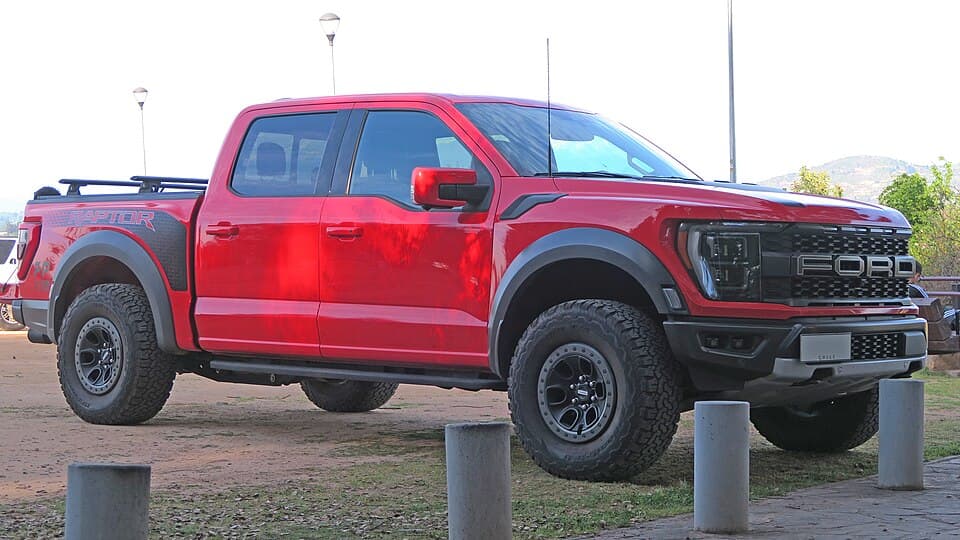
The gen 3 Ford Raptor and the GMC Sierra AT4X both start with a factory suspension built for off-road speed and articulation, but they solve the problem in opposite ways: the Raptor uses Fox Live Valve semi-active dampers tuned for high-speed desert running, while the AT4X uses Multimatic DSSV (Dynamic Suspensions Spool Valve) dampers tuned more for controlled, technical low-speed terrain. Neither truck is objectively better off-road; they're built for different kinds of off-road. The Raptor wins if your off-road time means open desert and whoops. The AT4X wins if your off-road time means rock ledges, mud, and trail obstacles where a front locker and underbody armor matter more than 60 mph over rough ground.
Price matters here too, and it is not close in the way most shoppers expect. Read on for where each truck actually pulls ahead.
Suspension architecture: Fox Live Valve versus Multimatic DSSV
The gen 3 F-150 Raptor runs Fox Live Valve dampers as standard equipment. These are semi-active shocks with electronically controlled valving that reads terrain and driver input dozens of times a second and adjusts damping force accordingly, softening for a rough dirt road, stiffening for a highway on-ramp. We have a full breakdown of how the system works and what it costs to service in our gen 3 Live Valve suspension explainer. Ford spent years building this truck around big wheel travel and a chassis that can take repeated high-speed impacts without the suspension bottoming out or the frame taking damage.
The AT4X uses Multimatic DSSV dampers, a spool-valve design (rather than a shim-stack design like most conventional shocks) that GM says gives more consistent, predictable damping across a wider range of inputs, particularly useful when you are picking a line over rocks at 5 mph rather than skipping across whoops at 50. DSSV dampers are also used in extreme motorsport applications, which is part of GMC's pitch for the AT4X's off-road pedigree.
Both systems are genuinely sophisticated factory equipment, a step beyond a standard twin-tube shock on nearly any other half-ton truck sold new. But exact spec numbers, front and rear wheel travel, damper bore size, and standard equipment content change across model years for both trucks, so verify travel figures, locker availability, and trim-specific hardware against the current Ford and GM press materials before you use any of those numbers to make a buying decision. What was standard on an AT4X two model years ago is not guaranteed to be standard on the current one, and the same caution applies to Raptor trim content.
Price and trim structure: what each truck actually costs to buy
Sticker price separates these two trucks more than any suspension spec does.
A gen 3 Raptor's MSRP moves around with trim, options, and model year, and used-market pricing gives a clearer real-world read than sticker alone. Our own pricing data shows the gen 3-era F-150 Raptor averaging roughly $84,100 across live 2025 listings and climbing toward $91,300 for 2026 listings, reflecting both inflation and demand for the newest trucks on lots. If you want the supercharged version, the Raptor R runs meaningfully higher again, averaging around $100,300 in 2023 listings and climbing past $145,000 in 2026 listings.
The AT4X sits in a different price bracket. GMC has consistently positioned the AT4X as a premium off-road trim rather than a halo performance truck, and its sticker price has historically landed well under a Raptor's, closer to a well-optioned F-150 Tremor or Ford's own mid-tier off-road trims than to the Raptor's price ceiling. Confirm current AT4X pricing against GMC's own configurator, since trim structure and standard content shift every model year and GMC has added an AT4X AEV Edition in some years with different armor and suspension content bundled in.
The practical takeaway: the Raptor costs more, and it costs more specifically because of the powertrain and the high-speed suspension hardware, not because of trim leather or infotainment. If you are cross-shopping on price alone, the AT4X undercuts a Raptor by a wide enough margin that it changes the conversation from "which is better" to "which is worth the difference." For a similar price-versus-capability argument within Ford's own lineup, see our comparison of the Raptor against the Tremor, which walks through the same question one brand over.
Where the Raptor pulls ahead: high-speed desert running
The Raptor's whole engineering brief, since the gen 1 SVT Raptor, has been surviving high-speed impacts in open desert terrain without breaking the truck or the driver's spine. The gen 3's wider track, longer-travel suspension, and Live Valve damping are built around that use case specifically: running whoops, washboard, and rough two-track at speeds that would beat a standard leaf-spring half-ton to pieces inside twenty minutes.
The AT4X was not built to that brief. GMC's suspension tuning philosophy leans toward controlled articulation and predictable low-speed behavior rather than absorbing repeated high-energy impacts at speed. That does not make it a bad off-road truck; it makes it a different one. If your off-road time looks like runs at Glamis or Silver Lake Sand Dunes, the Raptor's suspension architecture is doing exactly what it was designed to do, and the AT4X will feel overwhelmed well before the Raptor does.
Where the AT4X pulls ahead: technical, low-speed terrain
The AT4X's feature set leans hard into technical, low-speed capability: a front locking differential (in addition to the rear locker most trucks in this class offer), more aggressive underbody skid plating as standard equipment, and a suspension tune that GMC and reviewers have both characterized as better suited to picking a deliberate line over rocks or through mud than to absorbing high-speed hits.
This matters on terrain like rock ledges, off-camber trail sections, or slow technical climbs, situations where a locked front axle and predictable, well-controlled damping at low speed matter more than suspension travel and high-speed damper response. We are not going to hand you a precise articulation number or a crawl-ratio figure here, because exact specs vary by trim and model year and belong in GM's own materials, not in a forum-quoted number that goes stale. But the general characterization holds across recent AT4X model years: it is built for technical trail work in a way the Raptor is not, in the same way the Raptor is built for desert speed in a way the AT4X is not.
If you want a similar comparison already published on this site with a different full-size half-ton, our Raptor versus Silverado ZR2 comparison covers a lot of the same low-speed-versus-high-speed ground, since the ZR2 and AT4X share a good deal of GM off-road hardware philosophy.
Ownership and running costs
Neither truck is cheap to own, but they get expensive in different places. The Raptor's known cost centers, cam phaser noise on the EcoBoost variants, 10R80 transmission shift quality complaints, and tire costs once you are running 35s or 37s, are documented across our 3.5 EcoBoost problems by year and 10R80 fluid change pieces. The AT4X's running costs skew toward tire replacement (its factory off-road tire is not cheap to replace in a set) and the usual GM truck maintenance items, but it does not carry the same forum-documented pattern of powertrain complaints that the EcoBoost Raptor has accumulated across three generations.
Fuel economy favors neither truck particularly. Both are large, heavy, off-road-biased trucks running aggressive tires and a wide stance, and neither one is going to deliver commuter-car numbers regardless of which nameplate is on the tailgate.
The short version
- The Raptor wins on high-speed desert capability: Fox Live Valve damping, more suspension travel, and a chassis built around repeated hard impacts at speed.
- The AT4X wins on technical low-speed terrain: Multimatic DSSV damping tuned for control, a front locker, and heavier standard underbody armor.
- The AT4X costs meaningfully less at MSRP than a comparably equipped Raptor, and dramatically less than a Raptor R.
- Buy the Raptor if your off-road weekends look like dunes and open desert two-track. Buy the AT4X if they look like rock ledges, mud, and slow technical trail. Verify current trim content and exact suspension specs against Ford and GMC's own materials before you sign, since both trucks change year to year.
Deal alert
Shopping for one? Get new listings first
We sweep US dealer inventory and send you new Raptors matching your search — real listings, real asking prices, no spam.