Ford Raptor Front-End Clunk: UCA Bushings, Ball Joints, and What It Costs to Fix
A clunk over bumps on an F-150 Raptor is more often worn upper control arm bushings or ball joints than it is the shocks owners usually blame first. We walk through how to diagnose the noise correctly and what parts and labor actually run.
Gear in this article
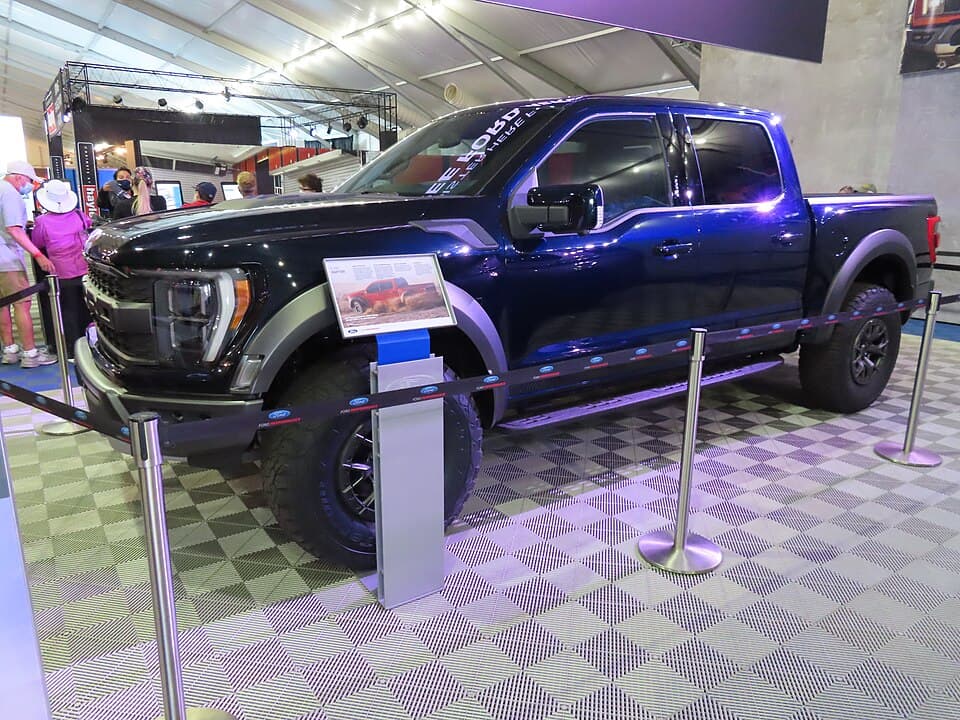
A clunk over bumps or washboard on an F-150 Raptor is usually the upper control arm (UCA) bushings or the upper ball joint, not the shocks. The shocks take the blame because they are the visible, expensive-looking part up front, but worn bushings and a loose ball joint are cheaper, more common failure points that produce the same knock. If you own a Gen 1, Gen 2, or Gen 3 F-150 Raptor and you hear a clunk over bumps, start at the upper control arm before you start pricing shocks.
This is a known conversation among owners across all three F-150 Raptor generations. It is not a Ford-published failure rate, there is no recall tied to it, and there is no TSB that names it as a defined defect. Treat everything below as forum- and shop-sourced pattern recognition, not an engineering bulletin.
Why owners blame the shocks first
The Raptor's front suspension uses long-travel upper and lower control arms with the shock mounted through the upper arm. When something up there is loose, the noise travels through the shock tower and shows up as a clunk that seems to come from the same corner as the shock. Owners hear it, feel it through the seat, and assume a $1,200-2,000 Fox or King unit is failing. Most of the time the shock is fine. The looseness is at the pivot points above and below it.
What actually wears: UCA bushings versus ball joints
Two different parts fail in two different ways, and they sound different if you know where to listen.
UCA bushings are the rubber (or polyurethane on some aftermarket arms) bushings that let the upper control arm pivot at the frame. When they wear out, the arm develops play at the inner pivot bolts. The clunk here tends to show up as a dull thud from up near the frame rail, worse on sharp hits and at low speed over speed bumps or parking lot lips.
Ball joints are the pivoting joints at the outer end of the control arms that let the spindle steer and the suspension articulate. A worn upper ball joint produces a sharper, more metallic clunk, and it is more likely to show up as a bump-steer feel, a slight wander on center, or a knock you feel through the steering wheel rather than just through the frame.
Both wear from the same root cause on a Raptor: long-travel suspension cycling hard and often, worse if the truck sees a lot of washboard, whoops, or repeated small-impact terrain rather than big single hits. A grease boot that has split and let the joint run dry fails faster than one that is intact.
Diagnosing it correctly before you pay for parts
Do not let a shop quote shocks off a verbal description of a clunk. Insist on this sequence, or do it yourself if you have a lift or ramps.
- Bump-steer test. With the truck stopped, have someone grip the tire at 12 and 6 o'clock and rock it vertically while you watch and feel the upper control arm pivot and the ball joint boot. Play here points at the bushing or the joint, not the shock.
- Shake test on a lift. With the front wheels off the ground, grab the tire at 3 and 9 o'clock and shake it side to side to check for steering and tie rod play, then 12 and 6 for upper/lower ball joint and bushing play. A shop doing this properly will isolate which joint is loose rather than guessing.
- Visual grease-boot inspection. Pull the wheel if you can, or get a light up in the wheel well, and look at the ball joint boots for tears, cracking, or visible grease flung onto the inside of the wheel. A torn boot on a joint that still "feels" tight is still a joint you replace soon, because dirt and water are already in it.
- Listen location. Have a second person bounce the corner or drive it slowly over a speed bump while you stand at the wheel well. A clunk that sounds like it is coming from near the frame rail points to the bushing. A clunk that sounds like it is at the spindle, closer to the hub, points to the ball joint.
A shop that skips straight to "it's probably the shocks" without doing a shake test on a lift is guessing. If your truck has started grinding rather than clunking, especially at low speed with the wheel turning, that is a different and more common complaint: see our writeup on why the IWE is grinding and what it costs to fix. The IWE (integrated wheel end, the vacuum actuator that locks and unlocks the front hubs for 4WD) fails often enough on these trucks that owners regularly confuse its noise with a suspension clunk. The two are not related and the fix is completely different.
Which generations get reported more
Owners on Gen 1 (2010-2014) and Gen 2 (2017-2020) forums report UCA bushing and ball joint wear more often than Gen 3 (2021+) owners do, but that is almost certainly a function of age and mileage, not a design difference Ford has acknowledged. A 2012 or a 2018 truck has had a lot more years of bushing flex and boot degradation than a 2022. Treat any generation-based pattern here as anecdotal. Nobody has published a failure rate by model year, and we are not going to invent one. Do not call this a "known defect" in a dealer conversation. It is an observed wear pattern discussed heavily in owner communities, which is a different and weaker claim, and dealers will (correctly) push back if you frame it as something Ford has owned up to.
What it costs to fix
Parts and labor vary by shop and region, and by whether you replace the control arm as a whole unit or just the bushings and ball joint individually. Most shops replace the entire upper control arm assembly rather than pressing in new bushings, because UCAs on these trucks are not expensive enough relative to labor to make rebuilding worth the shop's time.
| Path | Parts (both sides, estimate) | Labor (estimate) | Notes |
|---|---|---|---|
| OEM Ford UCA assembly | roughly $400-700 for the pair | 2-4 hours, call it $300-600 | Requires alignment after |
| Quality aftermarket UCA (non-uniball) | roughly $300-600 for the pair | 2-4 hours, same as above | Moog, Mevotech and similar are common reader-reported choices |
| Ball joint only (press-in style, where serviceable) | roughly $150-350 for the pair | 2-3 hours | Not all Raptor UCAs have a serviceable press-in joint; many are sold as one assembly |
| Performance uniball UCA | roughly $1,200-1,800 for the pair | 2-4 hours | This is a suspension upgrade, not a like-for-like repair, see below |
Call it a total of $700-1,400 at an independent shop for OEM or quality aftermarket arms, parts and labor combined, plus an alignment, and expect dealer pricing to run higher. These are estimates. Confirm current part pricing with your supplier and get an actual shop quote before you commit, since labor rates by region and whether the shop needs to cut loose a seized bolt can both move the number more than you would expect.
An alignment after this job is not optional. Changing the upper control arm changes camber and caster. Budget for it as part of the job, not as a surprise add-on.
If you are already planning a suspension upgrade rather than a stock repair, Camburg's uniball upper control arms are a common step for owners running bigger shocks or more aggressive geometry, like the Camburg Race Spec Uniball Upper Control Arms. That is a different purchase decision than fixing a worn stock bushing, and it costs more, but it removes the rubber bushing failure point entirely going forward. If your truck is already stuffed with King 3.0 coilovers or similar and you are chasing every bit of travel, this is the point in the conversation where "repair" and "upgrade" start to overlap.
What Ford's warranty covers
Front suspension components including UCAs and ball joints are generally covered under Ford's bumper-to-bumper warranty for the first 3 years or 36,000 miles, whichever comes first, on all F-150 Raptor generations. Outside that window, these are wear items and Ford does not cover them under the 5-year/60,000-mile powertrain warranty, because control arms and ball joints are suspension, not powertrain. If your truck is out of bumper-to-bumper but still relatively low mileage, a documented clunk complaint at a dealer with the issue reproduced on a lift is worth asking about as goodwill, but goodwill is discretionary and the dealer owes you nothing outside the warranty period. Do not walk in calling it a known defect. Walk in with a documented test drive and a technician's shake-test findings and ask what they can do.
If you are shopping a used Gen 1 or Gen 2 Raptor and want to check this before you buy, it is on the list in our Gen 2 Raptor buying guide and the Gen 1 Raptor buying guide. Shake the front end on a lift before you sign anything.
Bronco Raptor owners: this is not your truck
The Bronco Raptor runs a different front suspension design than the F-150 Raptor, and it has its own documented clunk complaint involving ball joints and sway bar end links. If you came here because your Bronco Raptor is clunking, read Bronco Raptor Front-End Clunk: Ball Joints, Sway Bar Links, or Something Worse instead. The parts, the cause, and the fix are different enough that applying this article's UCA diagnosis to a Bronco Raptor will send you chasing the wrong joint.
The short version
- A clunk over bumps on a Gen 1, Gen 2, or Gen 3 F-150 Raptor is more often a worn upper control arm bushing or upper ball joint than a shock problem.
- Diagnose it with a bump-steer test, a shake test on a lift, and a grease-boot inspection before you pay for any part.
- Budget roughly $700-1,400 at an independent shop for OEM or quality aftermarket UCA replacement plus an alignment, more at a dealer, and treat every number here as an estimate until your shop quotes your truck.
- This is an owner-reported pattern, not a Ford-acknowledged defect or a TSB. Do not call it that to a dealer.
- If the noise is a grind instead of a clunk, check the IWE first. If you drive a Bronco Raptor, this article is the wrong diagnosis, go read the Bronco-specific one.
Deal alert
Shopping for one? Get new listings first
We sweep US dealer inventory and send you new Raptors matching your search — real listings, real asking prices, no spam.