Why Your IWE Is Grinding and What It Costs to Fix
The integrated wheel end vacuum actuator fails on the same schedule across Gen 1 and Gen 2, usually right when you engage 4WD in a parking lot full of witnesses. Here is the part list, the labor time, and the two ways shops get the diagnosis wrong.
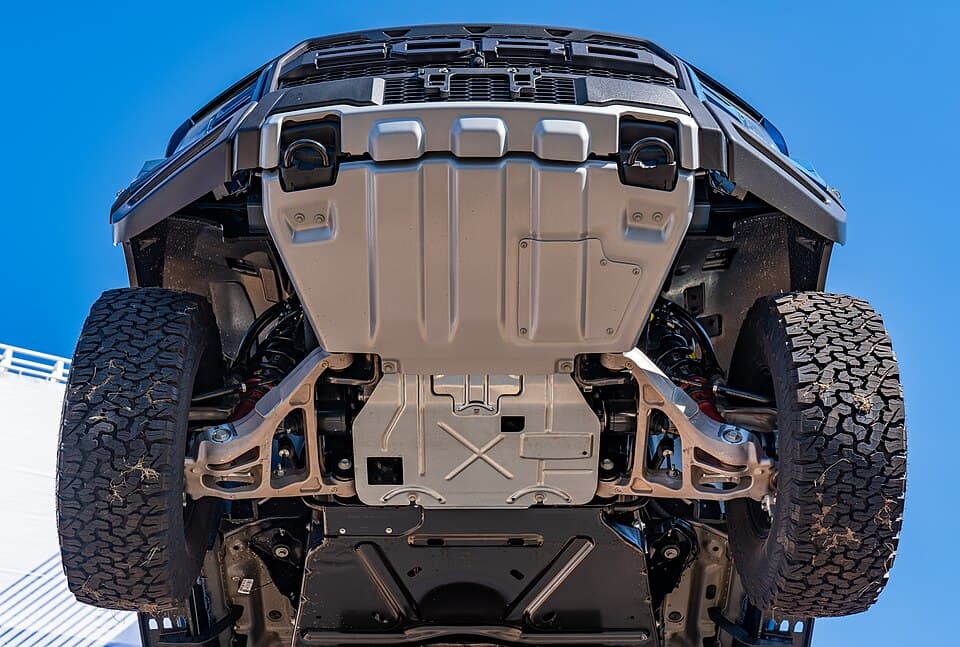
The grinding you hear when you shift into 4WD is almost never the front differential and almost never the hub bearing. It is the IWE (integrated wheel end, the vacuum-actuated mechanism that disconnects the front axle shafts from the wheel hubs in 2WD to cut driveline drag and improve fuel economy). On a Ford Raptor, that system fails on a predictable schedule on both the Gen 1 F-150 SVT Raptor (2010-2014, 6.2L V8) and the Gen 2 F-150 Raptor (2017-2020, 3.5L EcoBoost). It is a $150-250 parts fix done right, and a $600-1,100 shop job done right. It is also one of the most commonly mis-diagnosed noises on either truck.
What the IWE system actually does
Ford does not use manual locking hubs on the Raptor and never has. Instead, engine vacuum pulls a diaphragm inside each front wheel end, disengaging the axle shaft from the hub when you are in 2WD so the front wheels roll free and the diff, shafts and CV joints do not spin for no reason. Shift into 4WD and a solenoid mounted on the frame near the firewall releases that vacuum, a spring pushes the actuator back, and the axle shaft locks to the hub.
It is a clever way to get 4WD engagement without the driver ever leaving the seat. It is also a vacuum system living inches from road salt, mud and standing water, held together by a check valve, plastic vacuum lines, and rubber diaphragms that were never going to last the life of the truck.
The symptom, and why it shows up when it does
The complaint is almost always the same: a grinding, growling or barking noise from one or both front wheels right as you shift into 4WD, or sometimes just as you're driving off after engaging it. It is worse in the cold because the rubber in the actuator diaphragms and vacuum lines stiffens and cracks. It is worse when wet because water gets into a housing that is no longer sealing against vacuum, and because a weak vacuum signal means the actuator is only half-engaging, grinding against the axle shaft splines instead of locking cleanly.
This is also why it tends to happen in front of an audience. Cold morning, first 4WD engagement of the week, parking lot, everyone hears it.
Why shops get the diagnosis wrong
Mistake one: replacing the actuators when the actual leak is upstream. The IWE actuators get blamed first because they are the part making the noise, but the root cause is frequently a cracked vacuum check valve or a brittle vacuum line elsewhere in the harness that is bleeding off the vacuum signal before it ever reaches the wheel end. Swap both actuators, charge the labor, and the truck comes back grinding in six months because the line feeding them was never replaced. A shop that pulls the actuators without first pressure-testing the vacuum lines and check valve is guessing.
Mistake two: blaming the hub bearing. A worn front wheel bearing does make noise, but it is a steady, speed-dependent hum that changes when you sway the truck side to side, not a grind that appears specifically on 4WD engagement. If a shop quotes you a wheel bearing job (typically $450-900 per axle on either generation, using the numbers we've published on the Gen 1 known-problem list) based on this symptom alone, ask them to confirm with a vacuum test first. Bearings and IWE actuators fail independently and it is easy to solve the wrong problem for real money.
Parts list and what it costs
The correct fix replaces the system as a set, not one part at a time. Piecemeal replacement is how owners end up paying twice.
| Part | What it does | Typical part cost (estimate) |
|---|---|---|
| Vacuum check valve | Holds vacuum against the engine's pulse so the actuators stay engaged | $15-30 |
| Vacuum line / harness | Routes vacuum from the intake to the solenoid and actuators | $20-60 depending on how much you replace |
| IWE solenoid | Electrically switches vacuum on and off when you select 4WD | $40-90 |
| Wheel end actuators (both sides) | The diaphragm units at each hub that physically engage the axle shafts | $60-140 for the pair |
Add it up and a full DIY kit runs roughly $150-250 in parts on either generation. Labor is genuinely not hard: it is hand tools, some patience getting to the frame-mounted solenoid, and no special equipment beyond a vacuum pump to test your work. Shops typically quote this as a 2-3 hour job, more if the front skid plate and inner fender liners are tight to work around or if a line has to be traced through the frame rail.
At a shop, budget $700-1,100 on a Gen 1 and $600-1,000 on a Gen 2, parts and labor combined. The Gen 2 number runs slightly lower in practice mostly because it is a newer platform with less corrosion in the way, not because the parts are cheaper.
Ford does not owe you anything on this repair once the vehicle is out of the 3-year/36,000-mile bumper-to-bumper warranty. Within that window, it is a straightforward warranty claim. Outside it, this is an out-of-pocket wear item on both generations, and there is no recall covering it. If your dealer references a repair procedure for it, that is a TSB (a documented repair method, not free money) and it still gets billed unless you are still inside a warranty window or the dealer is extending goodwill, which is entirely at their discretion.
Upgrade options owners actually run
There is no bolt-on kit that eliminates the vacuum system entirely and replaces it with something better documented and widely proven, and be skeptical of anyone selling you one with big promises. What actually moves the needle:
- Use [Motorcraft](https://www.motorcraft.com/us/en_us/home/total-parts-lineup.html) OE-spec parts, not the cheapest parts-store actuator. The failure mode is largely a durability problem with rubber and plastic in a harsh environment. A better diaphragm and a properly routed, heat-shielded vacuum line buys real years, where a bargain actuator often fails again inside a season.
- Reroute the vacuum line away from heat sources while everything is apart. A lot of premature check-valve failure traces back to a line that sits against the exhaust or the turbo heat shield (on the Gen 2's 3.5L EcoBoost especially) and cooks from the outside.
- Run the front axle permanently engaged by leaving the truck in 4WD-adjacent settings rather than cycling 2H to 4H constantly. This is not a part you buy, it is a habit change, and it trades a small fuel economy hit and slightly more wear on the front diff and CV joints for far fewer vacuum cycles working the actuators. Most owners who tow or run mixed terrain do this without thinking about it.
None of this is exotic, and none of it is expensive next to the suspension and armor money most owners are already planning. If you're deciding between a clean used Gen 1 and a Gen 2 and cross-shopping this exact failure, it is worth reading through the best Ford Raptor year to buy in 2026 before you commit, since IWE condition is one of the easier things to check in a test drive and one of the easier things a seller can hide by warming the truck up before you arrive.
The short version
- The grinding on 4WD engagement is the IWE, not the hub bearing, on both the Gen 1 6.2L and the Gen 2 3.5L EcoBoost.
- Replace the check valve, vacuum lines, solenoid and both actuators together, not one at a time.
- Budget $150-250 in parts DIY, or $600-1,100 at a shop depending on generation and corrosion.
- If a shop skips the vacuum test and jumps straight to a wheel bearing quote, get a second opinion before you pay for the wrong repair.
Owner questions
- Why does my Ford Raptor grind when I shift into 4WD?
- The grinding is almost always the IWE (integrated wheel end) system, not the front differential or hub bearing. It's the vacuum-actuated mechanism that disconnects front axle shafts from the wheel hubs in 2WD. This fails on a predictable schedule on both the Gen 1 (2010-2014, 6.2L V8) and Gen 2 (2017-2020, 3.5L EcoBoost) Raptors.
- How much does it cost to fix a grinding IWE on a Ford Raptor?
- It's a $150-250 parts fix if you do it yourself, and a $600-1,100 shop job done right. At a shop, budget $700-1,100 on a Gen 1 and $600-1,000 on a Gen 2, parts and labor combined, with the Gen 2 running slightly lower due to less corrosion on the newer platform.
- Should I replace just the IWE actuators or the whole system?
- Replace the system as a set: vacuum check valve ($15-30), vacuum line/harness ($20-60), IWE solenoid ($40-90), and wheel end actuators for both sides ($60-140 for the pair). Replacing only the actuators is a common mistake since the root cause is often a cracked check valve or brittle line upstream, causing the grind to return in six months.
- How do I tell if my Raptor's noise is the IWE or a bad wheel bearing?
- A worn front wheel bearing makes a steady, speed-dependent hum that changes when you sway the truck side to side, not a grind appearing specifically at 4WD engagement. If a shop quotes a wheel bearing job ($450-900 per axle) based on that symptom alone, ask them to confirm with a vacuum test first before paying for the wrong repair.
- Is the IWE failure covered under Ford's warranty or a recall?
- Ford doesn't owe you anything once the vehicle is out of the 3-year/36,000-mile bumper-to-bumper warranty, and there is no recall covering it. Within that window, it's a straightforward warranty claim; outside it, it's an out-of-pocket wear item on both generations, even if a dealer references a TSB repair procedure.
Deal alert
Shopping for one? Get new listings first
We sweep US dealer inventory and send you new Raptors matching your search — real listings, real asking prices, no spam.