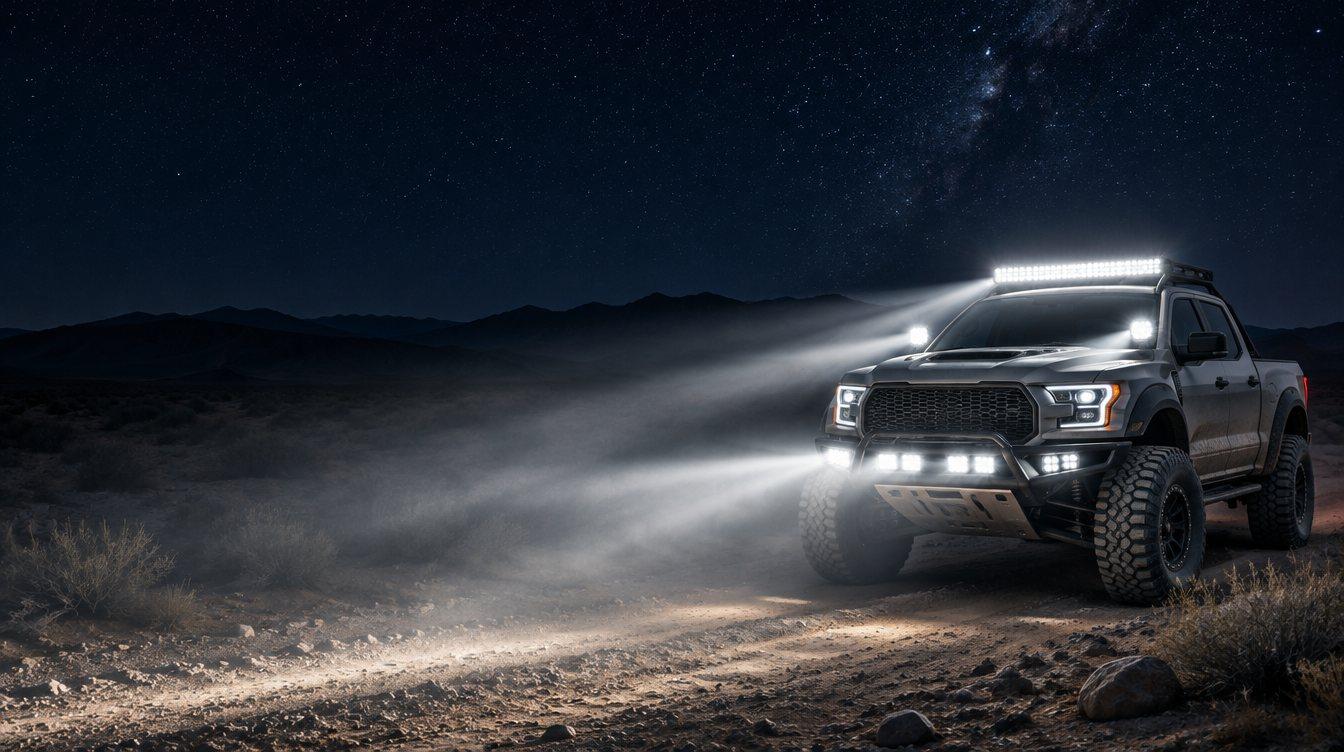
Interactive guide
Offroad Lighting 101
Skip the spec-sheet shouting match. Put lights on the truck, see exactly what they do to a real trail at night, and find out if you could stop in time. Then buy.
- Safe to drive
- 10 lux
- Mount spots
- 8
- Real physics
- 1/d²
What lux actually looks like
Lux is how much light lands on something. Below is the same patch of trail at four light levels. Remember the green one: 10 lux is the least light you can safely drive in, and every number on this page is about pushing it further down the trail.
 0.25 lux
You can tell there is a trail.
Rocks, ruts and edges are invisible.
 1 lux
You see bushes and big rocks as dark shapes.
You can't judge depth or speed. Fine for walking, not driving.
 10 lux
Rocks, ruts and the trail edge are readable at speed.
This is the floor. Everything on this page measures how far it reaches.
 50+ lux
Texture, small rocks, colour. Your eyes fully relax.
More than this up close just makes the distance look darker.
Add lights. Watch the trail light up.
Pick lights for each spot on the truck. The photo goes dark where no light lands, just like the real trail. Flip to lux zones to see the four levels above painted on the ground, and check whether you could stop in time.
Yes. Safe light reaches 397 ft. At 45 mph on dirt you need 234 ft to react and stop.
That is 6.0 seconds of seeing ahead. The red line on the trail is where you would finally stop.
Yes. Safe light reaches 397 ft. At 45 mph on dirt you need 234 ft to react and stop.
That is 6.0 seconds of seeing ahead. The red line on the trail is where you would finally stop.
+130 ft of safe light ahead · +24 ft wider at 100 ft · More reach, but still a narrow road pattern. Nothing reaches the trail edges.
+5 ft of safe light ahead · +20 ft wider at 100 ft · Low, wide and flat with a hard top cutoff, so light stays under the dust instead of bouncing back.
+90 ft of safe light ahead · +60 ft wider at 100 ft · The all-rounder. Some reach, some width, the smoothest blend into the edges.
of safe light side to side, 100 ft out. The trail itself is ~14 ft.
Try Dust to test it.
Your add-on lights pull 6.8 A. Wire them through a relay with a 10 A fuse.
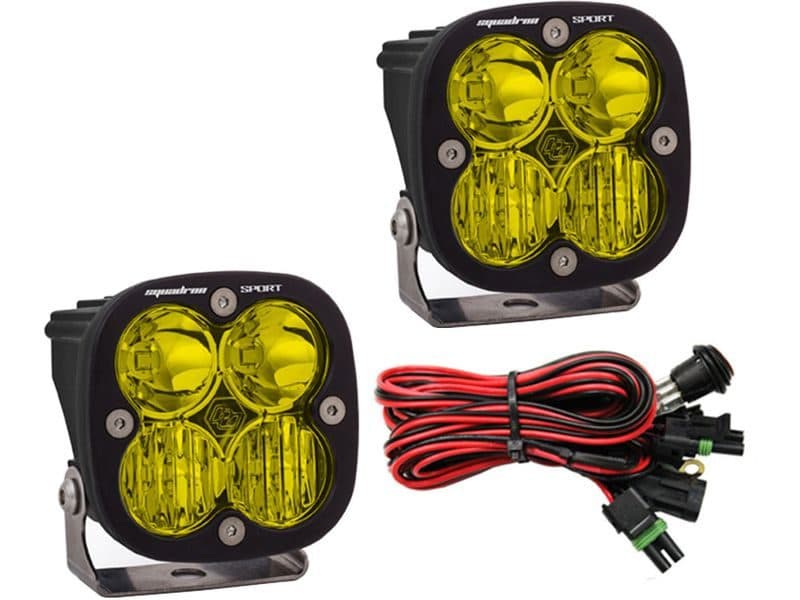
Same light, different shape
Every light makes the same trade. Squeeze it into a tight beam and it reaches further but goes narrow. Spread it out and you light the edges but lose distance. Drag the sliders and watch the green zone change shape on the trail.
The trade every light makes: hold the lumens fixed and tighten the optic. Throw climbs, width and smoothness fall. Same light, just put in a different place. A bigger throw number on the box does not mean a brighter light.
How far the centre beam travels, in feet, before it drops to 10 lux, about twilight. This is the number most brands lead with, and the easiest to inflate by squeezing the beam narrow.
A pair on the bumper, nothing else on. Green is safe-driving light, amber is shapes only, blue is moonlight.
16 lux at the centre. Double the distance and you get a quarter of the light. That inverse square law is why throw is so expensive: 2× the reach takes 4× the candela.
Where each light goes on the truck
Height matters most. Light mounted above the hood line bounces off the hood and the dust right back into your eyes. Tap a spot to see what goes there.
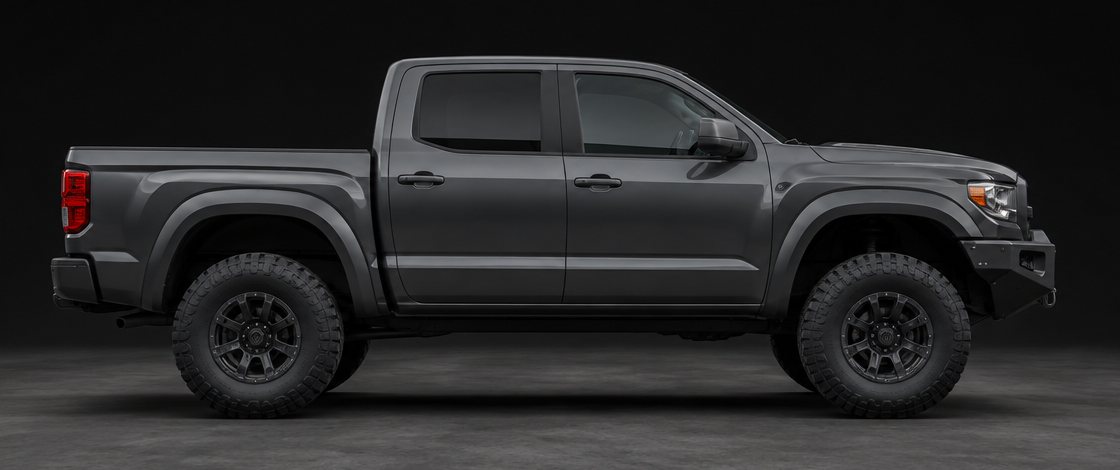
Bumper pods
2.4 ft · below hood lineThe workhorse spot. Bumper height gives distance without lighting up your own hood.
- Best fit
- 3" pod, driving/combo. The all-rounder. Some reach, some width, the smoothest blend into the edges.
- Wiring
- Run a fused, relayed harness to an upfitter or aux switch. 2017+ F-150 Raptors have six overhead upfitter switches wired from the factory.
- Watch out
- Pods poking above the bumper line light the hood. Keep the lens at or just below hood height.
Amber, daylight, or cool white
The same lights in four colours. Switch between clear air and dust to see how much light comes back at you.
5000K daylight. Closest to noon sun. The sweet spot for contrast and depth perception.
Honest footnote: whether amber truly cuts through dust is still argued. Dust scatters every colour about the same. What amber does for many drivers is reduce the glare and eye strain from that scatter. Mount height and a fog lens with a hard top cutoff matter more than colour.
How far does a specific light really reach?
125 pods and bars from Baja Designs, Rigid, Diode Dynamics, KC and more, with throw worked out from each maker's own candela figure. Sort by reach or by reach per dollar.
Power it right, keep it legal
Use the upfitter switches
2017+ F-150 Raptors have six overhead AUX switches wired from the factory. Gen 2 and Gen 3 tap points differ.
Gen 3 wiring guide →Fuse at 125%
Add up the draw on a circuit and fuse at about 1.25× it, then size the wire for the fuse, not the light. The simulator does the math.
Gen 2 wiring guide →Relay anything big
Light bars and 9" pods pull 8-22 A. A relay keeps that current off the switch and puts it on a short, heavy run from the battery.
Bars, mounts & legality →Off-road means off-road
Most high-output aux lights are not street legal. Many states want them covered or off on public roads. SAE/DOT fogs and driving lights are the exception.
Best LED pods for a Raptor →Ready to buy? Owner ratings, fitment and live prices for the lights in the registry.
Browse lighting mods →Quick answers
What does 10 lux mean for off-road lights?+
Lux is light landing on a surface. 10 lux is roughly twilight and is the common floor for usable light when driving. Throw ratings measure how far a light's centre beam travels before it drops to 10 lux.
Are more lumens always better?+
No. Lumens are the total light leaving the fixture. Where the optic puts that light matters more. A spot and a flood with the same lumens behave completely differently: the spot reaches further, the flood lights the edges.
Effective lumens vs raw lumens?+
Raw lumens are what the bare LEDs could produce. Effective lumens are what is left after the optic, lens and housing. Raw numbers often run 30-50% higher, so only compare effective to effective.
Should I run a roof light bar on my Raptor?+
A roof bar gives the most reach on dry, open desert, but mounted above the hood line it lights the hood and backscatters off dust straight into your eyes. Most experienced desert drivers rely on bumper-height lights and switch the roof bar off in dust.
Amber or white for dust?+
Many drivers find selective amber produces less glare in dust, fog and snow. Dust scatters all colours about the same, so mount height and a fog optic with a hard top cutoff matter more than colour. 5000K white gives the best contrast in clear air.
How do I wire aux lights on a Raptor?+
2017 and newer F-150 Raptors come with six overhead upfitter switches wired from the factory. Run each light through a fused, relayed harness to one of those circuits and size the fuse at about 125% of the light's draw.
Are off-road lights street legal?+
Most high-output aux lights are for off-road use only. Many states require them covered or switched off on public roads. SAE or DOT marked fog and driving lights are the exception; check your state's rules.
How the model works: each light is a point source with a measured-style intensity curve; light on a target falls with the square of distance. Light types are generic classes calibrated to the range of published lab specs, not any one brand. Some makers publish a combined score for the same four ideas; Baja Designs calls theirs ELS™.