Ranger Raptor MPG, Fuel Tank Size and Real Range, by Model Year
The EPA rates every US Ranger Raptor at 16 city, 18 highway and 17 combined, and Ford's tank is about 20 gallons. That puts paper range near 340 miles. Here is the math by year and what eats into it off-road.
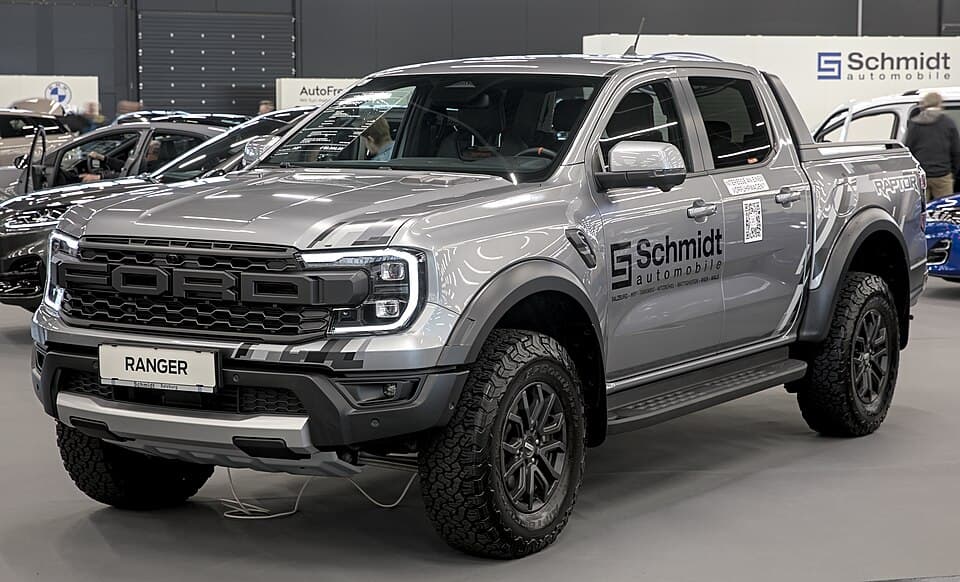
The EPA rates the Ranger Raptor at 16 city, 18 highway, 17 combined for every model year it has existed in the US so far, 2024, 2025 and 2026 all carry identical numbers. Multiply that 17 combined by the tank size on Ford's own spec sheet and you land at roughly 340-345 miles of paper range, with the exact number depending on which year's document you read. That is a calculation, not a test result, and off-road use eats into it faster than on an F-150.
The EPA numbers, year by year
Every Ranger Raptor sold in the US runs the same drivetrain: a 3.0L twin-turbo EcoBoost V6 making 405 hp and 430 lb-ft, paired to a 10-speed automatic. The EPA testing reflects that. There is no mpg difference between a 2024, 2025 or 2026 because nothing about the fuel system or gearing changed enough to move the number.
- 2024: 16 city / 18 highway / 17 combined, per fueleconomy.gov
- 2025: 16 city / 18 highway / 17 combined, per fueleconomy.gov
- 2026: 16 city / 18 highway / 17 combined, per fueleconomy.gov
For context, Ford's other Raptor-badged off-roader with a smaller EPA footprint, the Bronco Raptor, comes in lower at 15 city / 16 highway / 15 combined. The Ranger Raptor's extra few mpg combined comes down to less frontal area and less unsprung weight, not a meaningfully different engine tune.
Why the tank size on paper does not agree with itself
Here is where you need to read the actual document for your model year instead of trusting a single number repeated everywhere online. Ford's own spec sheets disagree on tank capacity:
- The 2024 Ford Ranger Raptor technical spec sheet lists a 20.3 gallon tank.
- The 2025 Ford Ranger Raptor technical spec sheet lists 20 gallons.
- The 2026 Ford Ranger technical spec sheet also lists 20 gallons.
We are not going to tell you Ford swapped tanks between 2024 and 2025, because we have no teardown, no part number comparison and no confirmation that the physical tank changed. It is just as likely this is a rounding or documentation correction between printings. What we will tell you is this: if you own a 2024, use 20.3 gallons for your own math. If you own a 2025 or 2026, use 20. The difference barely moves the range number anyway, about 5 miles at 17 combined, which is inside the noise of how you actually drive.
The same spec sheets disagree on other numbers too, which is worth knowing before you quote anything off a forum. Max payload is 1,375 lb on the 2024 sheet, 1,411 lb on the 2025 sheet, and 1,373 lb on the 2026 sheet. Front brake rotor size jumps from 12.24 x 1.33 in on the 2024 sheet to 13.42 x 1.34 in on the 2025 and 2026 sheets. Max crawl ratio is listed at 61.59:1 on the 2024 sheet and 67.88:1 on the 2025 and 2026 sheets. None of these are typos you should average together. Pull the sheet for your specific year and use that number. You can find the full breakdown on the 2024, 2025 and 2026 spec pages.
The range math, shown as math
This is arithmetic, not a dyno result or a tank-to-empty test. Tank size multiplied by the EPA combined figure:
| Model year | Tank (Ford spec sheet) | EPA combined | Calculated range |
|---|---|---|---|
| 2024 | 20.3 gal | 17 mpg | about 345 miles |
| 2025 | 20 gal | 17 mpg | about 340 miles |
| 2026 | 20 gal | 17 mpg | about 340 miles |
Treat 340-345 miles as a ceiling, not an expectation. It assumes you drive exactly like the EPA's city/highway test cycle, which nobody does in a truck with a Baja drive mode and 33-inch all-terrains. We have no published real-world range or fuel economy test for this truck from a source we trust enough to quote a number here, so we are not going to invent one. If you want the general real-world mpg discussion across every Raptor variant Ford sells, including owner-reported patterns, that lives on the site's Ford Raptor MPG piece.
What actually eats into that range off-road
None of the following has a published percentage attached to it for the Ranger Raptor specifically, so we are going to describe direction and magnitude in plain language instead of making up a number that sounds precise.
Sand. Running in sand, especially in a lower gear with the throttle open to keep momentum, is the single biggest range killer on this truck. The 3.0L EcoBoost is working against rolling resistance that a hard-packed road never generates, and boost stays up longer than it would cruising. Expect the needle to move noticeably faster than it does on pavement, hour for hour.
Low range and 4L crawling. Technical trails run in low range mean low speed, sustained load and more throttle modulation, which is a worse fuel economy case than highway cruising even though your actual ground speed is slower.
Towing. At a 5,510 lb max tow rating, the Ranger Raptor is not a dedicated tow rig, but owners do use it for side-by-sides and small trailers. Towing anywhere near that number drops range hard, both from aerodynamic drag and from the engine working against a heavier combined weight.
33-inch all-terrains. Every Ranger Raptor ships on LT285/70R17 all-terrain tires from the factory. They are a compromise tire, not a fuel economy tire, and the EPA number already reflects them. Swapping to a more aggressive all-terrain or a mud-terrain in the same size will cost you some more, though we do not have a tested figure to attach to it.
Short trips. A turbocharged V6 that has not reached operating temperature runs richer and the transmission has not settled into its most efficient shift pattern. If most of your driving is under 10 minutes, your real mpg will sit below the EPA combined number regardless of terrain, which is true of basically every modern turbocharged truck engine and not specific to this one.
What this actually means for trip planning
Treat 300 miles as your real-world planning number for mixed driving, and treat that as conservative padding against the 340-345 mile paper figure, not a tested result. If you are headed somewhere with no fuel for a long stretch, a dedicated run through dunes like Silver Lake Sand Dunes or a long desert loop through Johnson Valley, carry extra fuel. A bed-mounted auxiliary can is the standard fix owners land on, and it is the first thing we'd tell a new Ranger Raptor owner to budget for before any cosmetic mod. The site's known-problem list for this truck flags exactly this as the number one owner complaint, worse than any mechanical issue on the Ranger Raptor reliability page.
Fuel economy and range are not the only area where Ford's own documents disagree year to year. If you are deciding whether a 2024, 2025 or 2026 is the better buy, the full spec conflicts (payload, torque rpm, axle ratio, crawl ratio) matter more to a used buyer than the mpg story does, since mpg is identical across all three years. For the broader ownership picture beyond fuel, the Ranger Raptor cost of ownership breakdown and the Ranger Raptor common problems list are the next two things worth reading before you sign.
The short version
- EPA rates every US Ranger Raptor (2024, 2025, 2026) at 16 city / 18 highway / 17 combined, with no change across model years.
- Ford's tank spec is 20.3 gallons on the 2024 sheet and 20 gallons on the 2025 and 2026 sheets. That is a documentation difference we cannot confirm as a hardware change.
- Tank times EPA combined works out to about 340-345 miles, which is a calculation, not a real-world test.
- Sand, low range, towing and short trips all pull real mileage below that number. Nobody has published a real-world test figure worth quoting, so budget conservatively and carry extra fuel if you are running anywhere remote.
Deal alert
Shopping for one? Get new listings first
We sweep US dealer inventory and send you new Raptors matching your search — real listings, real asking prices, no spam.