2022 Ford Raptor: Specs, Problems, and What to Pay
The 2022 F-150 Raptor is a Gen 3 carryover year running the same 450 hp EcoBoost and single-valve Fox 3.1 shocks as 2021, with no Raptor R yet and a cam phaser rattle that still clusters on this model year. Used 2022 trucks average roughly $63,000 in 2026, ranging $52,000-72,000 depending on mileage and the 37 Performance Package.
Gear in this article
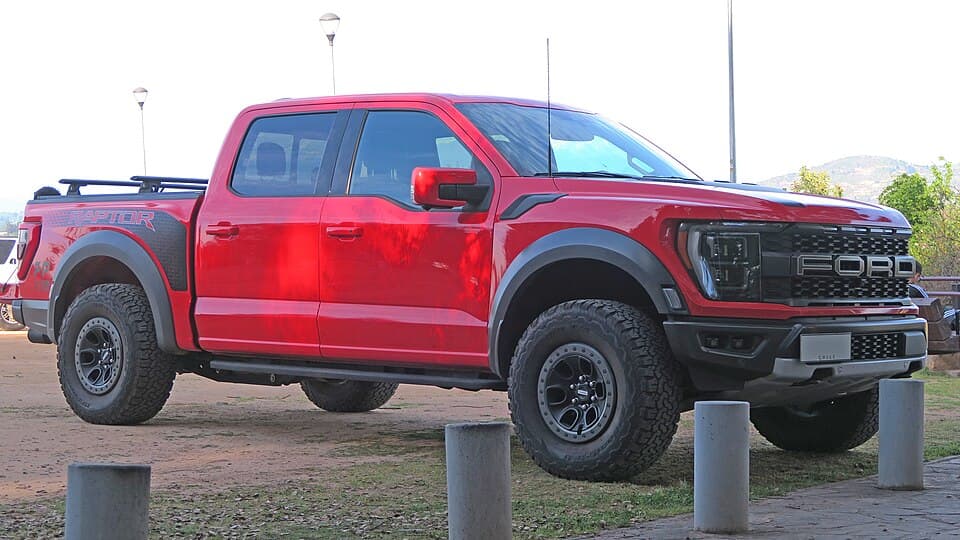
The 2022 F-150 Raptor is the second model year of Gen 3, a carryover truck built on the same 450 hp 3.5L High-Output EcoBoost, 10R80 ten-speed, and five-link coil rear with a Watt's link that the platform launched with for 2021. Shocks are Fox 3.1 Live Valve, a single internal valve reading the road through accelerometers; the Dual Live Valve design that splits compression and rebound control did not arrive until the 2024 refresh. There is no Raptor R this year, that supercharged 5.2L badge does not exist until 2023. Used 2022 Raptors average roughly $63,000 on the live market in 2026, with a real range of about $52,000-72,000 depending on mileage and whether the truck carries the 37 Performance Package.
Here are the numbers, then the reasoning.
| Spec | 2022 F-150 Raptor |
|---|---|
| Engine | 3.5L High-Output EcoBoost V6, twin-turbo, port and direct injection |
| Power | 450 hp @ 5,000 rpm |
| Torque | 510 lb-ft @ 3,500 rpm |
| Transmission | 10R80 ten-speed automatic |
| Shocks | Fox 3.1 Live Valve, single-valve (Dual Live Valve arrives 2024) |
| Rear suspension | Five-link coil, 24-in Watt's link |
| Suspension travel | 14.0 in front / 15.0 in rear |
| 37 Performance Package | 37x12.50R17 BFGoodrich KO2 on beadlock-capable forged wheels, 13.1 in ground clearance |
| Payload / towing | Roughly 1,400 lb / 8,200 lb, less payload with the 37 Package |
| EPA fuel economy | 15 city / 18 hwy / 16 combined |
| 0-60 mph | approx. 5.2-5.6 sec (tested range) |
What actually changed for 2022
Nothing under the skin. The engine, the transmission, the coil rear, and the single-valve Fox 3.1 shocks all carry over from the 2021 launch unchanged. What separates a 2022 from a 2021 is production maturity more than any spec sheet difference: a launch year always carries more early-build inconsistency than the model year after it, from panel fit to the occasional software glitch in a new infotainment stack, and by the second year of a platform most of that has been run down. That is a general pattern across new-generation trucks, not something we can point to a specific running change for on this exact platform, so treat it as a reason to lean 2022 over 2021 when the price is close, not as a guarantee that a specific 2021 problem is fixed.
The cam phaser rattle did not stay in Gen 2
The cam phaser rattle (the variable valve timing unit bolted to the front of each camshaft, the part on this engine most likely to wear loose enough to clatter at cold start) is the defect that defines Gen 2's reputation, worst on 2017-2018. It carried into the redesigned Gen 3 engine too, and owner reports cluster it on 2021-2022 trucks specifically, before it thins out on 2023 and later production. Cold start every 2022 you look at the way you would a Gen 2: the truck needs to have sat overnight with the engine off, no warm-up laps staged by the seller first. Listen for a metallic rattle in the first five to ten seconds that quiets as oil pressure builds. A rattle that runs longer than that, or never fully quiets, is worth a dealer visit before you buy, not something to write off as normal for a truck this age. For the full repair-cost breakdown by path, the Gen 2 cam phaser guide covers the same failure mode and the same shop math that applies here.
Two recalls worth checking before you buy
Two NHTSA campaigns touch the 2022 model year specifically. The first, campaign 22V675000 (Ford recall 22S59), covers 2022 Raptors built with the 37-inch tire and wheel option: Ford's own filing traces it to a production change on April 18, 2022, when an automated three-spindle lug nut tool replaced a manual process and was set to a nominal torque of 170 Nm instead of the intended 200 Nm, leaving wheel lug nuts under-torqued on affected trucks. About 1,519 units were covered, and owner notification letters went out September 26, 2022. Ford's remedy was tightening or replacing the lug nuts at no cost. The second, recall 26C37, covers 2021-2023 F-150s with the 8-inch Sync screen, including the Raptor: a software fault can leave the rearview camera image obscured by the infotainment home screen after the truck is shifted into reverse, fixed with a software update, in some cases over the air. Pull the VIN at nhtsa.gov/recalls before you buy and again before you sell, since a recall can post after you already own the truck.
The 37 Performance Package on a 2022
The 37 Performance Package puts 37x12.50R17 BFGoodrich KO2s on beadlock-capable forged wheels, with 13.1 inches of ground clearance against the standard 35-inch setup, and it is not standard equipment, so do not assume every 2022 in a listing has it just because the photos show big tires. It also eats into payload, and because of the lug nut recall above, a 2022 with the 37 Package is specifically the truck to check the wheels on before you sign anything, even after the recall repair has supposedly been done. Check the wheels themselves, not the tire size in the ad. A shop can bolt 37s onto a standard-package truck's stock wheels in an afternoon, and that truck rides, tows, and clears differently than a factory 37 Package truck built around the taller tire from the suspension tune outward. The full breakdown of what actually changes between 35s and 37s is worth reading before you pay 37 Package money for a truck that only looks like one.
2022 versus 2021: is the extra model year worth it
Mechanically, a 2021 and a 2022 Gen 3 are the same truck: same engine, same transmission, same shocks, same rear suspension. The practical differences are the ones above, a launch year's early-build variance against a second model year's slightly more settled production, and the lug nut recall that is specific to 2022's 37-inch tire trucks rather than 2021's. Neither of those is a reason to pay a large premium for a 2022 over a well-documented 2021 sitting at a lower price. If the maintenance history and the cold-start test both check out on the 2021, the model year alone should not move the decision much. The used Gen 3 buying guide walks through what to verify across the whole generation, not just this one year.
2022 versus 2023 and 2024: no Raptor R, single-valve shocks
The Raptor R does not exist until 2023, so if a listing calls itself a 2022 Raptor R, that is a labeling error or worse, walk away and confirm the build sheet. Against a 2023, the difference is mostly badge and options, since 2023 is still Gen 3's original shock and suspension spec. Against a 2024, the gap is real: the 2024 refresh brings Dual Live Valve shocks that control compression and rebound more independently than the 2022's single-valve setup, plus a redesigned front end and bigger screens. Owners who have driven both back to back describe the newer shocks as calmer at speed over rough ground, though that is a subjective read, not an instrumented test. If the Dual Live Valve tune matters enough to you to justify the price step up, that argument favors a 2024 over a 2022 regardless of mileage.
What a 2022 Raptor costs in 2026
Used 2022 F-150 Raptors average roughly $63,000 in 2026, with a range of about $52,000-72,000 driven mainly by mileage and whether the truck carries the 37 Performance Package. A higher-mile standard-package truck sits toward the bottom of that band; a low-mile 37 Package truck with the tech options lands near the top. That is a meaningful discount against a 2024, which starts around where a well-optioned 2022 tops out, so a 2022 is the more realistic entry point if Gen 3 capability matters more to you than the newest shocks. These ranges move by region and season, confirm against live listings before you make an offer. What a Ford Raptor costs across the whole lineup right now puts this year in context against every other trim and generation.
Who should buy a 2022
A 2022 makes sense if you want Gen 3's coil-rear ride and the 450 hp EcoBoost at a price meaningfully below a 2024, and you are willing to do the cold-start test and the wheel check the recall record calls for. It is a worse buy if a seller is pricing a 2021 like a 2022 with no discount for the launch-year variance, or if what you actually want is the Dual Live Valve tune and you are paying near-2024 money for a truck that cannot deliver it. Cold start it, pull the VIN against both recalls, check the wheels if it has the 37 Package, and let the paperwork and the cold-start test set the number. The best Ford Raptor year to buy in 2026 walks through how 2022 stacks up against every other year if you are still deciding which one to chase.
Owner questions
- How much is a used 2022 Ford Raptor?
- Used 2022 Raptors average roughly $63,000 on the live market in 2026, with a real range of about $52,000-72,000 depending on mileage and whether the truck has the 37 Performance Package. The market block on this page updates from live listings.
- Is there a 2022 Raptor R?
- No. The supercharged 5.2L Raptor R did not exist until the 2023 model year. Every 2022 Raptor is the 450 hp 3.5L High-Output EcoBoost.
- What shocks does the 2022 Raptor have?
- Fox 3.1 Live Valve with a single internal valve. The Dual Live Valve design that splits compression and rebound control did not arrive until the 2024 refresh.
- What is the 2022 Raptor 0-60 time?
- Roughly 5.2-5.6 seconds across instrumented tests, the same band as every Gen 3 F-150 Raptor.
- Does the 2022 Raptor have recalls?
- Two worth checking by VIN before you buy, covered in the recall section above, plus the cold-start cam phaser check that carried into Gen 3. If the truck has the 37 Package, inspect the wheels as the recall record calls for.
Deal alert
Shopping for one? Get new listings first
We sweep US dealer inventory and send you new Raptors matching your search — real listings, real asking prices, no spam.