Ford Raptor Payload: What It Can Actually Carry
A Raptor's payload is roughly 1,200-1,400 lb depending on generation and options, which is less than a base XL F-150 and disappears fast once you add a bed rack, a rooftop tent, and four adults. Here is the number by generation and how to read your own door sticker.
Gear in this article
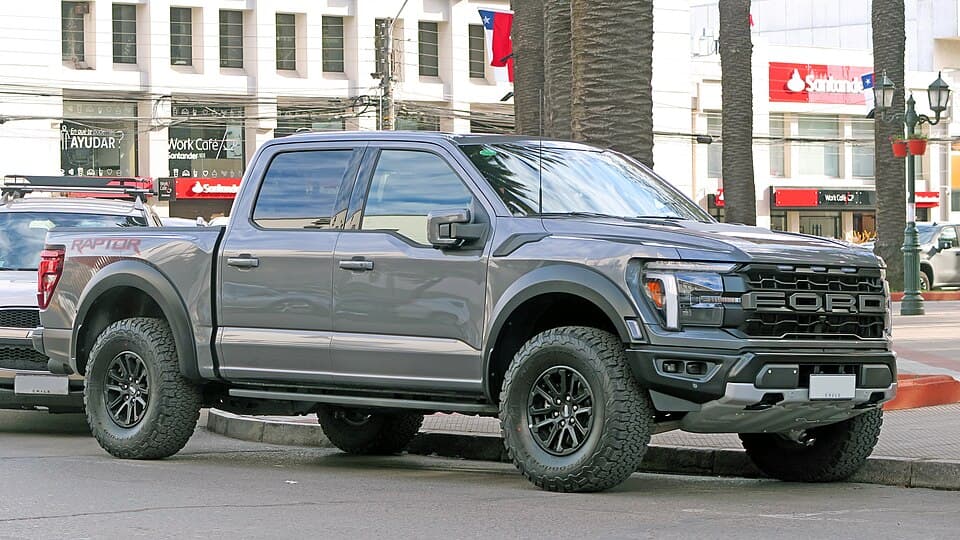
A Ford Raptor's payload runs roughly 1,000-1,400 lb depending on generation, cab configuration, and options, and the 37 Performance Package cuts into that number further. That is meaningfully less than a base F-150 XL, which is rated to carry noticeably more in the right configuration. The number on the spec sheet is a best case. The number on your door jamb is the truth.
Why the Raptor's payload is low in the first place
Payload is not about how strong the frame is. It is about how much weight the suspension can absorb before it runs out of travel and starts hammering the bump stops.
Every Raptor, from the Gen 1 through the Gen 3, is set up with long-travel suspension tuned to soak up whoops and desert washboard at speed. That means softer spring rates and shocks with a lot of low-speed compression travel to give away. A regular F-150 with stiffer, shorter-travel springs can hold more static weight before it sags, because holding weight is the design goal. The Raptor gives up some of that capacity in exchange for a suspension that can eat a G-out at speed without bottoming.
This is the same tradeoff that shows up when people compare shock packages like Fox 3.0 internal bypass shocks against ICON's 3.0 coilover kit in the Gen 2 whoops test: more travel and softer low-speed damping buys speed capability, not load capacity. Payload and desert manners pull in opposite directions, and Ford tuned the Raptor for the second one.
Payload by generation
These are honest ranges, not a single spec-sheet number, because payload changes with cab size, drivetrain options, and equipment. Your actual number is always on the door jamb, covered in the next section.
| Generation | Years | Approximate payload |
|---|---|---|
| Gen 2 | 2017-2020 | roughly 1,000-1,200 lb |
| Gen 3 | 2021-present, standard package | roughly 1,400 lb |
| Gen 3 with 37 Performance Package | 2021-present | somewhat lower, Ford does not publish a clean single figure and it varies by cab and options, confirm on your sticker |
| Raptor R | 2023-present | lower still, the supercharged curb weight comes straight out of payload, confirm on your sticker |
We are not publishing a Gen 1 (2010-2014) number here. Ford's published figures for that truck vary enough by cab and drivetrain option that any single range we gave you would be a guess dressed up as a spec. Pull it from your own door jamb, covered below.
The 37 Performance Package trades payload for tire and suspension capability. The 37-inch tires it ships with add unsprung mass, and Ford recalibrates the suspension around them. We are not going to guess at a specific pound figure for that tradeoff or name a tire brand and model we cannot confirm shipped on your specific build year, because Ford has changed tire suppliers and specs across Gen 3 model years. Check your build sheet or door sticker for what actually left the factory on your truck, and treat the standard-versus-37-Package gap as real but unquantified without your VIN.
The Raptor R's number is the least published of the bunch. The supercharged 5.2L (detailed on our Raptor R engine page) and the R-specific chassis hardware add curb weight, and every pound of curb weight comes straight out of payload since GVWR does not move much between trims. Nobody has published a payload table broken out by every Raptor R configuration worth quoting here. Verify with your own door sticker before you plan around it.
How to read your door jamb sticker
Forget every number in the table above the moment you are loading your actual truck. Open the driver's door and look at the yellow certification label on the jamb. It lists the GVWR (gross vehicle weight rating, the maximum your loaded truck is allowed to weigh, including passengers, cargo, and fuel) and the GAWR (gross axle weight rating) for front and rear.
Payload is not printed directly on every version of this label, but you can get it two ways:
- Some trucks list "Payload" directly on the tire and loading placard, usually on the same door jamb sticker below the tire pressure info.
- If it is not listed, subtract the curb weight (found on your window sticker or a corner scale) from the GVWR. What is left is your payload.
Two trucks built the same week off the same line can carry different amounts. Options like a moonroof, a tow package, or aftermarket wheels and bumpers all eat into that number by different amounts. This is why a spec sheet range is a starting point and your VIN-specific sticker is the answer.
The overlanding math that catches people off guard
This is where payload gets real. A build that looks reasonable on paper eats the whole number before you load a cooler.
Take a Gen 2 with a payload around 1,100 lb, a realistic mid-pack number for that generation:
- Rooftop tent: roughly 130-170 lb for the tent itself, more once you add an annex, and these figures vary by manufacturer so check your specific tent's spec
- Prinsu roof rack or a chase rack: roughly 40-90 lb depending on style, see our breakdown of Raptor roof racks and chase racks
- DECKED drawer system with tools and recovery gear loaded: roughly 200-300 lb once it is actually full, not empty
- Two adults up front, two in the back seat: roughly 500-650 lb
- Fuel, water, cooler, and general gear: roughly 100-200 lb easily
Add the low end of each range and you are past 970 lb before you have hooked up a trailer or loaded a single jerry can of extra fuel. Add the high end and you have blown well past 1,100 lb with four adults still standing outside the truck. This is the single most common way Raptor owners overload their trucks without realizing it: nothing on the list looks heavy by itself, but a rooftop tent plus a full drawer system plus four adults is a payload problem on every Raptor generation, not an edge case.
Weight up high, like a rooftop tent or a loaded rack, also raises the center of gravity and changes handling more than the same weight low in the bed would. That is a stability issue on top of the payload math, not instead of it.
Payload versus towing, and why tongue weight matters for both
Payload and towing capacity are different numbers answering different questions, and they interact.
Payload is what the truck itself carries: passengers, cargo, bed weight, roof rack weight, everything riding on the truck's own suspension. Towing capacity is what the truck can pull behind it on a trailer's own axles. The Raptor's towing capacity by generation is a separate spec, and it is generally higher than payload because a trailer carries most of its own weight.
The overlap is tongue weight (the downward force the trailer's hitch puts on your truck's rear axle, typically 10-15 percent of loaded trailer weight). Tongue weight comes out of your payload, not your towing capacity. Tow a loaded trailer and carry a full bed and four passengers at the same time, and you can hit your GVWR limit well before you hit your tow rating. Anyone planning to tow a trailer behind a loaded overland build needs to run both numbers, not just one.
The short version
- Real Raptor payload runs roughly 1,000-1,400 lb depending on generation, and the 37 Performance Package cuts it further by an amount that varies by build, confirm on the sticker.
- Softer, longer-travel suspension is why the number is lower than a standard F-150's: the Raptor is tuned for speed over rough terrain, not for carrying weight.
- Your door jamb's tire and loading placard has the real GVWR and payload for your specific truck. Trust that over any spec sheet, including this one.
- A rooftop tent, a roof rack, a loaded drawer system, and four adults will eat a Raptor's entire payload before you add fuel or water. Add it up before you build, not after.
Owner questions
- Ford Raptor payload capacity specs
- Payload runs roughly 1,000-1,400 lb depending on generation. Gen 2 (2017-2020) is roughly 1,000-1,200 lb, and Gen 3 (2021-present) standard package is roughly 1,400 lb. The 37 Performance Package and Raptor R (2023-present) both cut into that further, but Ford doesn't publish a clean single figure for those, so confirm your exact number on the door jamb sticker.
- Why is the Raptor's payload lower than a regular F-150's?
- Payload depends on how much weight the suspension can absorb before running out of travel, not frame strength. The Raptor uses long-travel suspension with softer springs tuned to soak up whoops at speed, while a regular F-150 has stiffer, shorter-travel springs designed to hold more static weight. That's why a base F-150 XL is rated to carry noticeably more than a Raptor.
- Does the 37 Performance Package reduce Raptor payload?
- Yes, it trades payload for tire and suspension capability. The package's 37-inch tires add unsprung mass, and Ford recalibrates the suspension around them, which lowers payload somewhat versus the standard Gen 3 figure of roughly 1,400 lb. There's no clean published pound figure, so check your build sheet or door sticker for your specific truck.
- Where do I find the exact payload rating for my specific Raptor?
- Open the driver's door and check the yellow certification label, which lists GVWR and front/rear GAWR. Some trucks list payload directly on the tire and loading placard below the tire pressure info. If not listed, subtract curb weight (from your window sticker or a corner scale) from GVWR to get your actual payload.
- Can a rooftop tent, roof rack, and full DECKED drawer system overload a Raptor's payload?
- Yes, easily. On a Gen 2 with roughly 1,100 lb payload, a rooftop tent (130-170 lb), a Prinsu roof rack or chase rack (40-90 lb), a loaded DECKED drawer system (200-300 lb), two adults front and two back (500-650 lb), plus fuel, water, and gear (100-200 lb) pushes you past 970-1,100+ lb before hooking up a trailer.
Deal alert
Shopping for one? Get new listings first
We sweep US dealer inventory and send you new Raptors matching your search — real listings, real asking prices, no spam.