Used Raptor R Buying Guide: What to Check Before Six Figures
A used F-150 Raptor R is a six-figure supercharged truck that may have lived a hard life at half its warranty, and the checks that matter are not the ones a regular used-truck inspection covers. Here is the year-by-year rundown, the R-specific inspection list, and what they really sell for.
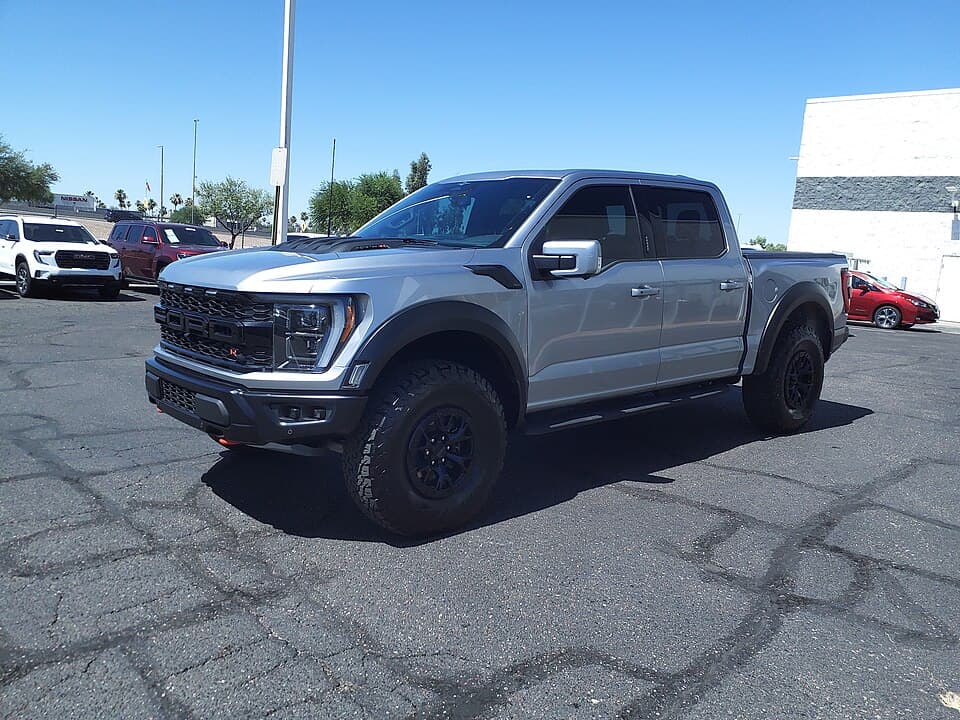
A used F-150 Raptor R is still a truck built to be driven hard, and most of the R-specific failure points do not show up on a normal pre-purchase inspection. Check the supercharger belt, the rear tire wear pattern, and a hot-soak test drive before you check anything a regular F-150 inspection would catch. These trucks have not been out long enough to have a long failure history, but they have been out long enough that the early ones are now off original warranty math, and that changes the price you should pay.
Which model years exist and what actually changed
The Raptor R launched for 2023 with a supercharged 5.2L V8 (a 2.65L Eaton TVS blower) rated at 700 hp and 640 lb-ft, backed by the 10R80 10-speed automatic. For 2024, Ford revised the calibration and intake path and bumped the rating to 720 hp. The mechanical hardware, the blower, and the drivetrain are the same across both years; the difference is tuning and induction, not a different engine. We cover the details of what changed and why in the Raptor R engine breakdown.
We are not going to guess at what changes for 2025 or later beyond what is verifiable. If you are looking at a newer model year, confirm the exact rated output and any running changes with the build sheet or the dealer, and cross-check it against that same engine article before you pay a premium for "the newer one."
What they actually sell for right now
Live market data on this site currently shows 2023 Raptor Rs averaging around $102,000, 2024s averaging around $115,500, and 2025s averaging around $127,700. These are broad averages across a wide spread of mileage, options, and condition, not a target price for any single truck. A well-optioned, low-mile 2023 can trade above a rough 2024, and a modded truck can trade either direction depending on what was done to it. Use the averages to sanity-check an asking price, not to negotiate a specific truck down to a specific number.
For context, a comparable non-R Gen 3 Raptor is running tens of thousands less across the same years, which is the real-world version of the question answered in Raptor vs Raptor R: what the extra money actually buys. If a used R and a loaded Gen 3 are within a few thousand dollars of each other, that is not a coincidence, that is the market telling you dealers are still asking launch-era markup on some of these.
Dealer markup history and why asking prices are still all over the map
The Raptor R launched into a market where dealers were adding five-figure market adjustments on top of sticker, and some markets never fully corrected. That history is still visible in used pricing today: two trucks with near-identical mileage and options can be several thousand dollars apart, and the spread swings by region and by how anchored the seller is to what the original buyer paid over sticker. When you are shopping, ask for the original window sticker or build sheet if the seller has it. A truck that started at a huge markup is not automatically overpriced now, but it tells you the seller (or the dealer reselling it) may be anchored to a number that has nothing to do with current market data.
The R-specific inspection list
A generic used-truck inspection misses almost everything that actually matters on this drivetrain. Here is what to check, in the order to check it.
Supercharger belt condition and chirp
Start the truck cold and listen for a chirp or squeal from the front of the engine in the first few seconds, before the belt tensioner settles. A chirp that goes away almost immediately is common and usually not a concern; a chirp that persists, or that comes back under load, points to a glazed belt or a tensioner going out of spec. Ask when the belt was last inspected or replaced. Ford's scheduled maintenance calls for a visual inspection of the accessory drive belt at normal service intervals, but we are not aware of a published fixed replacement mileage specific to the supercharger belt on this engine. Treat "I don't know" as a reason to budget for a belt at some point, not as a dealbreaker by itself.
Heat soak on a hot test drive
This is the check most PPIs skip entirely. Drive the truck hard enough to get the supercharger and intercooler heat-soaked (a few minutes of sustained higher RPM, not just idling in the lot), then bring it back to idle and watch for a rough idle, a pull-back in power, or any warning light. A truck that feels strong cold but goes soft or throws a code after it is fully warmed up is telling you something a 10-minute test drive around the block will never show you. If the seller will not let you drive it long enough to get it hot, that is worth noting on its own.
Rear tire wear pattern
At 700-720 hp and roughly 6,000 lb curb weight, the rear tires take abuse fast, and the wear pattern tells you how the truck was actually driven. Even wear across both rear tires with normal tread depth for the mileage is a good sign. Cupping, feathering, or one tire noticeably more worn than the other suggests aggressive launches, wheel hop, or an alignment nobody bothered to fix. Rear tires that look brand new on a truck with meaningful mileage are not automatically a good sign either; ask when they were replaced and why.
Driveline clunk and Watts-link noise
Put the truck in reverse, then drive, and listen for a clunk on the takeup. Do this a few times at low speed with a passenger listening from outside if you can. A clunk here can be a worn Watts-link bushing (the link that locates the rear axle side-to-side), a U-joint, or driveline slop from repeated hard launches. None of this is unique to the Raptor R, but the R sees more launches and more torque through the same rear end than a base Raptor, so check it every time.
Front brake condition
Stopping a 6,000-lb, 700-plus-hp truck from real speed repeatedly is hard on the front brakes. Pull a wheel if the seller allows it, or at minimum look through the wheel with a flashlight at rotor thickness and pad material. Warped rotors show up as a pulsation under braking on the test drive; do not dismiss it as "just needs a resurface" without pricing the actual parts, because on this truck it is a bigger caliper and rotor than a standard F-150's.
Warranty math on a used one
Ford's powertrain warranty on these is 5 years/60,000 miles, and the bumper-to-bumper is 3 years/36,000 miles, same structure as the rest of the F-150 lineup. On a used 2023 with 25,000-30,000 miles, you likely have a meaningful chunk of the 5/60 powertrain window left, which matters a great deal given what a supercharger or transmission repair costs out of pocket. On a 2023 with 40,000+ miles put on hard, you may be within a year of the powertrain clock running out entirely.
Do not guess. Pull the VIN and call a Ford dealer to get the actual in-service date and remaining coverage before you finalize a price; coverage varies by original in-service date, not just model year. If the truck is close to the edge of its powertrain warranty, price an extended service plan into your offer. Budget roughly $2,000-4,000 as an estimate for a reasonable ESP term, and confirm the actual number and coverage level with the provider, since it swings by term length and deductible. Treat that estimate as a negotiating point with the seller, not a reason to walk. For the fuller math on what one of these costs to keep on the road, see what a Raptor R actually costs to own.
Modded examples: pulley and tune trucks
You will run into used Raptor Rs with a smaller supercharger pulley, a tune, or both. A pulley swap spins the blower faster and raises boost, which raises cylinder pressure and heat load on a factory-calibrated engine, and it is a real risk multiplier if it was paired with a low-quality tune or run on pump gas it was not built for. Some owners run a tune package like the 5 Star Tuning Custom Tune Package conservatively and responsibly; others chase numbers and cook a motor. You cannot tell which one you are looking at from a listing photo.
If a truck has a pulley or tune, ask directly: what pulley size, what tune provider, what octane it was run on, and whether there is a dyno sheet or tuning log. A seller who cannot answer any of that, or who describes the mod but has no documentation, is a bigger red flag than the mod itself.
A full blower swap, meaning a different supercharger housing entirely rather than just a smaller pulley on the factory unit, is a different animal from a pulley-and-tune combo, and it usually means the buyer went in with a real budget and eyes open. Our mod database lists a full supercharger upgrade in this category; treat the exact displacement and generation numbers on any listing as something to confirm with the manufacturer rather than take on faith, since aftermarket blower specs and revisions for this platform are not something we are going to state as settled fact here. Either way, ask whether the original factory supercharger was kept, since that affects resale and any warranty conversation. Also confirm in writing what modifying the supercharger does to remaining factory or ESP coverage; altering forced induction hardware is exactly the kind of change that can get a related claim denied.
If you are cross-shopping against the truck's direct competition before you commit six figures, the honest comparison against the Ram TRX and Ram 1500 RHO is worth reading before you sign anything.
The short version
- Confirm the model year's real rated output (700 hp for 2023, 720 hp from 2024) against the Raptor R engine article, not a listing description.
- Do the checks a normal PPI skips: cold-start belt chirp, a genuinely hot test drive, rear tire wear pattern, driveline clunk in reverse-to-drive, and front brake condition.
- Pull the VIN and call Ford for actual remaining 3/36 and 5/60 coverage; do not assume from model year.
- Compare the asking price against the live averages (roughly $102k for 2023, $115.5k for 2024, $127.7k for 2025) and expect real spread from leftover launch-era markup.
- Any pulley, tune, or blower swap should come with documentation. No documentation, no premium, and price in the ESP if the powertrain clock is close to running out.
Owner questions
- Raptor R for sale near me
- Before buying one locally, check live averages: 2023 Raptor Rs run around $102,000, 2024s around $115,500, and 2025s around $127,700. These are broad averages, not target prices, so a well-optioned 2023 can trade above a rough 2024. Also inspect the supercharger belt, rear tire wear, and do a hot-soak test drive before finalizing any local listing.
- What's the difference between the 2023 and 2024 Raptor R engines?
- Both years use the same supercharged 5.2L V8 with a 2.65L Eaton TVS blower and the 10R80 10-speed automatic. The 2023 is rated at 700 hp and 640 lb-ft; for 2024, Ford revised calibration and intake path and bumped output to 720 hp. The hardware and drivetrain are identical—only tuning and induction changed.
- What should I check before buying a used Raptor R?
- Check five R-specific items a normal PPI misses: cold-start supercharger belt chirp, a genuinely hot test drive to check for rough idle or power pull-back after heat soak, rear tire wear pattern for cupping or uneven wear, driveline clunk in reverse-to-drive from a worn Watts-link bushing or U-joint, and front brake rotor/pad condition given the truck's 6,000-lb weight and 700-720 hp.
- How much does a used Raptor R cost right now?
- Live market data shows 2023 Raptor Rs averaging around $102,000, 2024s averaging around $115,500, and 2025s averaging around $127,700. These are broad averages across mileage, options, and condition, not target prices for a specific truck. Expect several-thousand-dollar spreads between near-identical trucks due to leftover launch-era dealer markups that never fully corrected in some markets.
- What warranty coverage does a used Raptor R still have?
- Ford's powertrain warranty is 5 years/60,000 miles, and bumper-to-bumper is 3 years/36,000 miles, same as the rest of the F-150 lineup. A used 2023 with 25,000-30,000 miles likely has meaningful powertrain coverage left, while a 2023 with 40,000+ hard miles may be within a year of the 5/60 window running out—pull the VIN and call Ford to confirm the actual in-service date.
Deal alert
Shopping for one? Get new listings first
We sweep US dealer inventory and send you new Raptors matching your search — real listings, real asking prices, no spam.