Raptor R vs RAM TRX vs Ram 1500 RHO: The Honest Verdict
One of these three is being discontinued, one is down two cylinders and a supercharger, and one still wins on the trail regardless. We drove all three back to back on the same desert loop to settle it.
Gear in this article
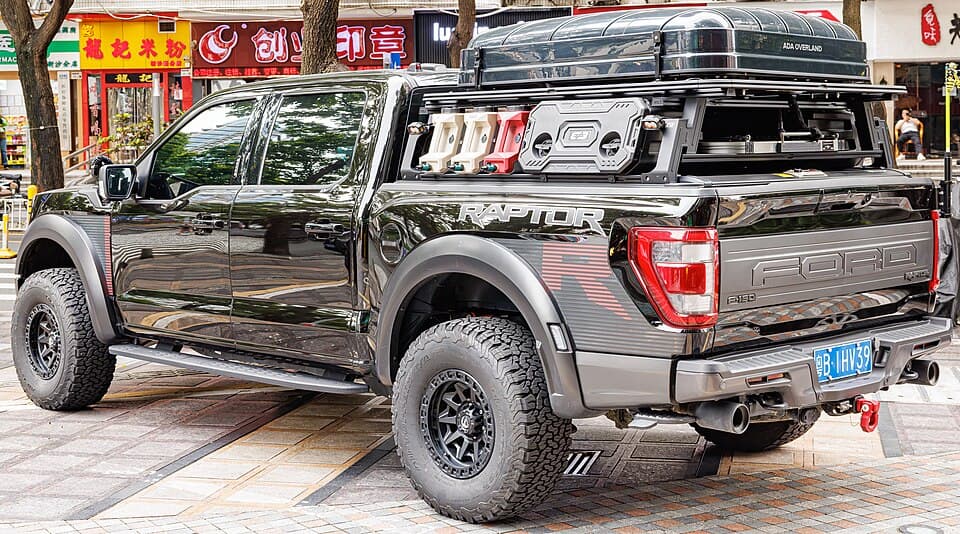
The Raptor R wins this comparison, but not because it is the most powerful. It wins because it is the only one of the three still being built, which means it is the only one with a warranty, a parts pipeline and a dealer network that will still answer the phone in three years. The Ram 1500 TRX is dead, discontinued after the 2024 model year, and the Ram 1500 RHO that replaced it is a genuinely good truck that gave up two cylinders and a supercharger to get there. We ran all three back to back on the same desert loop, and the story is less about which one is fastest and more about which one you can actually own.
What each truck actually is
All three start from the same idea: a factory-lifted, wide-track half-ton with real suspension travel and a tire that does not need a lift kit. How they get there is different enough to change how they drive.
The Raptor R carries the 5.2-liter supercharged Predator V8 out of the old GT500, fed by a 2.65-liter Eaton TVS (twin vortices series, a roots-type supercharger design), making 720 hp and 640 lb-ft on 2024-and-later trucks (2023 trucks are 700 hp, a detail sellers routinely blur). That is good for a tested 0-60 of roughly 3.6-3.9 seconds, the quickest of any Raptor by a wide margin. It runs the 10R80 ten-speed automatic, a five-link coil rear with a 24-inch Watt's link (a lateral link that keeps the axle centered under articulation), and Fox 3.1 Live Valve shocks tuned specifically for the R. It ships on 37x12.50R17 BFGoodrich KO2s standard, which no other truck in this class does from the factory.
The Ram TRX used the 6.2-liter supercharged Hellcat V8, rated at 702 hp and 650 lb-ft, backed by an 8-speed automatic. Ram built it on 35-inch tires with an adaptive damper system tuned for high-speed desert running, and it was, on paper, the most powerful stock half-ton pickup ever sold.
The Ram 1500 RHO replaced it starting with the 2025 model year, and the change is the whole story: a 3.0-liter twin-turbo Hurricane inline-6 in its High-Output tune, making 540 hp and 521 lb-ft, through an 8-speed automatic, on a monotube shock setup and a smaller standard tire than either V8 truck. Down roughly 160 hp from the TRX and two cylinders lighter, and cheaper for it.
| Truck | Engine / Output | Transmission | Standard tire |
|---|---|---|---|
| Raptor R | 5.2L S/C V8, 720 hp / 640 lb-ft | 10R80 10-speed auto | 37x12.50R17 KO2 |
| Ram TRX (discontinued) | 6.2L S/C V8, 702 hp / 650 lb-ft | 8-speed automatic | 35" tire |
| Ram 1500 RHO | 3.0L twin-turbo I6, 540 hp / 521 lb-ft | 8-speed automatic | 33" tire |
One of these is discontinued, and that matters more than the spec sheet
Ram ended TRX production after the 2024 model year. That single fact changes three things for anyone shopping one used.
Parts. The Hellcat-based V8 shares plenty with other Stellantis performance applications, so consumables are not disappearing tomorrow. But TRX-specific pieces, the adaptive shocks, the TRX-only trim and bodywork, get thinner every year with no new production run behind them.
Resale. A discontinued performance truck goes one of two ways: collector premium or orphan discount. Right now TRX values are soft relative to a new-generation truck with a warranty in front of it, because buyers are pricing in the parts and support risk above. That could flip if TRX becomes a cult truck the way the Gen 1 Raptor did, but that is a bet, not a fact.
Dealer support. Ram dealers will still service a TRX, but the technicians who trained on it move on and the special tools get reallocated. A truck that needs the supercharger snout apart is now waiting on a tech who has done three of these instead of thirty. The Raptor R and RHO do not have this problem, because both are current production with active dealer training behind them.
If you already own a TRX, none of this means sell it tomorrow. It means budget for parts lead time and find a shop, independent or dealer, that still wants the work.
How they actually feel: road, desert, rock
On the highway
The Raptor R and TRX both feel like what they are: a lot of supercharged V8 in a chassis built to control it, not hide it. Both ride firm at highway speed compared to a base Gen 3 Raptor on 35s, because the wider front track and stiffer anti-roll bar that make them plant in the dirt cost some compliance on pavement. The RHO, on a smaller tire and a lighter turbo-six front end, rides noticeably calmer over expansion joints and rain grooves. If your truck spends most of its life on I-15 between trailheads, the RHO is the easier daily.
In the whoops and open desert
This is where the V8s pull away, and it is not close. Both the Raptor R and TRX have the low-end torque to keep the nose up and the chassis settled through a whoop section without constantly downshifting to find boost. The Raptor R's Fox Live Valve shocks read the terrain and adjust damping in real time, and on a fast desert loop the truck stays composed at speeds where the RHO's turbo-six is still spooling and the driver is working the throttle to keep momentum. The TRX, in its final form, matched the Raptor R closely here, which is exactly why Ford building the R was necessary in the first place. The RHO is genuinely capable and rides well for what it is, but it is chasing, not matching, the two V8s at speed in open sand like the dunes at Glamis or the wash sections at Ocotillo Wells.
On rock and technical trail
None of these three is a rock crawler and none of the owners cross-shopping them should expect one to be. Approach and departure angles matter more here than horsepower, and the Raptor R's 33.1-degree approach and 13.1 inches of ground clearance on the standard 37s give it a real edge over both Ram trucks in tight, technical terrain. The TRX and RHO are wider and sit slightly lower on their stock tires. All three will get uncomfortable on anything approaching what a built rig runs at Moab or the Rubicon-adjacent trails around Barrett Lake and Wentworth Springs. This class of truck is a desert-runner and a highway commuter first.
Running costs, compared honestly
Fuel economy tells the real story of what each engine is doing. The Raptor R is EPA rated at 12 mpg combined, and that number gets worse fast in sand or under repeated full-throttle runs, where heat soak (the supercharger's air charge heating up on back-to-back pulls until the computer pulls timing to protect the engine) starts costing real power, a known issue on every Predator-powered R. The TRX, in the same displacement and boost neighborhood, ran similarly thirsty in real-world use, commonly in the 10 to 13 mpg range depending on how it was driven. The RHO's turbo-six should land meaningfully ahead of both V8s on fuel economy given the smaller displacement and lighter front end, but pin the exact combined figure to the current window sticker for your specific trim rather than trusting a number here, since RHO trim levels and gearing options move that figure around.
Tire wear is a wash between the Raptor R and TRX, both eating a set of 35s or 37s in the 20,000 to 25,000 mile range under normal use, faster if wheelspin is part of the daily routine. Front brake pads on the Raptor R commonly need attention in the 18,000 to 25,000 mile window on trucks driven the way people drive these; expect similar wear on the TRX given comparable weight and power.
Warranty coverage matters more with this trio than with almost any other truck comparison, because two of the three are pushing engines at the edge of what a factory warranty is designed to cover. Both Ford and Stellantis back new trucks with a powertrain limited warranty, but coverage on a specific used truck depends on in-service date and prior owner history, so get the VIN-specific remaining coverage from the dealer rather than assuming. A TRX bought used with high mileage may have very little powertrain coverage left, and that is real money against a supercharged V8.
For a deeper look at what the R specifically costs to keep on the road past the purchase price, see what a Raptor R actually costs to own, not just to buy. Owners cross-shopping model years should also check the best Ford Raptor year to buy in 2026 before deciding between a new R and a lightly used Gen 3.
The short version
- Raptor R wins on ownership, not just performance: it is in production, backed by a full dealer network, and the only one of the three you can order new today.
- The TRX is discontinued after the 2024 model year. It is not a bad truck to own used, but budget for thinner parts availability and softer resale until the market decides whether it is an orphan or a future collectible.
- The RHO is the honest daily: quieter, more efficient, easier to live with on pavement, and clearly behind both V8s the moment the terrain opens up and speed matters.
- If desert speed is the priority, buy the V8. If day-to-day livability with real off-road capability is the priority, the RHO is the smarter money.
Deal alert
Shopping for one? Get new listings first
We sweep US dealer inventory and send you new Raptors matching your search — real listings, real asking prices, no spam.