Running Johnson Valley in a Raptor: What to Know Before You Go
The open desert, sand washes, and dry lake beds are stock Raptor territory, but the Hammers canyons that made this place famous are built for buggies on 40s, not full-size trucks. Here is where a factory truck fits, where it does not, and what the Marine Corps shared-use closures mean for your trip.
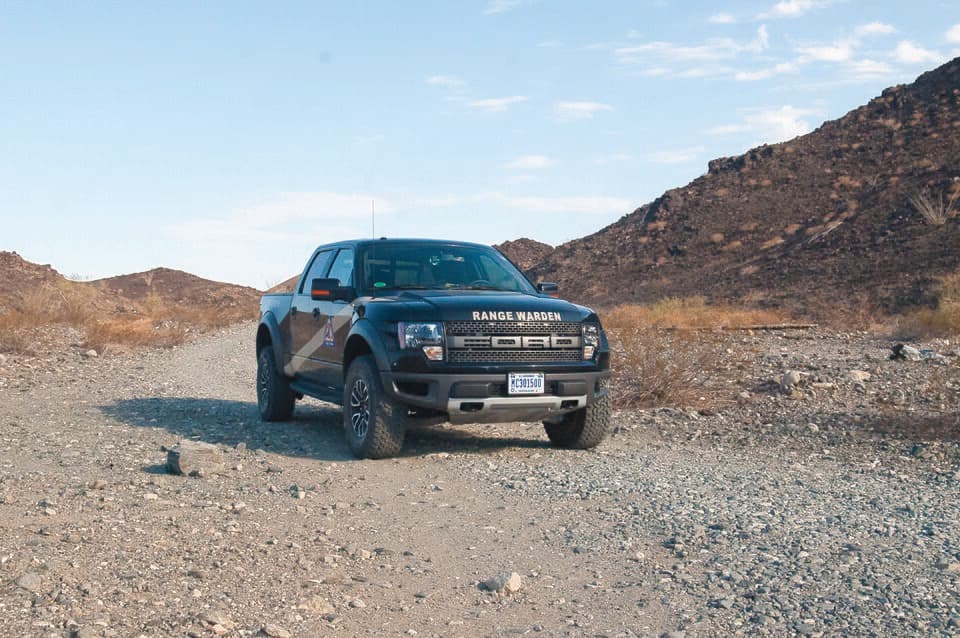
A stock Raptor handles Johnson Valley just fine, as long as you stay out of the Hammers. Johnson Valley OHV Area, outside Lucerne Valley, California, is roughly 96,000 acres of open BLM desert, dry lake beds, sand washes, and rolling hills, plus a shared-use area next door that the Marine Corps closes off for training a couple times a year. It is the largest OHV area in the country and the home of King of the Hammers, but the race course and the general riding area are two very different things. The open desert and the lake beds are Raptor territory. The rock-crawling canyons that made the place famous on TV are not, and a stock truck has no business in them.
What Johnson Valley actually is
Johnson Valley sits east of Lucerne Valley in San Bernardino County, bordering the Marine Corps Air Ground Combat Center at Twentynine Palms. The BLM manages the open riding area, and it is free to use with no permit required for casual recreation. Sources differ slightly on exactly how the roughly 96,000 acres split between fully open land and the adjacent shared-use area the Marines share with the public, so treat any precise acreage breakdown as an estimate and check the BLM's Johnson Valley page before you plan around it.
See our Johnson Valley OHV Area location page for the quick-reference version of all this: air-down pressure, season, and permit status in one place.
The shared-use portion is the wrinkle. The Marine Corps runs at least two training exercises a year, typically one in February and one later in the year, and the shared-use area closes to the public for the days around each one. The closure dates move year to year and get published on the base's own release schedule, so pull the current calendar before you plan a trip anywhere near the boundary rather than trusting a date you read somewhere else.
King of the Hammers happens in early February at Means Dry Lake, the southern entrance to the OHV area. For one week the lake bed turns into a temporary city of RVs, race trucks, and vendor rows, and the roads in and out are a parking lot. Outside race week the same lake bed is just open desert, and that is a real difference for anyone planning a normal weekend trip.
Where a stock Raptor fits and where it does not
The bulk of Johnson Valley is exactly what a factory Raptor was built for: open desert two-tracks, whooped-out sand washes, graded roads out of Hammertown, and the dry lake beds themselves. None of that asks anything of the truck beyond airing down and picking a sane speed for the terrain in front of you. This is the same category of running as Stoddard Valley OHV Area closer to Barstow, just bigger and closer to the Hammers name recognition.
The named Hammers trails, Sledgehammer, Jackhammer, Backdoor, Chocolate Thunder, and the rest of that canyon network, are a different sport. Those lines were cut for four-link buggies on 40s with a wheelbase half the length of a Raptor's, running low range at walking speed over boulder stacks that would tear the front bumper off a stock truck in the first quarter mile. A stock Raptor does not belong on any of them, and neither does a modified one without real rock armor and a lot more ground clearance than 12 inches. If you came here wondering whether your Raptor can run the actual King of the Hammers race course, the honest answer is no, and that is true of most built trucks too. The desert washes and dry lake beds are the Raptor's lane; the rock canyons are for a completely different vehicle.
We covered this same split in more detail for a different park in Can a Stock Raptor Run Moab?. The pattern repeats here: horsepower and suspension travel handle whoops and washboard, but they do not solve a trail that was built for a narrower, shorter vehicle.
Tire pressure and recovery basics
Air down before you leave the pavement. 15-18 psi is the range that works for most stock Raptors on the mix of sand and hardpack in the open riding area, and it is the same range the site recommends for Johnson Valley's terrain generally. Lower pressure widens the contact patch in soft sand and softens the ride over washboard, both of which matter more here than raw power does.
Carry real recovery gear even on an easy run. A kinetic recovery rope, a set of traction boards, and a way to air back up before you hit pavement again are the baseline. Cell coverage is spotty to nonexistent through most of the valley, so tell someone your route and your return time before you leave, and do not assume a call for help is an option if something breaks. If you are building toward tougher terrain and want a winch on the truck before you outgrow the easy trails, our breakdown of the best winch for a Raptor that actually fits covers what actually bolts up without cutting the bumper.
If you run with a group anywhere near the rockier fringes of the riding area, use a spotter outside the vehicle for anything you have not driven before. It costs nothing and it is the difference between a scraped skid plate and a bent control arm.
Tires, gearing, and whether you need 37s
Factory 35s are enough for everything a stock Raptor should be doing at Johnson Valley. The open desert and lake beds do not reward bigger tires the way rock crawling does, and stepping up to 37s mostly buys you clearance and confidence you will not use out here. If you are chasing 37s for a different reason, whether that is towing, looks, or a future trip somewhere rockier, our 35s vs 37s tradeoff breakdown covers the real gearing, speedometer, and warranty tradeoffs before you spend the money.
Stock gearing and the factory transfer case handle everything in the open riding area in 4-High. You will not need 4-Low or a locked rear differential for sand washes and graded roads. Save that mode for soft sand where you are working for traction, not for terrain you can drive normally.
When to go and what to bring
The best window is October through April. Summer in the Mojave is genuinely dangerous, not just uncomfortable: triple-digit heat on a truck sitting in low range, or a person on foot after a breakdown, is a real emergency, not an inconvenience. If you are set on a summer trip, go early morning only and be off the trail before midday.
There are no services in the riding area itself. No gas, no water, no cell signal you can count on. Bring everything you need for the day, plus a margin: extra water beyond what feels necessary, a full-size spare or a plug kit and a compressor, and enough fuel to cover more miles than you planned, because desert navigation eats more mileage than the map suggests. Camping is allowed on BLM land throughout the open area outside of any posted closures, and it is free, but you are on your own for everything from firewood to trash pack-out.
Follow standard BLM tread-lightly rules: stay on existing roads and washes, do not cut new lines across untouched desert, and pack out what you bring in. The desert crust here takes decades to recover from a single set of tire tracks in the wrong place, and it is also how the BLM decides whether an open area like this one stays open.
The short version
- Johnson Valley OHV Area is roughly 96,000 acres of free, permit-free BLM desert outside Lucerne Valley, California, plus a shared-use area next to the Marine Corps base that closes for training windows a few times a year.
- A stock Raptor is fully capable of the open desert, sand washes, graded roads, and dry lake beds that make up most of the riding area.
- The named Hammers trails are rock-crawling terrain for short-wheelbase buggies on 40s, not for any Raptor, stock or built.
- King of the Hammers runs in early February at Means Dry Lake and turns the area into a temporary city for a week; the rest of the year the same ground is open riding.
- Best season is October through April. Bring your own fuel, water, and recovery gear, since there are no services and cell coverage is unreliable through most of the valley.
Owner questions
- Best off-road trails at Johnson Valley OHV
- The open desert two-tracks, whooped-out sand washes, graded roads out of Hammertown, and the dry lake beds are best for a stock Raptor, needing only airing down and sane speeds. Avoid the named Hammers trails like Sledgehammer, Jackhammer, Backdoor, and Chocolate Thunder, which are rock-crawling terrain cut for short-wheelbase buggies on 40s, not Raptors.
- Can a stock Raptor run the Hammers trails at Johnson Valley?
- No. The Hammers trails were cut for four-link buggies on 40s with a wheelbase half a Raptor's length, running low range over boulder stacks that would tear the front bumper off a stock truck in the first quarter mile. Even a modified Raptor without real rock armor and more than 12 inches of clearance doesn't belong there.
- What tire pressure should I run at Johnson Valley?
- Air down to 15-18 psi, which is the range that works for most stock Raptors on the sand and hardpack mix in the open riding area. Lower pressure widens the contact patch in soft sand and softens the ride over washboard, mattering more here than raw horsepower on Johnson Valley's roughly 96,000 acres of terrain.
- When is the best time of year to visit Johnson Valley OHV Area?
- October through April is the best window. Summer in the Mojave is genuinely dangerous, since triple-digit heat on a truck stuck in low range, or a person on foot after a breakdown, is a real emergency. If you must go in summer, go early morning only and be off the trail before midday.
- Do I need 37-inch tires for Johnson Valley?
- No, factory 35s are enough for everything a stock Raptor should be doing at Johnson Valley's open desert and lake beds. That terrain doesn't reward bigger tires the way rock crawling does, so stepping up to 37s mostly buys clearance and confidence you won't actually use out here.
Deal alert
Shopping for one? Get new listings first
We sweep US dealer inventory and send you new Raptors matching your search — real listings, real asking prices, no spam.