Can a Stock Raptor Run Moab?
Hell's Revenge and Poison Spider do not require lockers or 37s the way forum lore suggests, but two obstacles will humble a stock Gen 3. We ran the full loop bone stock to find out exactly where it struggles.
Gear in this article
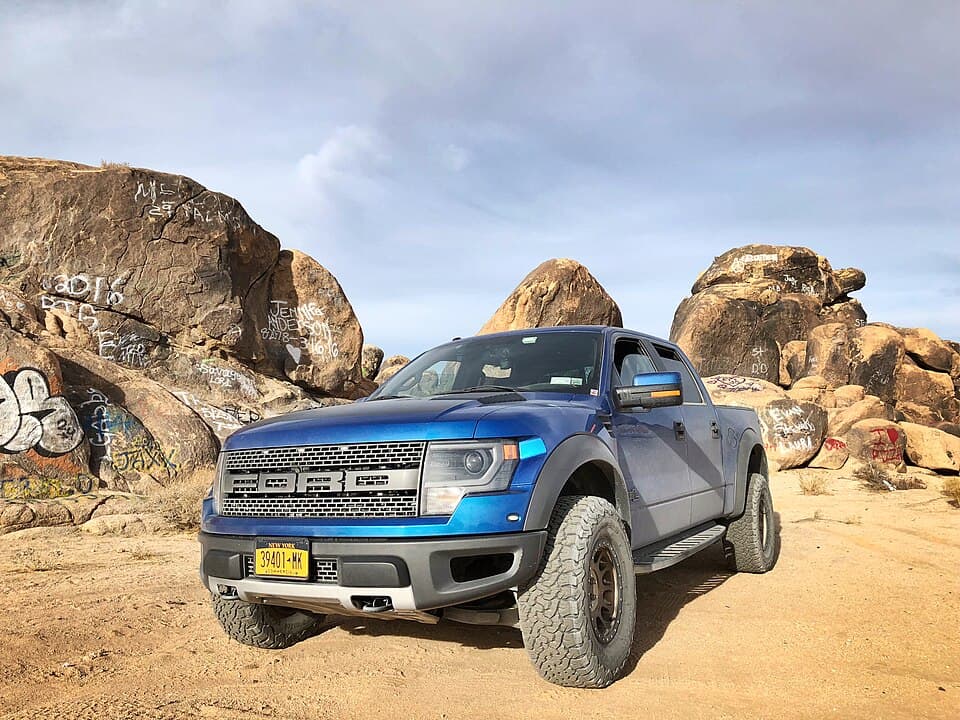
A stock Gen 3 F-150 Raptor on its factory 35-inch tires clears the bypass lines on both Hell's Revenge and Poison Spider without a locker upgrade or a tire swap. It does not need 37s and it does not need anything beyond the factory Torsen front limited-slip and electronic locking rear. Where it struggles is two spots: a narrow rock-fin crossing partway through Hell's Revenge, and a stepped ledge climb on Poison Spider that guide outfits do not even agree on a name for. Both have marked bypasses built for exactly this reason. We ran the loop in a bone-stock Gen 3 SuperCrew on the standard 35" BFGoodrich KO2s to see where the truck actually gives up.
Which trails a stock Raptor actually clears
Hell's Revenge and Fins & Things are doable in a full-size truck on stock 35s if you get out and look at every ledge before you commit to it. Poison Spider, Top of the World, and Gemini Bridges are fine as long as you take the marked bypasses instead of the exposure lines built for short-wheelbase Jeeps. None of this requires a front locker, a lift, or 37s.
Pritchett Canyon and the tightest slots on Hell's Revenge are a different conversation. A stock Raptor, or a modified one, does not belong there. The recovery bill for a stuck or hung-up full-size truck on that terrain is real money, and those lines were never cut with a full-size half-ton in mind. If you want the version of this trip that fits inside factory warranty and factory sheet metal, cross that trail off the list.
Where a stock truck actually stops
Somewhere on Hell's Revenge the trail pinches into a rock crack narrow enough that the Jeep crowd photographs it and the full-size crowd should not attempt it. Ask five guide services what to call it and you get five different names depending on which map they learned the trail from, so we are not going to hang this piece on a proper noun we can't confirm across every guidebook. What we can tell you from running it: the direct line does not fit a stock Raptor at any tire pressure, and the marked bypass exists precisely because full-size trucks keep trying it anyway. Take the bypass.
Poison Spider has its own version, a steep stepped rock climb, sometimes marked as the Waterfall on trail maps, sometimes labeled something else depending on the source. Whatever the sign says, it rewards a short wheelbase and a narrow track, and it punishes anything wider than a Jeep by hanging the frame rails between the steps. The bypass around it is well marked and every commercial guide running this loop uses it instead. Skip the direct line in a stock Raptor. It is a geometry problem, not something you air down your way through.
Why width and wheelbase beat power and travel here
Moab's slickrock was cut by decades of Jeep traffic, and the ledges and step-ups reflect that. A stock Gen 3 has 450 hp, 12.0 inches of ground clearance on 35s, and a Fox 3.1 Live Valve suspension that soaks up washboard better than anything Ford has put under a half-ton before it (see the Gen 3 F-150 Raptor specs for the full rundown). None of that helps at the two spots above.
The Raptor is a full-size truck, noticeably wider across the body and longer between the axles than a Wrangler Rubicon. That gap matters more than any spec sheet number: a crack a Jeep splits with room on both sides is a genuine squeeze for a Raptor, and the long wheelbase means an approach or departure angle that looks fine on paper still puts the frame rails or a bumper corner into contact on a step a short-wheelbase rig clears without touching. Horsepower and suspension travel solve washboard, whoops, and sand. They do not solve a trail that is simply too narrow for the truck.
Tire pressure, gearing, and what the locker actually does
Air down to 15-20 psi before you touch the slickrock, the same range this site recommends for the mixed sand and slickrock at Sand Hollow. Lower pressure widens the contact patch and lets the tire conform to the rock instead of skating across it, and that does more for traction on Moab's sandstone than anything else you control from the driver's seat.
The stock 4.10 gears and the 10R80 ten-speed are fine for this terrain in Low range, first or second gear, walking the truck up a ledge on throttle rather than powering into it. Rock Crawl mode, standard on every Gen 3, holds gears low and softens the throttle map so you are not lurching into obstacles.
The electronic locking rear differential locks the rear axle together so both rear tires turn at the same speed regardless of traction, which matters the moment one rear tire lifts off a ledge. It does nothing for the front axle, which stays open unless the Torsen limited-slip is already biasing torque toward the tire with grip. On slickrock, where traction is usually good everywhere and the problem is geometry rather than slip, the locker matters less than forum threads suggest. Tire pressure and a spotter are doing more work than the rear diff.
The damage risk on a stock truck
Rocker panels are the first thing to touch on any ledge crossing that goes slightly wrong, and a stock Raptor has nothing down there but sheet metal and a plastic rocker molding. Running boards, where equipped, are worse. They hang lower than the rocker and are not structural. Expect to lose one, or bend it into modern art, on the first misjudged line.
The rear bumper corners are the other predictable casualty, especially backing down a ledge or dragging the departure angle on a step-down. The factory rear bumper is steel but it is styled, not armored, and the corners extend further than the frame behind them.
Underneath, the factory skid plating covers the front differential and the oil pan area but leaves the transfer case thinner than most owners assume. A hard strike on an unmarked line can crack the factory plastic pieces even where steel exists elsewhere. None of this is warranty territory. Ford's powertrain warranty does not cover trail damage, and a dealer will document a rock strike as exactly that.
The minimum armor that changes the answer
A stock Raptor clearing Hell's Revenge and Poison Spider is a truck babying every line with a spotter out the window. A truck with real underbody armor and rock sliders can commit to more of the trail without flinching, which is the honest reason to spend the money before this trip rather than after it.
| Part | Price | What it buys you |
|---|---|---|
| SVC Offroad Full Skid Plate Kit | $1,000-1,450 | Quarter-inch aluminum from the front diff to the transfer case, replacing the factory plastic |
| Rago Fabrication Bolt-On Rock Sliders | $950-1,300 | Real sliders under the rockers instead of running boards that fold on first contact |
| ADD Bomber Rear Bumper | $1,200-1,700 | A tucked rear corner that survives a ledge backdown the factory bumper will not |
Budget roughly $3,150-4,450 for all three installed, and that is before tires (shop labor varies by region, so treat this as an estimate). If you are already planning a step up to 37s for the added clearance, price that separately. Our breakdown on what 37s cost on a Gen 2 Raptor applies directionally to a Gen 3 as well, and a set of BFGoodrich KO3 37s is a reasonable target if you plan to run Moab more than once.
Permits, seasons, and going alone
Neither Hell's Revenge nor Poison Spider requires a permit for a private vehicle. Spring and fall are the seasons that matter. Summer bakes the slickrock hot enough to stress tire compound and a cooling system sitting in low range for hours, and Easter Jeep Safari week turns every trailhead into a parking lot regardless of what you are driving.
Do not run either trail alone in a stock truck. A spotter outside the vehicle is the actual traction control system on ledge terrain, not a drive mode. Go with at least one other vehicle, tell someone your route, and carry real recovery gear even though neither trail is technically remote. If you already run a winch-capable bumper, this is the one trip where a Warn Zeon 10-S earns its weight, though a stuck stock Raptor on these trails is usually a strap-and-tug problem, not a winching problem.
The short version
- A stock Gen 3 Raptor on factory 35s clears Hell's Revenge and Poison Spider using the marked bypasses. It does not need 37s or a front locker.
- Two specific spots, one on each trail, stop a stock truck outright regardless of what a guide calls them. Take the bypass every time.
- Width and wheelbase, not horsepower or suspension travel, are what a stock Raptor lacks against Moab's slickrock.
- Skid plates, rock sliders, and a real rear bumper change what you can attempt without a spotter walking every line, and they run roughly $3,150-4,450 installed as a set, before tires.
- Skip Pritchett Canyon and the tightest Hell's Revenge slots in any Raptor, stock or built. That is not a clearance problem money fixes.
Owner questions
- Can a stock Raptor handle Moab trails?
- Yes. A stock Gen 3 F-150 Raptor on factory 35-inch BFGoodrich KO2 tires clears the bypass lines on both Hell's Revenge and Poison Spider without a locker upgrade or tire swap, using only the factory Torsen front limited-slip and electronic locking rear. It struggles only at two specific spots on those trails, both of which have marked bypasses.
- What tire pressure should I run on a Raptor at Moab?
- Air down to 15-20 psi before touching the slickrock, the same range recommended for the mixed sand and slickrock at Sand Hollow. Lower pressure widens the contact patch and lets the tire conform to the rock instead of skating across it, which does more for traction on Moab's sandstone than anything else you control from the driver's seat.
- How much does armor for a Moab trip on a Raptor cost?
- Budget roughly $3,150-4,450 installed for three items: the SVC Offroad Full Skid Plate Kit ($1,000-1,450) covering the front diff to transfer case, Rago Fabrication Bolt-On Rock Sliders ($950-1,300) replacing the fold-prone running boards, and the ADD Bomber Rear Bumper ($1,200-1,700) for a tucked rear corner. That's before tires.
- Which Moab trails should a Raptor avoid entirely?
- Skip Pritchett Canyon and the tightest slots on Hell's Revenge in any Raptor, stock or modified. Those lines were never cut with a full-size half-ton in mind, and the recovery bill for a stuck or hung-up full-size truck on that terrain is real money — it's a geometry problem money can't fix, not a clearance issue.
- Does the Raptor's rear locker matter much on Moab slickrock?
- Less than forum threads suggest. The electronic locking rear differential locks both rear tires to the same speed once one lifts off a ledge, but it does nothing for the open front axle beyond the Torsen limited-slip. On slickrock, where traction is usually good but the problem is geometry, tire pressure and a spotter do more work than the rear diff.
Deal alert
Shopping for one? Get new listings first
We sweep US dealer inventory and send you new Raptors matching your search — real listings, real asking prices, no spam.