Raptor Wheels: Sizes, Offsets, and What Actually Fits
Factory sizing is 17x8.5 on a 6x135 bolt pattern across every F-150 Raptor generation, and the safe aftermarket window stays close to that. Here is the offset math, the beadlock nuance, and the 35 and 37 recipes owners actually run without rubbing or wrecking a bearing.
Gear in this article
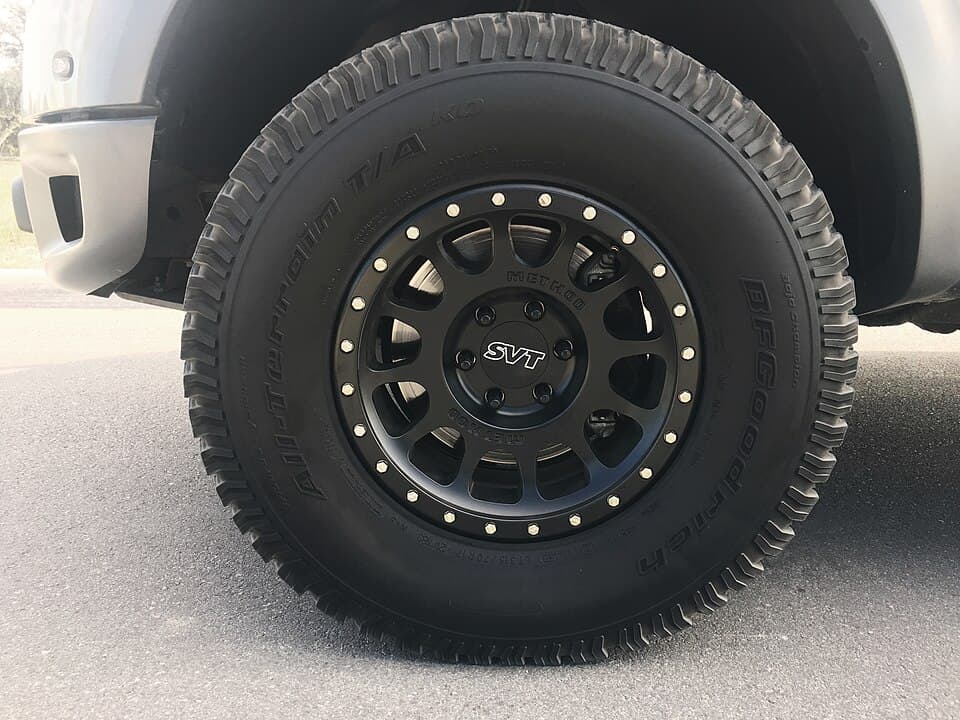
Every F-150 Raptor generation rolls off the line on a 17x8.5 wheel, 6x135 bolt pattern, factory offset around +34mm, and the Raptor R and late Gen 3 trucks add a beadlock-capable forged option in the same 17-inch diameter. The safe aftermarket window for most builds stays close to stock: 17x8.5 to 17x9, offsets from about +12mm to +34mm depending on backspacing and tire width, and anything wider or more negative than that starts eating fender liner and bearing life. The table below is the fitment cheat sheet; the rest of this covers why 17s are still correct off-road, what offset actually does to your steering and bearings, and which recipes owners actually run.
| Generation | Factory size | Bolt pattern | Offset range that fits | Max tire without rubbing |
|---|---|---|---|---|
| Gen 1 (2010-2014 SVT) | 17x8.5 | 6x135 | +12mm to +34mm | 35s with a leveling kit, 37s need a lift and trim |
| Gen 2 (2017-2020) | 17x8.5 | 6x135 | +12mm to +34mm | 35s stock-ish, 37s with a 2-3 inch lift and fender trim |
| Gen 3 (2021-present) | 17x8.5 | 6x135 | +18mm to +34mm | 37x12.50R17 fits stock on the 37 Performance Package trucks |
| Raptor R | 17x8.5, beadlock-capable option | 6x135 | +18mm to +34mm | 37x12.50R17 fits stock |
This is a general window, not a promise for every trim. Fender liner clearance, whether you have the factory Performance Pack, and your tire's sidewall profile all move the number, so check the mod database and measure your own truck before you order anything expensive.
Why 17s are still the right call off-road
A 20-inch wheel looks right in the dealer lot and is the wrong wheel the first time you hit a rock at speed. More wheel diameter means less sidewall between the rim and whatever you just hit, and sidewall is what absorbs the impact instead of transferring it straight into the bead and the barrel. A 37x12.50R17 has a taller, more flexible sidewall than a 37 mounted on a 20, since the tire gives up more of its overall diameter to the wheel to hold the same rolling circumference. That sidewall is what lets you air down to 15-18 psi for sand or rock without the tire folding off the bead, and it is why every serious desert or overland build on a Raptor lands back on a 17 no matter what trim it started life on.
Twenty-inch wheels cost you in three places: less sidewall to absorb impact, a shorter list of off-road tread options since most 35s and 37s are not built in a 20-inch bead diameter, and more unsprung mass on a truck that already runs the widest brakes in the lineup. None of that shows up on a spec sheet. It shows up on the trail, as a bent barrel or a tire you cannot find in stock.
Offset and backspacing, in one section
Offset is the distance from the wheel's true centerline to its mounting face, in millimeters. A less positive (or negative) offset pushes the wheel and tire further outboard, away from the truck. A more positive offset tucks it further inboard, closer to the suspension and brakes.
That outboard shift moves the tire's contact patch further from the steering axis, which increases scrub radius, the distance between where the tire touches the ground and where the steering axis meets the ground. A bigger scrub radius means more force working against the steering components and the wheel bearing on every turn, pothole, and hard one-side brake. A big offset change on a heavy truck is not a cosmetic call: it loads the factory bearing and tie rod ends beyond what they were sized for, and it is a real factor in premature bearing wear and heavier steering effort, not just a "feel" difference.
Backspacing is the same measurement from the other side, the distance from the wheel's mounting face to its inboard edge instead of from centerline. Shops tend to talk offset, spec sheets sometimes list backspacing, and you need both before you order a wheel, since the same offset can produce different backspacing depending on the wheel's overall width. Give the shop your exact tire size and ask them to spec the offset for your fender clearance rather than picking a number off a forum thread.
Beadlock-capable versus a true beadlock
The Raptor R and the late Gen 3 37 Performance Package trucks ship with a factory wheel Ford calls beadlock-capable: it has the bolt pattern and ring provision for a beadlock kit, but no functional beadlock ring installed from the factory. A true beadlock, like the Method Race Wheels 701, bolts an outer ring through the tire bead itself and clamps it mechanically to the wheel, which is what actually lets you air down into single digits without the tire rolling off the rim.
The street-legal nuance is real and varies by state: a true beadlock ring is not DOT-rated the way a standard wheel is, and some states treat a functional beadlock as off-road-only, while plenty of owners run them daily with no issue. Confirm your own state's rule before you commit to a true beadlock as a daily driver, since this is exactly the kind of claim that is not safe to guess at.
Weight and unsprung mass on a truck with this much travel
A Raptor carries more suspension travel than almost anything else sold with a warranty, and that travel is only as good as the suspension's ability to control the wheel and tire's mass as it moves. Every added pound at the wheel is unsprung mass, weight the shocks control directly rather than weight the springs and chassis absorb. A heavier forged wheel or a true beadlock ring adds real pounds right at the corner that matters most for ride control, and on a truck built around Fox or Live Valve dampers tuned for a specific unsprung weight, that added mass can measurably change how well the suspension tracks whoops at speed. Not a reason to avoid beadlocks or forged wheels, just a reason to weigh the actual wheel before you buy it.
TPMS and lug torque
Every Raptor generation uses direct TPMS sensors mounted in the wheel, and swapping wheels means transferring the factory sensors or buying replacements sized for the new bolt pattern and valve stem. Confirm sensor compatibility with the wheel shop before the swap, since a mismatched sensor is a dash warning light you will chase for weeks. For lug torque, do not trust a forum number, including ours: torque to the value in the current Ford workshop manual for your model year, and re-torque after the first 50-100 miles, since a wheel settling onto a new hub face is a known cause of a lug backing off if that step gets skipped.
Fitment recipes owners actually run
Two combinations show up over and over in build threads and in our own mod database: a 35x12.50R17 on a stock-offset or mildly negative wheel with a leveling kit, no fender trim on most Gen 2 and Gen 3 trucks, and a 37x12.50R17 on a 17x8.5 or 17x9 wheel with a 2-3 inch lift and some fender trim on Gen 1 and Gen 2, or no lift at all on a Gen 3 with the factory 37 Performance Package. If you are pricing the second recipe from a stock Gen 2, we broke down the real installed cost from a trim-and-tune budget build up to a full fender and suspension package. Either recipe also changes rolling diameter enough that the ECU's speedometer and shift tables need attention, a separate question from wheel fitment: see whether you actually need a tune after 37s before you assume a bigger tire alone solves anything.
What to avoid
Cheap cast wheels sized for a half-ton daily driver are not built for repeated off-road impact loading, and the failure mode is a cracked barrel, not a slow leak you catch in the driveway. If the truck sees real trail use, spend the money on a forged wheel or a reputable off-road-duty cast wheel like the Method 305 NV, not the lightest or cheapest 17-inch wheel that clears the caliper. That is the difference between a bent wheel you can still air up and drive home on and one that lets go entirely.
Cost tiers, takeoffs to forged
Factory takeoff wheels, a stock set pulled off another Raptor during an upgrade, run cheapest at roughly $600-1,200 for a set of four to five depending on condition and whether TPMS sensors are included. A quality cast off-road wheel like the Method 305 NV lands at $1,500-2,100 for a set of five, an easy install most shops handle in 2-3 hours. A true beadlock set like the Method 701 runs $2,200-3,200 installed, a moderate-difficulty 2-4 hour job with periodic outer-ring bolt torque checks afterward. Custom-order forged wheels sit at the top of the range, often well past $3,500 for a set of five depending on finish and spec, and lead time from the maker is usually the longer pole than the install itself. Budget the wheel, the TPMS sensors if not included, and mount-and-balance labor as three separate line items, since a bundled quote tends to hide which part costs what.
The short version
Stick with 17x8.5 in the 6x135 pattern unless you have a specific reason to go wider, keep offset in the +12mm to +34mm window and confirm backspacing against your exact tire before you order, and treat a true beadlock as a trail tool with a street-legal question mark rather than a default upgrade. Check the F-150 Raptor Gen 3 page and the mod database for your specific trim's factory numbers before you buy anything, since the Performance Package changes what fits stock and a forum thread guessing at your generation is how most bad wheel purchases happen in the first place.
Owner questions
- What wheel size and bolt pattern does the F-150 Raptor come with from the factory?
- Every F-150 Raptor generation rolls off the line on a 17x8.5 wheel with a 6x135 bolt pattern and a factory offset around +34mm. The Raptor R and late Gen 3 trucks add a beadlock-capable forged option in the same 17-inch diameter, but the bolt pattern and diameter stay consistent across all generations.
- What offset range is safe for aftermarket Raptor wheels?
- The safe aftermarket window for most builds runs from about +12mm to +34mm on a 17x8.5 to 17x9 wheel, depending on backspacing and tire width. Gen 3 and Raptor R trucks narrow that to +18mm to +34mm. Anything wider or more negative starts eating fender liner and bearing life.
- What's the difference between beadlock-capable and a true beadlock wheel on a Raptor?
- Beadlock-capable, which ships on the Raptor R and late Gen 3 37 Performance Package trucks, has the bolt pattern and ring provision but no functional beadlock ring installed. A true beadlock, like the Method Race Wheels 701, bolts an outer ring through the tire bead and clamps it mechanically, letting you air down into single digits without the tire rolling off the rim.
- What does it cost to put new wheels on a Raptor?
- Factory takeoff wheels run roughly $600-1,200 for a set of four to five. A quality cast off-road wheel like the Method 305 NV lands at $1,500-2,100 for a set of five. A true beadlock set like the Method 701 runs $2,200-3,200 installed, and custom-order forged wheels often run well past $3,500 for a set of five.
- Can you fit 37-inch tires on a Raptor without a lift?
- Yes, on Gen 3: a 37x12.50R17 fits stock on the 37 Performance Package trucks and on the Raptor R, both running 17x8.5 wheels. On Gen 1 and Gen 2, 37s need a 2-3 inch lift and fender trim, while 35s fit stock-ish on Gen 2 or with a leveling kit on Gen 1.
Deal alert
Shopping for one? Get new listings first
We sweep US dealer inventory and send you new Raptors matching your search — real listings, real asking prices, no spam.