Ranger Raptor Fuel: 87 or 91 Octane? What Ford and the EPA Actually Say
Ford recommends 91 octane premium for the Ranger Raptor's 3.0L twin-turbo V6, while the EPA's listing says regular. Here is what each document means, what you give up on 87, and how to read the fuel door and owner's manual for your truck.
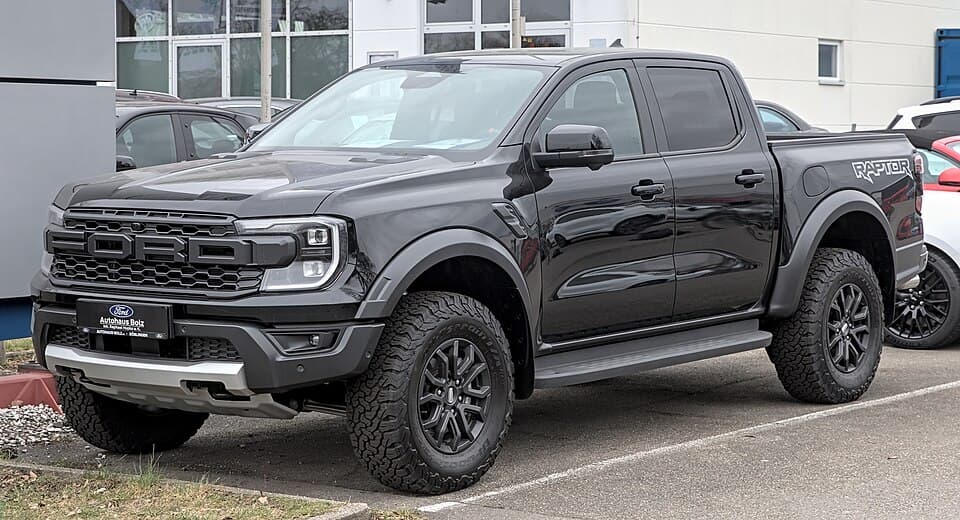
Ford says 91 octane. The EPA says regular. Both are correct, and they are answering different questions: Ford's spec sheets for the 2024, 2025 and 2026 Ranger Raptor all list 91 octane premium as the recommended fuel for the 3.0L twin-turbo EcoBoost V6. The EPA's fuel economy listings for all three model years show "Regular Gasoline" as the fuel type. Neither document is wrong. "Recommended" and "the fuel the truck is rated on" are not the same claim, and the gap between them is what this article is about.
What Ford's spec sheet actually says
Ford's own technical spec documents for the 2024, 2025 and 2026 Ranger Raptor list 91 octane as the recommended fuel across every model year the truck has been sold in the US. That is consistent across all three documents, which is rare for this truck's spec sheets. The payload figure moves around between 1,375, 1,411 and 1,373 lb depending on the year and which PDF you pull, and the front rotor size changes between the 2024 and 2025 sheets. The fuel recommendation does not move. Ford has been telling you the same thing since launch.
"Recommended" is Ford's word, not "required." That distinction matters because Ford does not publish a separate minimum-octane requirement or a warning that the engine will be damaged on 87. Compare that to some performance applications where the manual states a hard octane floor; Ford's Ranger Raptor language is recommendation language, aimed at getting the engine's advertised 405 hp and 430 lb-ft, not a hard limit below which something breaks.
What the EPA listing says, and why it is not a contradiction
The EPA's fueleconomy.gov listings for the 2024, 2025 and 2026 Ranger Raptor all show "Regular Gasoline" as the fuel type, with the same 16 city / 18 highway / 17 combined mpg rating across all three years. Read it as the grade the truck is listed to use, not as Ford's advice for getting the rated output. The EPA page does not say why it lists regular, and Ford's spec sheets do not explain the difference either, so the useful takeaway is narrow: regular is listed as usable, and Ford's own documents recommend 91.
If you only read one of these two documents, you will walk away thinking you know something you don't. Read both, and the picture is simple: the truck is engineered around 91 octane for its rated output, and it is also built to not strand you, run badly, or fail outright if 91 isn't available.
What actually happens if you run 87
Here is the honest mechanical answer. The 3.0L EcoBoost, like essentially every modern turbocharged, direct-injected engine, uses a knock sensor and the engine control unit to detect pre-ignition (knock) in real time. When the computer sees knock, it retards ignition timing and can pull back boost pressure to keep combustion in a safe range. On 87 octane, which has less resistance to knock than 91, the ECU will do this more often and more aggressively than it will on premium, particularly under load.
Ford does not publish a horsepower or torque figure for the engine running on 87 octane, so we're not going to invent one here. Nobody has published a test number for this specific application worth quoting. What we can tell you with confidence is the direction of the effect: less available timing advance and more conservative boost management under 87 generally means less peak power and a flatter, less responsive feel at full throttle, especially at higher engine loads. Whether that is a number you'd notice in daily driving around town is a different question than whether you'd notice it towing up a grade in July.
When premium actually matters
The knock-retard behavior described above is worst exactly when an engine is working hardest and running hottest: high load, high rpm, extended wide-open-throttle, and high ambient temperature. For a Ranger Raptor owner that means two real-world scenarios where the gap between 87 and 91 is most likely to show up:
- Towing near the truck's 5,510 lb max rating, especially up long grades, where the engine is at sustained high load for minutes at a time rather than a quick highway merge.
- Hot-weather, low-speed, high-load driving, like sand or technical trail work in desert heat, where intake air temps are already elevated and the turbos are working.
This is general turbocharged-engine behavior, not a number Ford has published for this specific truck. If you tow regularly or plan on running the truck in places like Glamis or Johnson Valley in summer, premium is the fuel to default to, because that is where knock control has the most work to do and the least margin to spare.
Do owners actually notice a difference on 87?
Search any Ranger Raptor forum thread on this topic and you'll find owners split down the middle. Some run 87 daily and say they can't tell. Others swear the truck feels flatter and say they won't run anything but premium. Both camps are reporting real seat-of-the-pants impressions, but neither is data. Nobody involved has run a controlled back-to-back dyno test on the same truck, same day, same conditions, swapping only fuel grade, and published the result. Treat every forum claim about "lost horsepower on 87" as an anecdote, including the confident-sounding ones with a specific number attached.
How to read your own owner's manual
The spec sheet data above is accurate for all three US model years to date, but the fuel section in your actual owner's manual for your specific build is the document that governs your truck. Pull up the digital manual for your model year, or check the fuel filler door, and look at the fuel-type language directly. Ford's spec PDFs and the 2024 Ranger Raptor, 2025 Ranger Raptor and 2026 Ranger Raptor spec pages on this site reflect the recommendation as published, but your fuel door decal and your specific owner's manual are the last word if anything looks inconsistent after a running change.
What this costs you in practice
A 20-gallon tank (20.3 gal on the 2024 spec sheet, 20 gal on 2025 and 2026) means the price difference between 87 and 91 on a fill-up is real but not large in absolute terms, generally a few dollars per tank depending on regional pricing, which varies by state and by week. Given that this truck already has one of the shorter real-world ranges in the Raptor lineup, a detail covered in our Ranger Raptor cost of ownership breakdown, the extra cost of premium is small next to the truck's other running costs.
The short version
- Ford's spec sheets recommend 91 octane for the 3.0L EcoBoost in every US model year so far. The EPA lists regular gasoline as the fuel type; that is not the same thing as Ford's performance recommendation.
- "Recommended" is not "required." Ford does not publish a minimum-octane threshold or an 87-octane output figure.
- The ECU will retard timing and manage boost more conservatively on lower octane. Expect that effect to show up most under towing load and in hot weather, not idling around town.
- Forum claims about exact power loss on 87 are anecdotes. Nobody has published a real test number for this engine.
- Check the fuel section of the owner's manual for your specific model year before you decide, and default to 91 if you tow near the 5,510 lb max or run the truck hard in heat.
Deal alert
Shopping for one? Get new listings first
We sweep US dealer inventory and send you new Raptors matching your search — real listings, real asking prices, no spam.