Bronco Raptor Accessories That Are Actually Worth It
The accessories worth real money on a Bronco Raptor add up to $1,200-2,600, and half the popular ones are not on the list. We rank what earns its keep, what the factory already covered, and what to skip.
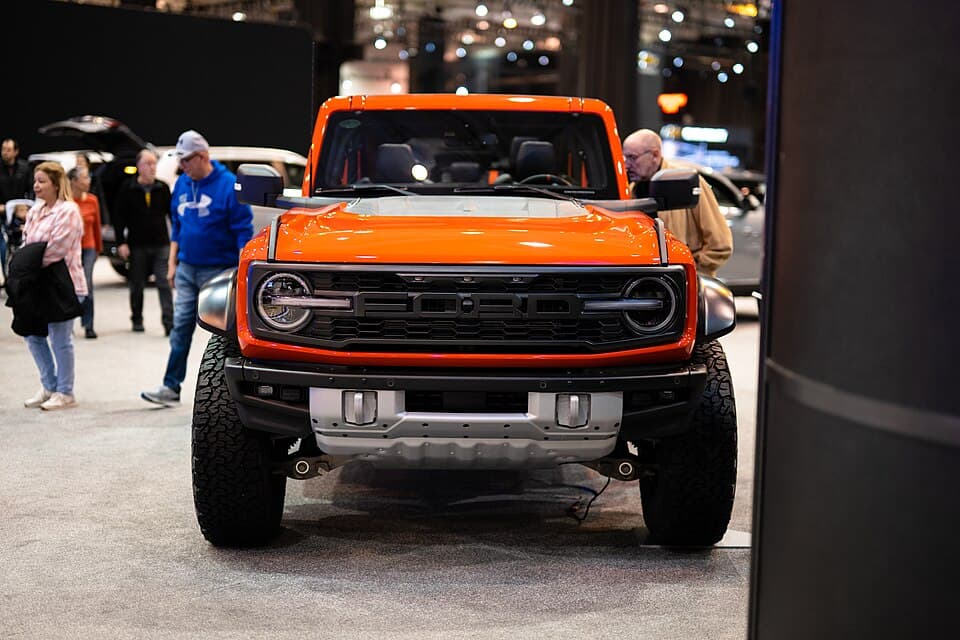
Buy rock sliders first, a real light bar or pod set second, and MOLLE door panels third. That covers the two gaps Ford actually left on this truck: no rocker protection at all and factory door nets that sag within a month. Budget roughly $1,200-2,600 for that core stack depending on brand. A sensible full build, sliders, lights, interior storage, plus fixing the factory roof rack's wind noise or swapping to a quieter rack, lands around $1,500-3,300. Skip a lift kit and skip a cheap wheel swap; both take something away from this specific truck instead of adding to it, and we get into why below.
This is a spending guide, not a parts catalog. See the Bronco Raptor's full spec rundown for the numbers behind these calls, and the full mod pricing breakdown if you want to compare categories beyond what is covered here.
Rock sliders come first, because Ford skipped them
The Bronco Raptor is 85.7 inches wide, 8.6 inches wider than a base Bronco, and it ships with no rock sliders standard, which is backwards for a truck built this wide and marketed this hard on trail capability. That is not our opinion alone; it is the same conclusion we reached comparing it against the Gen 3 F-150 Raptor, where we called sliders step one on this truck, not an accessory.
Ford does sell rock rails as a dealer-installed accessory, but that is an add-on purchase, not something that comes on the truck when you drive it off the lot. Aftermarket bolt-on sliders from the catalogs that build for the Bronco platform, sized for the Raptor's wider track, run roughly $700-1,600 in parts depending on brand and whether you are buying a slip-on tube or a full welded rocker guard. Add $200-400 if a shop bolts them on instead of you; it is a moderate job, a few hours with hand tools for the bolt-on versions, more if you are having a welded set installed. Confirm any slider you are pricing actually lists Bronco Raptor fitment and not just standard Bronco fitment before you order; the wider track and larger tires change mounting points on some kits.
This is the one purchase on this list we would not talk anyone out of. A rocker panel meets a rock at the wrong angle exactly once before you wish you had spent the money.
Skid plates: factory already covers the basics
Unlike the sliders, this is a case where Ford did its job. The Bronco Raptor leaves the factory with skid plates covering the front, the engine, the transmission and the transfer case, real underbody coverage a base Bronco does not get standard. For most owners, fire roads, washboard, and the occasional rock garden, that factory coverage is enough. Do not spend money duplicating it.
Where an upgrade earns its keep is sustained rock crawling, not the occasional trail day. The factory aluminum panels are thinner than a dedicated aftermarket kit and can dent or crack on a hard, direct hit. A thicker aluminum or steel replacement kit covering the same area runs roughly $700-1,400 in parts, plus shop labor if you are not installing it yourself. For most owners, that money is better spent on rock sliders first. A scraped skid plate did its job. A torn rocker panel did not.
The roof rack question, already answered
We already tested this on the Bronco Raptor's factory modular roof rack, so we will not re-run the argument here, just the money. The drone above roughly 55-60 mph comes from the square-edged crossbar shedding air, not a bad seal or the removable top. Pulling the front crossbar off entirely was the only fix that killed the tone outright in our test, and it costs nothing but a wrench and well under an hour. A wind deflector or edge wrap runs $20-90 and meaningfully quiets it without removing the tone above 65 mph. Swapping to a low-profile aftermarket rack solves it for good and runs roughly $650-900 in parts plus 3-5 hours of install labor, but it means giving up the factory rack's T-slot accessory system.
Whether a rack is worth it at all depends on what you are actually carrying. If you need a mounting point for a rooftop tent, a cargo box, or an awning, budget for one of the three options above and pick based on how much the noise bothers you at highway speed. If you are not putting anything up there, do not buy a rack to have one; it is drag and noise with nothing to show for it.
Spare tire carrier for a 37: situational, not automatic
The Bronco Raptor carries its spare on the tailgate, like every four-door Bronco, and a 37-inch spare is heavier than what the hinge and latch were sized around on a standard Bronco. Owners running the truck hard off-road for years, not just weekend trail days, are the ones who report real wear at the tailgate hinges and latch under a full-size 37 spare over time.
Aftermarket options exist to move that weight off the tailgate entirely, usually a rear bumper with an integrated swing-out carrier, and they are not cheap: budget $1,000 or more for the carrier alone, more with a bumper replacement and install labor. Fitment is not universal either. At least one popular carrier built for the standard Bronco, from RTR, is explicitly not compatible with the Bronco Raptor, so confirm Raptor-specific fitment before you order rather than assuming a Bronco part bolts to a Bronco Raptor.
For most owners who are not doing extended overlanding trips or desert racing, the factory tailgate mount is fine. Treat a swing-away carrier as a purchase for a specific use case, towing or trail time heavy enough to justify it, not a default add to the list.
Interior storage and MOLLE panels
The factory door pockets use fabric nets, and they sag and stretch within weeks of real use, especially with anything heavier than a water bottle in them. Steel MOLLE panels from the aftermarket brands that build for the Bronco platform replace the net directly and hold their shape, with mounting slots on the outside face for pouches, a light, or a fire extinguisher mount. Front-only sets run roughly $150-250; a full set covering front doors, rear doors, and the rear cargo window area runs closer to $300-400.
Install is bolt-in, under an hour for a set, no cutting or drilling. This is the cheapest, easiest item on this list relative to what it fixes, and it is the kind of purchase most owners make once and never think about again.
Lighting: where the money actually shows
A light pod or bar is the one accessory here that changes what the truck can do after dark, not just how it carries gear. A pair of small auxiliary pods, the entry point for most owners' first lighting upgrade, runs roughly $320-420 and mounts to a bumper or A-pillar bracket without cutting anything, an easy install in an hour or two. A 30-inch light bar runs roughly $900-1,200 installed and needs a proper mount, a relay, and a dash switch, budget that wiring alongside the bar itself rather than as an afterthought. A higher-output round pod pair, the step up from the entry pods, runs roughly $1,400-1,800 and throws distance the smaller pods do not, at a real price jump for it.
Whichever tier you pick, check your state's rules on auxiliary lighting before you wire in a permanent dash switch; most states require off-road lights to be covered or switched off on public roads, and that is a legal question for your state, not something a part number solves.
Skip it: lift kits and cheap wheel swaps
A lift kit is the wrong purchase on this truck, and the logic is the same one that applies to a Raptor pickup carrying more suspension travel than most trucks get from a dedicated aftermarket kit. The Bronco Raptor already runs 13.0 inches of front travel and 14.0 inches of rear on Fox 3.1 Live Valve shocks, and it ships on 37s from the factory, every trim, no options needed. A leveling spacer does not add travel, it uses up stroke that is there to let the wheel drop away from the frame on a hard landing, the exact thing you bought this suspension for. There is no tire-clearance problem here to solve with a spacer; Ford already solved it before you bought the truck.
A cheap wheel swap chasing a different look or a wider stance is the other one to leave alone. Change the offset without knowing the number and you either tuck the tire uselessly deep or push it out past the fender on a truck that is already 85.7 inches wide and tight through some trail gates as it sits. Pushing the tire further outboard also loads the front suspension's upper ball joint harder, the same joint that is already this truck's known wear item, showing up as early as 20,000-40,000 miles on hard-driven trucks; see our full breakdown of that failure if you are hearing a clunk already. A wheel swap that adds load to a part already flagged as the truck's weak point is not a look worth the math.
The short version
- Rock sliders first: the Bronco Raptor ships with none, and at 85.7 inches wide it needs them more than most trucks its size. Budget $700-1,600 in parts.
- Skid plates are already covered from the factory for normal trail use. Only upgrade them if you are doing sustained rock crawling, not fire roads.
- The factory roof rack has a documented wind-noise issue above 55-60 mph. Pull the front bar for free, spend $20-90 on a deflector, or budget $650-900 for a quieter aftermarket rack, depending on what you need the rack for.
- A 37-inch spare on the tailgate is fine for most owners. A swing-away carrier is a $1,000-plus purchase for a specific use case, not a default buy, and fitment is not universal.
- MOLLE door panels are the cheapest fix on this list for the factory door nets sagging out. Budget $150-400.
- Lighting is where the money changes what the truck can actually do at night: $320-420 for pods, $900-1,200 for a real light bar, more for higher-output round pods.
- Skip the lift kit; the truck is already at height and already on 37s. Skip a cheap wheel swap with the wrong offset; it loads the ball joint that is already this truck's known weak point.
Owner questions
- Bronco Raptor accessories worth buying
- Buy rock sliders first ($700-1,600 in parts), a real light bar or pod set second, and MOLLE door panels third ($150-400). Budget roughly $1,200-2,600 for that core stack, or $1,500-3,300 for a full build including lights, storage, and fixing the roof rack's wind noise. Skip lift kits and cheap wheel swaps.
- Should I buy rock sliders for my Bronco Raptor?
- Yes—the Bronco Raptor is 85.7 inches wide, 8.6 inches wider than a base Bronco, and ships with no rock sliders standard. Aftermarket bolt-on sliders sized for the wider track run roughly $700-1,600 in parts, plus $200-400 for shop installation. This is called the one purchase on the list not worth talking anyone out of.
- Do I need to upgrade the factory skid plates?
- No, not for most owners. The Bronco Raptor ships with factory skid plates covering the front, engine, transmission, and transfer case, which is enough for fire roads, washboard, and occasional rock gardens. A thicker aftermarket kit runs $700-1,400 in parts and only earns its keep for sustained rock crawling, not occasional trail days.
- How do I fix the Bronco Raptor's roof rack wind noise?
- The drone above roughly 55-60 mph comes from the square-edged crossbar, not a bad seal. Pulling the front crossbar off entirely costs nothing but a wrench and under an hour. A wind deflector or edge wrap runs $20-90, or swap to a low-profile aftermarket rack for roughly $650-900 plus 3-5 hours of labor.
- Is a lift kit or wheel swap worth it on the Bronco Raptor?
- No, skip both. The truck already runs 13.0 inches of front travel and 14.0 inches of rear on Fox 3.1 Live Valve shocks and ships on 37s from the factory, so a leveling spacer just uses up stroke needed for wheel drop. A wrong-offset wheel swap also loads the front ball joint, already a known wear item failing at 20,000-40,000 miles.
Deal alert
Shopping for one? Get new listings first
We sweep US dealer inventory and send you new Raptors matching your search — real listings, real asking prices, no spam.