Bronco Raptor Roof Rack Wind Noise: What Fixes It and What Just Muffles It
The factory modular rack drones above 55 mph on every Bronco Raptor we have tested, and aftermarket cross bars do not automatically solve it. We tested four configurations and only one killed the noise at highway speed.
Gear in this article
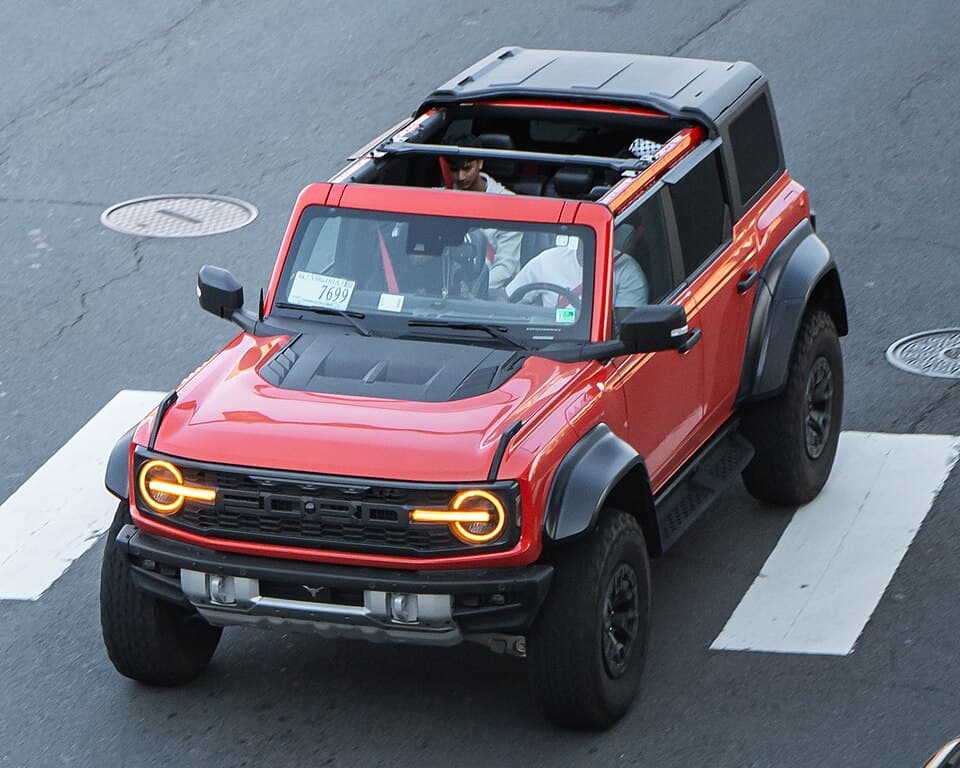
The drone comes from vortex shedding off the factory modular rack's crossbar profile, not the removable top or a bad seal. In our testing on a 2023 Bronco Raptor, the only configuration that killed the tone at highway speed was pulling the front crossbar off entirely. Wind deflectors and edge wrap cut real volume but left a tone above 65 mph. This is one truck, one route, run by us, not a wind-tunnel study, and results will vary truck to truck.
The noise starts around 55 mph and gets hard to ignore by 70-75 mph on every rack-equipped Bronco Raptor we've driven. The modular rack has not changed since launch in 2022, through the 2026 model year, so this applies across the whole lineup.
What is actually causing the noise
Air doesn't flow smoothly around a square-ish crossbar. It separates off the sharp edges and sheds a string of small vortices behind the bar, alternating top and bottom, the same physics that makes a flag flap or a wire hum in the wind. Each vortex is a tiny pressure pulse. String enough of them together at a steady rate and your ear hears a tone, not just wind rush.
That tone's pitch and volume scale with road speed and with the shape and width of whatever sits in the airflow. That's standard aerodynamics, true of any square-edged roof rack on any vehicle, not something Ford-specific. It's why the noise is faint at 40 mph and obvious by 65-70: more air moving across a fixed obstruction, faster.
Why the factory rack seems worse than it should be
The modular rack sits higher off the roof than a low-profile aftermarket bar, and the crossbar is a flat-sided extrusion with a T-slot channel running down it for mounting accessories. Our best explanation, based entirely on what we heard in the cabin and not on any wind-tunnel data, is that the slot gives air a second edge to separate off, which would explain why a deflector alone didn't kill the tone the way it usually does on a plain round bar. The front and rear bars also sit closer together than most aftermarket two-bar setups, and pulling the front bar dropped the noise more than removing one of two bars should. That points to the two bars interacting rather than shedding independently. Both ideas are informed guesses from the road, not documented engineering findings, and we're flagging them as such once here rather than every time they come up below.
If what you're chasing is a clunk over bumps rather than a wind drone, that's a different and well-documented issue on this truck; see our breakdown of the Bronco Raptor's front-end clunk causes. Worth ruling out separately: the Bronco Raptor also has a known wind roar around the removable top's header seal and rear corners, unrelated to the rack. Top noise tends to worsen with age and changes if you reseat the latches or reseal it. Rack drone doesn't. Pull the rack off for one highway loop before spending money on seals; if the noise disappears, it was never the top.
The four configurations we tested
We ran the same truck, same tires, same 30-mile highway loop, at roughly 55, 65 and 75 mph, changing one variable at a time. The verdict column is our subjective read from inside the cabin, not a decibel reading, since we didn't have calibrated sound equipment for this test.
| Configuration | What we heard above 65 mph | Verdict |
|---|---|---|
| Factory modular rack, bare | Clear tonal drone, loudest of the four | Baseline, do not leave it like this |
| Factory rack + aftermarket wind deflector on front bar | Noticeably quieter, tone still present | Muffles it, does not solve it |
| Factory rack + adhesive edge wrap on front bar's leading edge | Similar reduction to the deflector | Muffles it, cheapest option |
| Front bar removed, rear bar only | Tone gone at every speed we tested | The only fix that worked for us |
We didn't have a full Prinsu Roof Rack installed on this truck to run as a fifth configuration. A handful of owners running that swap on Bronco Raptor forums report a similar result to pulling the front bar, which lines up with the general principle that a rounder, lower-profile bar sheds air more cleanly than a square extrusion. Take that as owner reporting, not a tested result.
What each fix actually does
Wind deflectors. A small fairing mounted ahead of the front bar redirects air up and over the bar face, cutting how much separates off the sharp factory edge. It brought the volume down noticeably in our test, but didn't remove the tone.
Edge wrap. Adhesive strips on the leading edge of the bar, sometimes sold as turbulator or vortex-generator tape, trip the airflow before it separates cleanly, turning a tonal whine into a duller, broadband sound. Cheapest option here, and in our test it landed close to the deflector's result.
Bar rotation. This doesn't exist on the factory rack. Round or oval aftermarket bars from brands like Yakima or Rhino-Rack can sometimes be rotated a few degrees to change the angle airflow hits them, a legitimate fix on those systems. The Ford modular rack's bars are a fixed square profile bolted at a fixed angle with no rotation adjustment.
Removing the front bar
Pulling the front bar was the only fix that worked outright in our test. With just the rear bar in place, there's less total obstruction facing the wind. It's a factory bolt-on piece, not a modification:
- Reach the crossbar's mounting feet at the roof rails; a stepstool helps on this truck's roof height.
- Remove the fasteners securing the front bar's feet to the rack rails; confirm the correct bit and torque sequence in your owner's manual before you break anything loose.
- Lift the bar straight up and off, and keep the hardware in a labeled bag.
- Leave the mounting points as-is. Nothing else needs to change to drive it this way.
- Reverse the steps to reinstall the bar whenever you need the front mounting point back.
The job takes well under an hour with basic hand tools. The tradeoff is real: you lose a forward mounting point for something like an awning bracket or the front tie-down on a rooftop tent, and you're down to a single bar for load spread.
What it costs to fix versus what it costs to replace the rack
A deflector or edge-wrap kit runs roughly $20-90 depending on brand, and both are a 15-30 minute DIY install with basic tools.
Removing the front bar costs nothing but a wrench and well under an hour, since it's a bolt-on factory piece.
Replacing the whole factory rack with a low-profile aftermarket unit like the Prinsu Roof Rack is the more permanent, more expensive path: budget roughly $650-900 in parts, plus 3-5 hours of install labor if a shop does it. That buys the quietest setup here, but means giving up the factory T-slot system some owners use for MOLLE panels and quick-attach lighting.
Fuel economy and roof load rating consequences
The Bronco Raptor's EPA rating is already thin: 15 mpg combined against a 20.8-gallon tank. Any roof rack adds drag, and pulling the front bar or swapping to a lower-profile rack claws back some of that penalty, but call the real-world change an estimate in the neighborhood of a mile per gallon or less, not something most drivers will notice on a trip computer.
Roof load rating matters more once you start changing hardware. Confirm the current dynamic and static load figures in the owner's manual for your specific model year before loading anything up there; Ford has revised these figures across the Bronco lineup over time, and a number quoted online may not match your build date. Drop to a single rear bar and you've also cut your usable mounting span roughly in half, which matters a lot for a rooftop tent or a long cargo box and less for something small like a light bar.
The short version
- The drone is vortex shedding off the factory modular rack's square crossbar profile, unchanged across every model year, 2022 through present.
- Our best explanation for why it's worse than a typical rack involves the T-slot channel and tight bar spacing, but that's an inference from listening, not a documented finding.
- Deflectors and edge wrap cost under $100 and meaningfully quiet it, but neither removed the tone above 65 mph in our test.
- Removing the front bar was the only configuration that killed the noise outright, at the cost of one mounting point.
- A full swap to a low-profile rack like the Prinsu runs roughly $650-900 plus install labor and solves it for good, but gives up the factory T-slot system.
- Don't confuse this with the separate, well-known wind roar around the removable top's header seal. Test with the rack off before spending money on seals.
Owner questions
- How do I actually stop the wind noise from my Bronco Raptor's roof rack, not just quiet it down?
- Remove the front crossbar entirely. In testing on a 2023 Bronco Raptor, that was the only configuration that killed the tone at every speed tested, including above 65 mph. Wind deflectors and adhesive edge wrap both reduced volume noticeably but left a tone present above 65 mph, so they muffle the drone rather than eliminate it.
- What speed does the Bronco Raptor roof rack noise start at, and does it affect all model years?
- The noise starts around 55 mph and becomes hard to ignore by 70-75 mph on every rack-equipped Bronco Raptor tested. Since the modular rack hasn't changed since the truck launched in 2022 through the 2026 model year, the issue applies across the entire lineup, not just specific model years.
- What does it cost to fix Bronco Raptor rack noise versus replacing the whole rack?
- A deflector or edge-wrap kit runs roughly $20-90 and installs in 15-30 minutes DIY. Removing the front bar costs nothing but a wrench and under an hour, since it's a bolt-on factory piece. A full swap to a low-profile rack like the Prinsu Roof Rack runs roughly $650-900 in parts plus 3-5 hours of install labor.
- Is the Bronco Raptor roof rack noise the same thing as the wind noise around the removable top?
- No. The Bronco Raptor also has a separate, well-documented wind roar around the removable top's header seal and rear corners, unrelated to the rack. Top noise worsens with age and changes if you reseat the latches or reseal it, while rack drone doesn't; pulling the rack off for one highway loop tells you which one you're dealing with before spending money on seals.
- Will removing the front bar or switching racks hurt my Bronco Raptor's fuel economy or roof load capacity?
- The EPA rating is already thin at 15 mpg combined against a 20.8-gallon tank, but removing the front bar or switching to a lower-profile rack only claws back roughly a mile per gallon or less, not something most drivers notice. Dropping to a single rear bar does cut usable mounting span roughly in half, which matters for a rooftop tent or long cargo box.
Deal alert
Shopping for one? Get new listings first
We sweep US dealer inventory and send you new Raptors matching your search — real listings, real asking prices, no spam.