A Raptor in Snow: What the Tires Give Up and What to Run Instead
Four-wheel drive and 35s look like a winter answer. The tire compound is the part nobody checks, and it is the part that decides whether the truck is any good in January.
Gear in this article
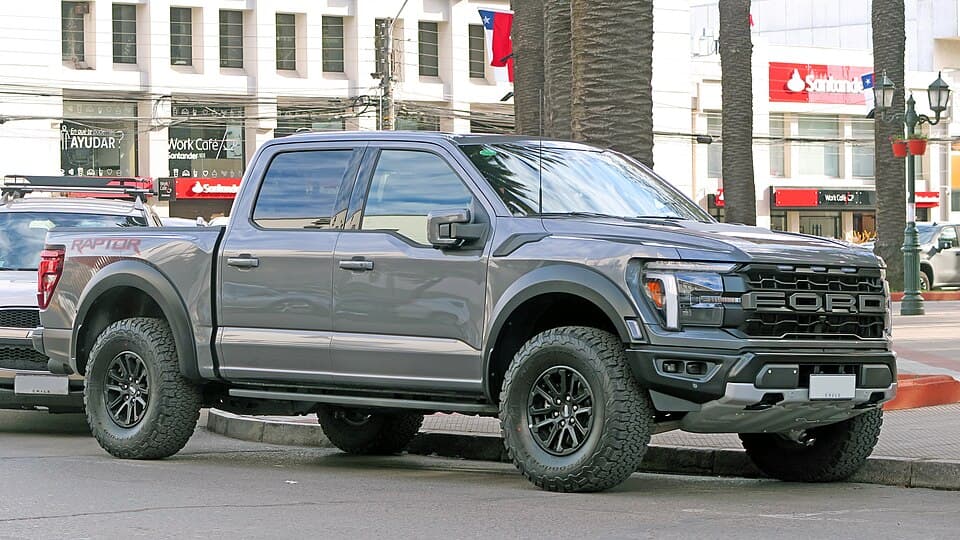
The stock all-terrain tire, not the four-wheel-drive system, is what runs out of grip first in real snow. A Raptor's transfer case and drive modes can put power down on almost any surface, but the factory KO2 (on most Gen 2 and Gen 3 trucks) is not a winter compound, and by January that gap shows up as long stopping distances and a truck that plows straight through an intersection instead of turning. If you live somewhere that gets real, repeated snow, dedicated winter tires do more for safety than any drivetrain setting ever will.
Why the stock tire is the limiter, not the drivetrain
Every generation of Raptor, from the Gen 1 5.4 and 6.2 trucks through the Gen 3 and the Raptor R, ships with a locking rear differential, a two-speed transfer case, and drive modes tuned for loose terrain. None of that fixes a cold, hard rubber compound.
All-terrain tires like the factory-fit BFGoodrich KO2 are built around a tread compound optimized for warm-weather traction and tread life on gravel and pavement. Below roughly 40 degrees Fahrenheit, that compound stiffens up and loses grip, regardless of tread depth. Four-wheel drive gets you moving on packed snow; it does nothing for stopping distance or cornering grip on ice, and both of those are pure tire-compound problems. A Raptor with 4WD engaged and all-terrains on ice will stop just as slowly, and turn just as poorly, as a two-wheel-drive truck on the same tires. This is the single most common misunderstanding buyers bring into a first snow-belt winter, and it is worth internalizing before you spend money anywhere else.
The 3-peak-mountain-snowflake rating, and whether your Raptor's stock tire carries it
The 3PMSF (three-peak-mountain-snowflake) symbol on a tire's sidewall means that tire has passed a specific snow-traction test and is certified for severe winter service, the same standard true winter tires and some all-weather tires carry. An "M+S" (mud and snow) stamp is not the same thing. M+S is a tread-pattern designation with almost no performance testing behind it, and most all-terrain tires, including the ones that come stock on a Raptor, carry M+S rather than 3PMSF.
We are not going to state with certainty which exact stock tire on which exact model year carries the 3PMSF badge, because tire specs and factory fitments change across production runs and trim packages, and getting this wrong on your truck matters. Check the sidewall of your actual tire, or run the tire's model number through the manufacturer's spec sheet, before you assume either way. What we can say with confidence: even on the trucks where the stock all-terrain does carry the snowflake symbol, it is still an all-terrain compound first, optimized for a broad range of conditions rather than for ice and packed snow specifically. A dedicated winter tire, not carrying an all-terrain tread pattern at all, will out-brake and out-corner it in a real cold-weather test every time. For a fuller rundown of what owners actually run in each season, see the site's tire comparison for the Raptor lineup.
How 4A and 4H handle mixed winter surfaces
On Gen 2 and Gen 3 F-150 Raptors, 4A (auto four-wheel drive) constantly varies torque split between the front and rear axles based on wheel slip, which makes it the right mode for a mixed commute: dry pavement, then a slushy on-ramp, then a plowed but wet lane. 4H (four-high, locked) splits torque evenly front to rear all the time, which helps in consistent snow or deep, unplowed conditions but can fight you and cause binding on dry pavement or intermittently clear sections, since the front and rear axles are forced to turn at the same rate even where grip differs side to side.
For a daily-driver winter commute with patches of dry road between snow, 4A is the better default. For a truck that is going to sit in continuous snowpack, on a rural route or up a mountain grade that never sees bare pavement, 4H is the better call. Neither mode changes what your tires can actually grip once you ask for it. The Ranger Raptor and Bronco Raptor use their own version of this logic through their respective drive-mode selectors, and the same principle holds: pick the mode for the surface consistency, not for the worst-case grip you are hoping to find.
Winter tire sizing that actually fits
The stock wheel and tire package on most Raptors runs wide, aggressive rubber, and that same width becomes a liability in deep snow, more on that below. If you are shopping a winter-specific tire, you do not need to match your summer 35s or 37s inch for inch. A slightly narrower, taller winter tire on the stock wheel or a dedicated steel winter wheel is a common, cost-effective path, and it is worth doing the sizing math against your truck's actual offsets and fender clearance before you order anything. The wheel sizing and offset guide covers what actually clears the fender liners and control arms on each generation, since a winter tire that rubs at full lock in a parking lot is worse than useless in a snowbank.
Budget for the swing here: a set of four true winter tires on a dedicated wheel set, mounted and balanced, runs roughly $1,200-2,200 depending on the size your Raptor needs, and Raptor sizes are not cheap sizes. A seasonal wheel-and-tire package you swap yourself twice a year, spring and fall, is the move that actually saves money over three or four winters, versus buying winter tires mounted on your existing 35s or 37s wheels every season and paying a shop to remount.
The weight and width problem in deep snow
A Raptor is heavy, roughly 5,700-6,400 lbs depending on generation and cab configuration, and it is wide, with a track width built for stability on rocks and whoops, not for cutting through deep, unpacked snow. A narrower vehicle with a narrower tire tends to cut down through snow to find a firmer layer underneath. A Raptor's width, plus a 35 or 37-inch all-terrain's aggressive void ratio, tends to plow and pack snow ahead of the tire rather than cutting through it, which is the "plough-through problem": in deep, unpacked powder, more surface area and more weight can work against you rather than for you, unlike in sand or mud where those same traits help.
This is one reason a stock or lightly-lifted Raptor on a proper winter tire often outperforms a heavily built truck on 37s in genuine deep snow. If you are running 37s and King or Fox coilovers for desert work, ask yourself honestly whether winter is really the season you need that setup, or whether a seasonal tire swap on the stock wheels gets you through January better. The tradeoffs between 35s and 37s generally are covered in more depth in the 35s vs 37s tradeoff breakdown, and most of that logic about weight and rolling resistance applies just as hard in snow as it does on the trail.
The practical verdict for a snow-belt owner
If you see real, repeated winter weather, buy a dedicated winter tire set on its own wheels and swap it in every fall. Do not rely on the stock all-terrain, 3PMSF-rated or not, to do a winter tire's job. Use 4A for daily mixed-surface driving and reserve 4H for sustained snowpack. Keep your winter fitment inside the clearances your generation's wheel wells actually allow, and if you run 37s in summer, recognize that a narrower winter tire on a smaller wheel is often the better winter choice, not a downgrade.
The short version
- Four-wheel drive does not fix ice or hard-packed snow; tire compound does. The stock all-terrain, whatever its rating, is still an all-terrain first.
- Confirm the 3PMSF symbol on your actual tire's sidewall rather than assuming; fitments vary by model year and trim.
- Use 4A for mixed dry-and-snow commuting, 4H for sustained snowpack driving.
- Budget roughly $1,200-2,200 for a dedicated winter tire and wheel set, and check clearances against the wheel sizing guide before you order.
- In deep, unpacked snow, a Raptor's width and weight work against it; narrower winter rubber often beats your summer 37s.
Owner questions
- Will engaging 4WD on my Raptor help me stop faster on ice if I still have the stock KO2 tires?
- No. A Raptor with 4WD engaged and all-terrains on ice will stop just as slowly, and turn just as poorly, as a two-wheel-drive truck on the same tires. Stopping distance and cornering grip on ice are pure tire-compound problems, so four-wheel drive only helps you get moving on packed snow, nothing more.
- Does the factory BFGoodrich KO2 on my Raptor have the 3-peak-mountain-snowflake rating for winter?
- It varies, since tire specs and factory fitments change across production runs and trim packages, so you should check the sidewall of your actual tire or run the model number through the manufacturer's spec sheet. Even if it carries the 3PMSF badge, it's still an all-terrain compound first, and a dedicated winter tire will out-brake and out-corner it in real cold-weather testing.
- Should I use 4A or 4H on my Gen 2/Gen 3 Raptor during a winter commute with patchy snow?
- Use 4A for a daily-driver winter commute with patches of dry road between snow, since it constantly varies torque split based on wheel slip. Reserve 4H, which splits torque evenly front to rear at all times, for continuous snowpack on a rural route or mountain grade that never sees bare pavement, since it can bind on dry pavement.
- How much should I budget for a dedicated winter tire and wheel setup for my Raptor?
- A set of four true winter tires on a dedicated wheel set, mounted and balanced, runs roughly $1,200-2,200 depending on the size your Raptor needs, since Raptor sizes aren't cheap. A seasonal wheel-and-tire package you swap yourself twice a year, spring and fall, saves money over three or four winters versus remounting winters on your existing 35s or 37s wheels each season.
- Are my summer 37-inch tires better than narrower winter tires for deep snow, given my Raptor's weight?
- No. A Raptor weighs roughly 5,700-6,400 lbs depending on generation and cab configuration, and its width plus a 35 or 37-inch all-terrain's aggressive void ratio tends to plow and pack snow ahead of the tire rather than cutting through it. A narrower winter tire on a smaller wheel often beats those summer 37s in genuine deep, unpacked snow.
Deal alert
Shopping for one? Get new listings first
We sweep US dealer inventory and send you new Raptors matching your search — real listings, real asking prices, no spam.